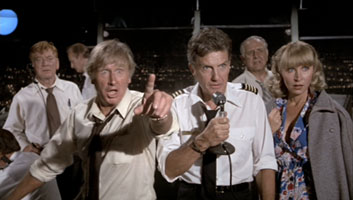
Five Writing Secrets I Learned From the Movie “Airplane”

Perhaps one of the greatest movies of all time, “Airplane” was released when I was four years old. I think that deep within this movie lies some incredible secrets to writing. I know what you’re thinking:

“Surely, you can’t be serious?”

I am serious. And don’t call me Shirley.

1) A Credible Narrator – the reader wants to at least have the ability to trust the narrator. You can have great stories about liars, cheaters and preachers, but if the reader starts to feel like the narrator is lying, the foundational reason for moving forward begins to crumble.

For example, when the passengers lose confidence in the ability of the flight crew, chaos breaks out on the plane:

Elaine Dickinson: There’s no reason to become alarmed, and we hope you’ll enjoy the rest of your flight. By the way, is there anyone on board who knows how to fly a plane?

If your reader begins to doubt your narrators ability to “fly the plane,” they’ll start looking for an excuse to stop reading. And a parachute.

2) Know your identity as a writer, and stick to it. If your strength isn’t found in writing 18th century narratives written from the perspective of a button maker, then avoid writing them. If your name isn’t Shirley, don’t pretend to be Shirley.

Rumack: Can you fly this plane, and land it?
Ted Striker: Surely you can’t be serious.
Rumack: I am serious… and don’t call me Shirley.

Rumack knows who he is, and what he can do. You need to do the same.

3) Clarity – When writing, clarity is important. This exchange between the plane and the flight tower is a perfect example of the confusion that occurs in the absence of clarity:

Roger Murdock: Flight 2-0-9’er, you are cleared for take-off.
Captain Oveur: Roger!
Roger Murdock: Huh?
Tower voice: L.A. departure frequency, 123 point 9’er.
Captain Oveur: Roger!
Roger Murdock: Huh?
Victor Basta: Request vector, over.
Captain Oveur: What?
Tower voice: Flight 2-0-9’er cleared for vector 324.
Roger Murdock: We have clearance, Clarence.
Captain Oveur: Roger, Roger. What’s our vector, Victor?
Tower voice: Tower’s radio clearance, over!
Captain Oveur: That’s Clarence Oveur. Over.
Tower voice: Over.
Captain Oveur: Roger.
Roger Murdock: Huh?
Tower voice: Roger, over!
Roger Murdock: What?
Captain Oveur: Huh?
Victor Basta: Who?

4) Use your setting to help emphasize the tone of the piece and aid in characterization. But if you can’t do that, at least know where the story is taking place (as opposed to Elaine’s lack of awareness):

Elaine Dickinson: [Flight #209 has gone into yet another nose dive] … Ted, the altitude! We’re falling, Ted! We’re falling! The mountains, Ted! The mountains!
Ted Striker: What mountains? We’re over IOWA!
Elaine Dickinson: The… THE CORNFIELDS, TED! THE CORNFIELDS!

5) Referencing classics can add depth and additional layers of meaning:

Jack: What’s going on? We have a right to know the truth!
Rumack: [to the passengers] All right, I’m going to level with you all. But what’s most important now is that you remain calm. There is no reason to panic.
[Rumack’s nose grows an inch long]
Rumack: Now, it is true that one of the crew members is ill… slightly ill.
[Rumack’s nose continues to grow longer and longer, à la Pinocchio]
Rumack: But the other two pilots… they’re just fine. They’re at the controls flying the plane… free to pursue a life of religious fulfillment.

So there you have it, five valuable secrets gleaned from the recesses of a classic.

Don’t forget to head on over to Wednesday’s post – it’s the first time I’ve every tried to write a “choose-your-own-adventure-style” blog. Just read the story about a girl buying a lottery ticket, and then, in the comments, pick from one of five possible directions the story will go. Next Wednesday I’ll continue the story around the most chosen option. Deadline to have your vote count is Friday night, midnight.

To learn more lessons on writing, check out the following blog posts:

Five Writing Lessons I Learned From Napoleon Dynamite

Five Writing Lessons I Learned From Dumb and Dumber

Five Writing Lessons I Learned By Having Dinner With B & E

It Snowed Again – Help Me Find Joy in the World

I’ve gotten some great feedback in the comments section of this blog and on Twitter regarding my recent posts about writing secrets learned from funny movies.

It has me wondering: what is your favorite comedy movie of all time?

And within that movie, what was your absolute favorite line?

Finally, don’t forget to go back to yesterday’s post – I tried something a little different and wrote a choose-your-own-adventure-style post. The readers (you) get to decide which direction the story will go.

A “Choose Your Own Adventure” Post

Remember “Choose Your Own Adventure” books? Well, this is a little experiment I’ve always wanted to try. I’ve written a scene – all you have to do is read it, and then choose where the story goes next. So play along and leave your choice in the comments section below.

* * * * *

“I’ll take a Super-Eight and three $5 Bingos,” the woman mumbled to the boy behind the register. He looked to be about 18. His ears were pierced and the holes stretched to the size of a nickle, filled with a clear circle. He stared at her for an extra moment, chewing his gum in wide, loping movements.

Continue reading “A “Choose Your Own Adventure” Post”

Letters From John

From left to right: John, Graeme and Ben

The next day we hiked down to the creek: Ben, John, Graeme and I. The descent into the valley was sheer, steep, and we clung to small trees as we slid into the field below. Once there we followed a winding path on high ground – that time of year the entire meadow was nearly under water, practically a bog. On the rocky banks of the stream we cast old lines, looked for fish in the still pools, then skipped rocks when we didn’t catch anything.

* * * * *

A few weeks later, long after Maile and I had returned to our house outside of London, I wrote a letter to John. I guess I wanted to somehow encourage him to keep on the straight and narrow, not to let his old life destroy him.

He wrote me back in a large, loping script. Now that I have kids, I recognize it as the handwriting of someone who is only learning to write, or perhaps hasn’t done much of it for a very long time.

John thanked me for writing. He was surprised and happy to discover that Shawn and John are actually the same name, just with different origins. He told me how excited he was to have started a new life, and how he wanted to help other guys in his situation.

* * * * *

A few years later we received sad news.

John was dead. The circumstances were questionable. He had died of a heart attack – we didn’t know if he had overdosed or if his heart had just given out after years of misuse and brokenness.

Not long after that, more bad news.

The pull of Graeme’s old lifestyle, the influence of his old friends, proved irresistible. He had left Ovis Farm, gotten back into trouble. The social workers were looking for him. The constable was looking for him. Then, one day, while running from police, he darted out into the road. He was struck by a car, and killed. He was only in his twenties, and his girlfriend was about to have his baby.

* * * * *

There’s a war waging right now for people’s lives. For some it’s trying to stay clean one more day. For others it’s that whisper telling them the time has come to end it all. For all of us, it involves choices. This or that. Life or death.

I guarantee you one thing: this struggle is so much bigger than the paltry little contests on the gridiron or the ball diamond that grip our attention. So much more hangs in the balance than a trophy or a title. Lives. Real lives. Why do we pay so much attention to entertainment, and so little to the contests that really matter?

There’s so much to do. I feel like I do so little.

* * * * *

“To preserve a man alive in the midst of so many chances and hostilities, is as great a miracle as to create him.”  ~Jeremy Taylor

* * * * *

To read part one of this story, go here: The Boxer and the Caged Wolf

Five Writing Lessons I Learned By Having Dinner With B & E

You’ve seen me do this before.

I’ve learned writing lessons from Napoleon Dynamite and Dumb and Dumber. Last weekend, it got even more real.

I learned writing lessons during a social event. Namely, the couples’ date my wife and I went on with our good friends, B & E (whose identities will remain anonymous, at least for as long as they choose).

So here they are: the Five Writing Lessons I Learned By Having Dinner With B & E:

1) Too much can be a bad thing. We went to The Chocolate Cafe in Lititz, PA, and this place just oozed with amazing food, uniqueness (is that a word?) and friendliness. (Let’s be honest – the kids weren’t along, so I may or may not have felt the same way about McDonald’s). But one thing that immediately became a challenge for B was the sheer number of specialty drinks they had. He couldn’t decide, and eventually went with a shot glass-size serving of tap water.

So if you are preparing for your next novel, and have just completed your 147th character profile, you might want to start killing characters off. Too much can be a bad thing.

2) Make a decision and go with it. My wife occasionally struggles with pulling the trigger regarding what she’s going to order. There’s lots of hemming and hawing, lots of  “needing more time,” and a whole lot of deliberating.

She’s my wife, so I love her for it.

If you are writing, and you can’t decide what blog post to write, or where to direct your protagonist, or how long to go before submitting that piece you’ve been editing for 14 years…just make a choice and go with it! I understand that everything on the menu looks good, but you’ll never enjoy the meal if you don’t make a decision.

3) Choose your breaks carefully. At one point during the meal, Maile turned to me and said, “So, are you going to ask them about that thing?” Pause.

That was not a good place for a pause. B & E nearly thought I was about to pitch them my writer’s pyramid scheme, and began planning their escape. The pause did not work there, because it was deceptive. One deceptive break in your writing, and everyone will laugh and sigh with relief (as did B & E); too many deceptive breaks in your writing, your reader’s will get pissed off, and you might lose them. As Anne Lamott says, your readers want to be massaged my a masseuse, not whacked by a carpet beater (or something along those lines).

4) Tell your story in order, from beginning to end. As we were leaving B & E’s house, I nearly backed into two vehicles. Going backwards or out of order in writing almost also leads to wrecks. Unless you’re Stephen King, or trying something just for the fun of it, start in the beginning, then tell the middle, and end at the end. Believe me, that’s challenging enough for most of us.

5) Don’t write in isolation. I could have gone to the Chocolate Cafe by myself, but I wouldn’t have had nearly as much fun. I wouldn’t have learned more about someone else, and I know I wouldn’t have ordered that chocolate pretzel for dessert.

While the act of writing is almost always done alone, surround yourself with other writers, people who will rejoice with you in your success and encourage you when everything stinks.

So there you have it, five more lessons learned.

Have you learned anything about writing recently that you’d like to share?