The Girl From the City of 25 Million #RideshareConfessional

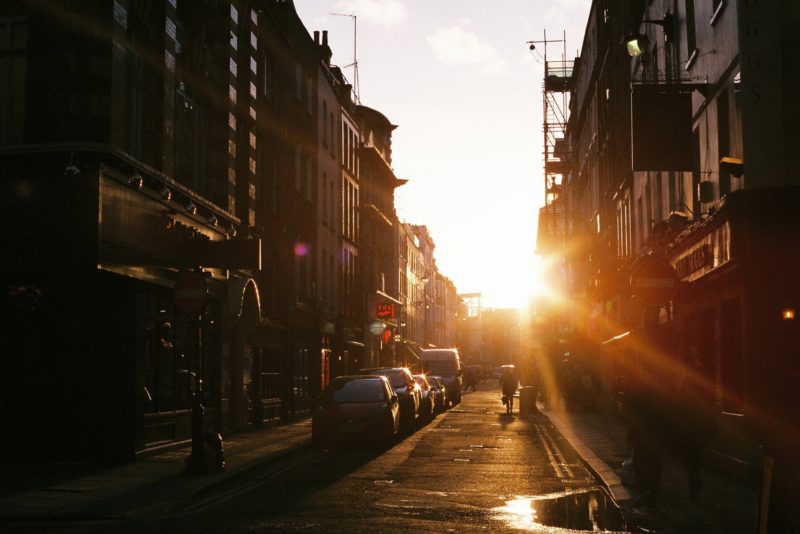
Photo by Alexandre Chambre via Unsplash

I picked the girl up on a gray day in January, much warmer than usual, the perfect day for Jose Gonzalez’s music and leaving the windows down a few inches. The sun started to break up the clouds.

“I’m sorry, did I keep you waiting?” she asked as she got into the car.

“No, not at all,” I say. I always say that, although in this case it was true.

Her destination was the Harrisburg Area Community College, Lancaster campus. Ten minutes away. We drove towards the eastern edge of the city.

“How long have you lived here?” I asked.

“About four years,” she said.

“And where were you before that?”

“I’m from South Korea,” she said. “I’m Korean.”

“Do you like it here?”

“It’s nice, yes. I like it. But I don’t think of it as a city. I’m from Seoul.”

“Wow,” I said. “What brought you all the way here?”

“Getting my education. I like it here. I hope I can stay, but if not, that’s okay.”

The sun is warm through the windshield. I can’t believe it’s January.

“Do you know other South Koreans here in Lancaster?”

“Oh, no,” she said, laughing. “There aren’t very many of us. I know a lot of Japanese. But not many Koreans.”

“I drive a lot of Chinese students over at F&M,” I said. “I think there are three or four hundred of them there.”

“The Chinese are everywhere!” she said, laughing again. It’s interesting to think how different we are, how far apart we grew up.

“When you live in Seoul, I mean, I don’t know the geography well, are you close to North Korea? Do you worry about that?”

“Yes, we’re close,” she said, shrugging, “but all that happened before I was born. I don’t think about it too much, except when they launch missiles.”

We pull into the college.

“First or second building?”

“Second.”

She paused.

“You know, North Koreans are always fleeing to the South, to escape their government. I don’t know how they do it. And when they get to the south, they try to pretend they’ve always been there. The discrimination against North Koreans can be bad. It’s sad, really. We’re all the same. Same island.”

I pull up to her building.

“Really,” she said. “It’s very stupid and sad.”

She said it as if she had only just realized they were the same.

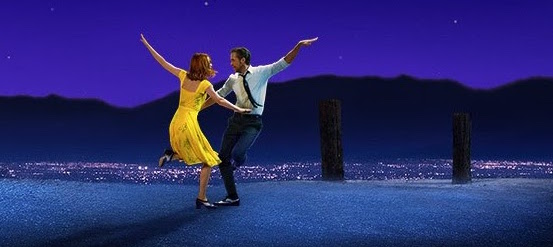
Some Thoughts On La La Land and Living

La La Land - Reviews

La La Land. I told Maile as we walked out of the theater that I had tears in my eyes throughout the movie because the various parts about trying to make it as a creative person hit too close to home.

There’s a part where Mia and Sebastian, two young folks trying to chase down their dreams in Los Angeles, are having it out. He has just delivered the news to her that she got a call back for a rehearsal and they really want to see her. This could be her big break.

But she’s failed too many times in the past. She’s tells him she’s finished.

* * * * *

Mia: Maybe I’m not good enough.
Sebastian: You are.
Mia: Maybe I’m not.

Mia: I don’t want to do it anymore.
Sebastian: Why?
Mia: Because I think maybe it hurts just a bit too much.

* * * * *

Oh, man, that’s it, isn’t it? We have these things we want to do, things that are connected to the deepest parts of ourselves, but we’ve tried so many times, and nothing has hit the mark. We try and try again, and each time it feels like a crap shoot, the toss of the dice. We think we know what we want to be, we think we know where we want to be, and it all seems so impossibly far away.

I started chasing my dream of being a writer seven years ago. And I’ve made a living at it these long seven years. But there’s always something out there, something just beyond my reach. I remember standing at that kitchen island in Virginia, telling Maile we didn’t have enough money to get through the winter. I remember the two of us unpacking our things into my parents’ basement. I remember all the various contracts that fell through or didn’t happen, for whatever reason. The rejection emails from agents and editors and the low traffic at the blog, no matter how hard I tried.

There are a million and one reasons to quit, and they come at us fast. The disappointment hurts. The sense, not that people hate what you’re creating, but that they honestly couldn’t care less.

The ache I felt in the movie, the ache that resonated with me, had nothing to do with what Mia and Sebastion did or did not manage to do by the end of the movie (no spoilers here, at least not on purpose). The ache I felt was in response to this knowledge that there are things we are meant to do, no matter what road they lead to.

Does that make sense?

I truly believe I’m meant to live this life as a writer, and that will stay true for all the years I live on this planet, whether I have a New York Times bestseller or simply continue on writing books that handfuls of people read. And that’s the ache, the oh-so-sweet ache: this is my life. I’m living it. It is neither more nor less than what it is.

Can that be enough? That’s the question. Can this life I’m living be enough?

* * * * *

Here’s to the ones who dream
Foolish as they may seem
Here’s to the hearts that ache
Here’s to the mess we make

– “The Fools Who Dream,” La La Land

How to Remove a Tattoo Yourself #RideshareConfessional

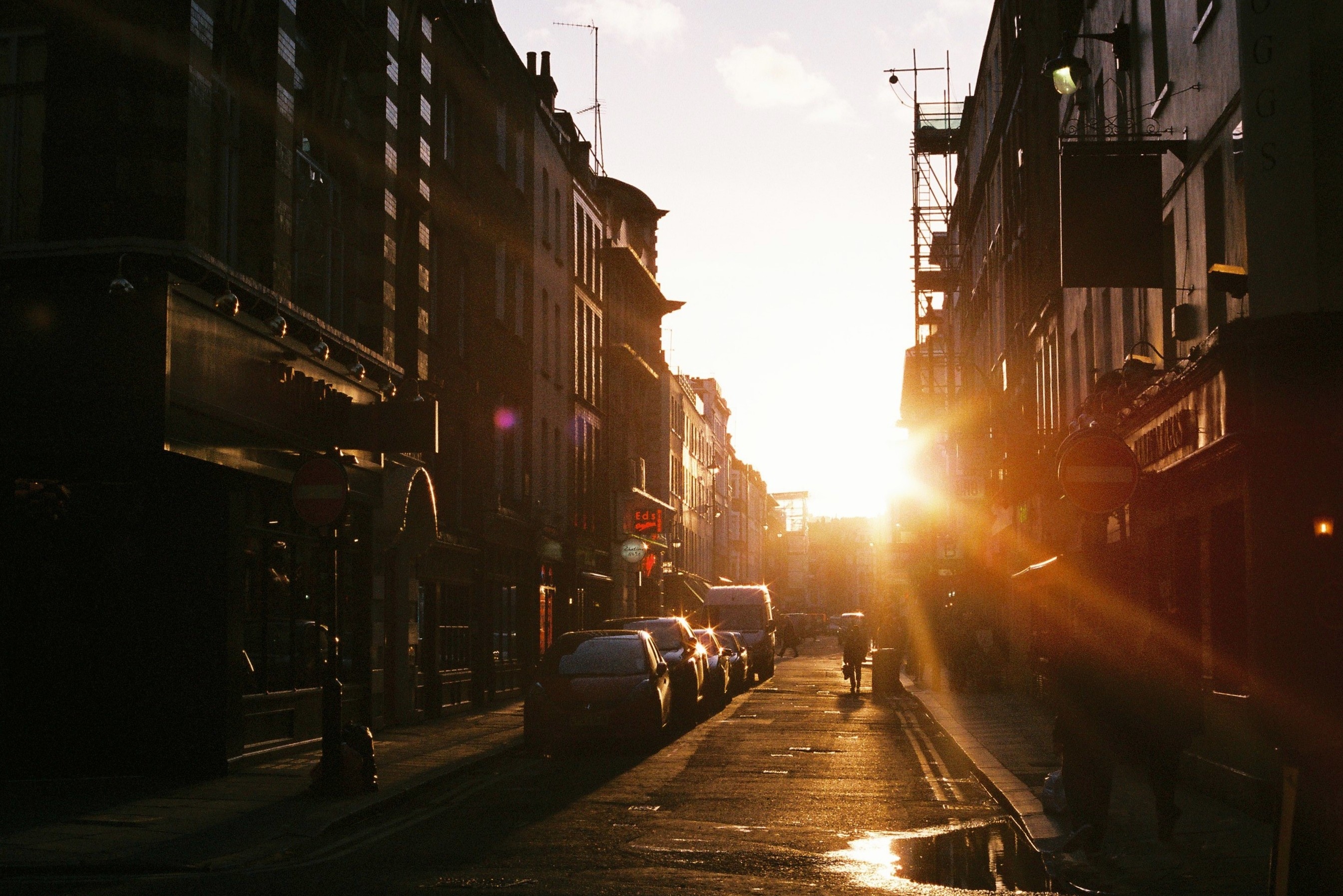
Photo by Don Ross via Unsplash

I woke up thinking I could really use a sunny day, what with all the craziness in the world and the lack of sleep due to an overabundance of small children in the house, but the bright white lines between the shades fooled me. I opened them to find a very bright yet cloudy sky. No luck.

I drove a couple who whispered to each other the entire ride, and a young business man whose hair was exquisitely in place, not a single strand rebelling. The sky was still gray, with a spitting rain and wind that chased trash cans down city streets.

I picked a girl up behind the gym, at a small tattoo parlor. She came out nursing her arm, as if it was broken. She told me she is joining the Marines, or at least that’s the plan, so she has to have a tattoo removed from her forearm and wrist.

“That doesn’t sound pleasant,” I said.

“It’s not,” she said, wincing. “It won’t stop burning.”

She told me when her brother joined the Marines, he had a large tattoo that wasn’t in a place you are allowed to have tattoos as a Marine, but he removed it himself. With lemon (or lime, I can’t remember) and salt.

“If you rub it hard enough,” she said, “it comes off.”

I winced. She shrugged.

“Now he has a huge scar there. But no ink.”

I dropped her off in the city, and again it looked like the sun might come out. There were touches of blue along the horizon, above the buildings.

I picked up a girl from where she worked just outside the city. She was kind and had lots of piercings. The sun had not come out.

“Do you like your job?” I asked her.

“I don’t hate it,” she said, and then she laughed this joyous laugh, as if she knew she was the craziest person on the planet and didn’t care in the least. That laugh! I realized that if we listen to people laugh, we can find a touch of sunshine there. It’s not exactly like the real thing, but on days like these, with boiling clouds gathering at the horizon, with far away sheets of rain falling on distant fields, it will have to do.

How I Rediscovered the Country I Know #WeWelcomeRefugees

FullSizeRender

“Is this Mohammad?”

“Yes! Yes.”

“Did you hear about the refugee concert in the city tomorrow? Do you need a ride?”

“Yes! Yes. Please.”

“I’ll pick you up around 3?”

“Yes. Okay. Thank you!”

* * * * *

I pull up outside a small duplex in the southwest side of Lancaster City. Mohammad comes outside with three of his boys. His oldest boy is with his mother – she is learning to drive. Mohammad is all smiles as he shakes my hand and we herd the three boys into the back of my Suburban. They jump in, giddy at the adventure.

We drive into the city under a pale blue sky. We park and walk through the cold January day to Tellus360, the venue for Church World Service’s refugee concert. The place is packed, and we still have an hour until the festivities begin. I talk with one of the CWS employees.

“I was going to go pick up Mohammad,” he tells me, “so I called him, but he said, ‘No, I have a friend picking me up.’ I said, ‘Mohammad, who is this friend?’ I didn’t know he had friends who could bring him into the city.'”

We both laugh. This is what it means to be a friend in the 21st century, I think. As simple as that.

Soon a line of reporters form to interview Mohammad. Everyone wants to talk to the Syrian refugee, especially in light of the recent executive order.

And this is where I say that if you do not know refugees, it is easy to hear the EO and think, “What’s the big deal? It’s only 120 days.” But if you know refugees, if you know people who have been trying for years to get permission to come and  are now afraid they must start the process over, if you know people who are in danger because they’ve translated for the US military in the Middle East and now they cannot flee, if you know people who only want to be reunited with their children, or their spouse, or their parents, only then, perhaps, can you know why some of us have been heartsick this weekend. Why we have lost sleep. Why we wake up with a gnawing sensation in our gut, that the country we love has forgotten how to love some of the most vulnerable.

I stand back and I watch as Mohammad tells his story over and over again. His boys crawl all over him. The lights are bright in his eyes. Behind him, through the glass, I can see the entire city of Lancaster. This is a world away from where he came from. A world away.

* * * * *

Tellus360 is so packed I can’t even walk from floor to floor. It seems the entire city has shown up to give their support. Volunteers cross paths with refugees they knew from years ago. It is a beautiful thing, seeing so many cultures mingling, so many different races smiling and hugging and welcoming one another.

I go back up and find Mohammad.

“I have to leave,” I say, “but I can come back and pick you up later. Just call me.”

“No,” he says. “We are ready. Come, boys.”

So I lead them through the mob – me, then the three boys, then Mohammad, following his sons, keeping them in line as they walk through a chaotic environment in their new country. We burst out into the cold and it feels good to be alive in that moment.

He claps his hand on my shoulder and his boys dart around us like butterflies.

“All these people,” he says, his eyes shining. “All these people.”

He clenches his fist and clutches it to his chest.

“I feel peace,” he says.

* * * * *

We arrive at his house.

“Okay,” I say. “Great to see you, Mohammad.”

“No, come in!” he says.

I look at the clock.

“I should really get home,” I say. I am, perhaps, a typical American. I do not feel immediately comfortable going into someone’s home who I do not know well, whose language I do not speak. I do not want to be an inconvenience.

“Come!” he says, and he will not take no for an answer. “Come in. I insist.”

I follow him inside and take off my shoes and we sit on his sofa. He tells me about his parents, in their 70s, too old to come to the US.

“When we fled Syria for Jordan,” Mohammad says, “My father told me he would rather die in Syria than travel and die somewhere else.” He smiles a sad smile and shrugs. I can tell he misses him.

He tells me about his recent escapades in buying auto insurance. He tells me how his new landlord came to him, found out about his life and how hard he was working, and gave him a $200 discount on the rent. Mohammad didn’t even ask for it.

“Until I am making better money,” Mohammad explains. “That’s what he told me. He is a good man. He is human.”

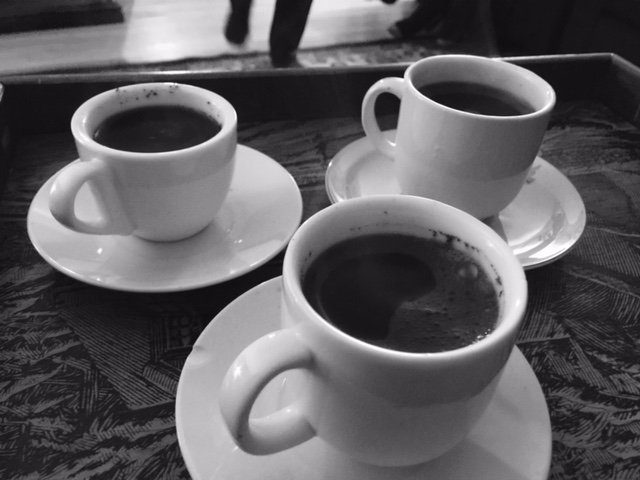
He gives me coffee, again, it is not a question of whether or not I want it – the only question is if I would like sugar or not. The sharp black liquid is good. Hours later, I still feel it in my veins, like a jackhammer.

“I really must go,” I say, and I put on my shoes, and he walks me out to the car. It is cold, and I see the boys through the window, drinking the remains of our coffee. My children do that. They are always asking for coffee. Amazing, how alike we are, though we were born 10,000 miles apart. Amazing, how we all want the same things: a quiet place to live; a way to make a living; hope for a future for our children. And peace.

Their grandfather chases them away from the small mugs of coffee. I smile.

“Thank you,” I say.

“No, thank you,” he says. “It was a good night.”

“It was a good night,” I say. The streets are dark as I turn the car around. I pass him one more time, and he is on the sidewalk, in his socks. I beep the horn, he waves, and for a moment I feel like I am back in the country I know.


When I Looked For the Syrian Refugee at His House, and What I Found #RideshareConfessional

Photo by Danka & Peter via Unsplash

I started driving early on Thursday morning. My brain wasn’t completely awake, so when the girl asked to go to the subway on Queen Street, I did a double-take. I honestly wondered, the subway? Since when did Lancaster have a subway? It dawned on me, as I drove, that she was talking about the sandwich shop. She seemed young to be opening a business for the day, but there she went, taking out her keys, unlocking the door, letting herself in. The morning was still dark, and I know that feeling. For four years in England I was opening quiet shops before London was fully awake.

Later, there was the girl who argued with me about the fare being charged to her credit card – I don’t set the fare and have no way of changing it. There was the college kid who graduates this spring and can’t decide if he wants to return home to San Francisco or move to New York, where all his friends are headed. There was the quiet, reserved girl who erupted with joy when I put Jason Isbell on the radio.

There was the Indian mother and her son who I drove to school. She was so tender with him, commenting on what a nice day it was, asking him if he had everything he needed, reminding him to work hard. She asked me to drive her home, so I did. She couldn’t believe her school was offering Mandarin.

“It’s so difficult,” she said quietly. “It’s so precise.”

* * * * *

Some of you will remember that a few months ago I met with a Syrian man, a refugee who lives here in Lancaster, to begin collecting his story in an attempt to perhaps write a book about him and his family’s trials in getting to the US. January has been busy, and I haven’t been able to follow up with him. Until a few days ago, when I called and realized his phone wasn’t working. The only other way I had to contact him was by going to his house, a place I’d never been before.

Just in case you don’t know me, let me tell you this: my preferred method of communication is text or email. A distant second is by phone. In third, so far from first you can barely see it, would be actually showing up at someone’s house I barely know. But I really wanted to set up another time to talk with him, so, when one of my fares took me into that part of the city, I swung by his home.

Two of his sons met me at the door – they were perhaps 10 and 18 years old. Just a guess. The 10-year-old was the most take-charge kind of kid I’ve ever seen, and I wonder if it’s from being the one who speaks the best English. I can imagine him taking care of everything for them: talking to the cable guy, going along to the grocery store, asking questions when they are out and about.

“Is your father here? I’d like to speak with him,” I said hesitantly.

“Come in, come in,” the 10-year-old insisted, holding the door open firmly in that overwhelming sort of hospitality you only find in Middle Eastern people. Their determination to show kindness exceeds any other culture I’ve spent time in.

So I went inside and their mother came into the room and the boy rattled off some commands to her and she handed him her phone. I assumed he was calling his dad. He pushed the phone into my hands.

“Here,” he said. “You talk?”

“Hey! Hello!” I said into the phone, a little disarmed by the situation. “How are you? Yes? Can we get together?”

Their father told me that he had found a job, and he sounded ecstatic about it. No, he could no longer meet during the day. Yes, he would love to hang out again. Perhaps some evening? He gave me his new number. I said I would call in the next few days.

“Yes! Please,” he said. “Please call. Thank you so much. Thank you.”

The entire time I was on the phone with him, his 18-year-old son was insisting I sit on the sofa. He beckoned towards it like a salesman. Make yourself comfortable. You don’t have to stand here in our home.

“No, thank you,” I whispered, smiling. When I finished talking, his 10-year-old took back the phone and walked me out to my car in his socks, grinning the entire time.

“Thank you,” I said. He nodded and smiled, an embarrassed grin, and then he sprinted back to his house. In that moment he reminded me of my own son.

* * * * *

I thought of their family the rest of the day while I drove. I felt for them – they come from a culture where community is everything. Everything! And now here they are, far from home, in a place that politely declines to sit down on their sofa, no matter how hard they insist.

The quiet mother. The accommodating sons. The father ecstatic to have a menial job. I wonder if this city knows the blessing it is to house people who have been through so much, whose only concern is making their way in this new life, who gather together at their own table at the end of the day and share their new adventures. I wonder if this city knows how good it has it when families like this are given a chance at life, right here on these crumbling streets.

I started a new Facebook page to house all of my Rideshare Confession posts. Head here to see them all in one place and, while you’re there, do me a favor and Like the page?

The Secret to a Happy Marriage

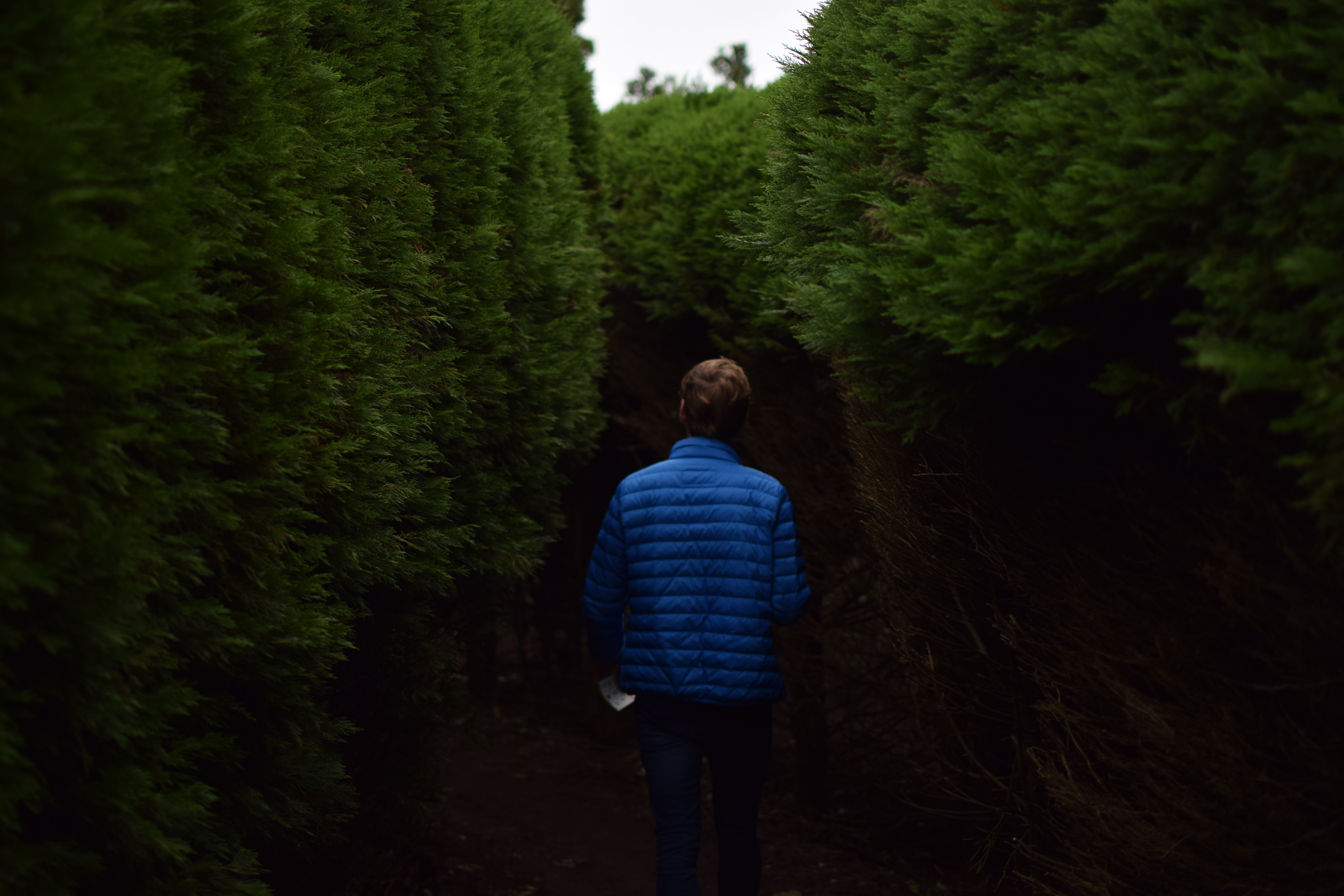
Photo by Tycho Atsma via Unsplash

Can it really have taken me
sixteen years to realize you can
live in the same house with someone
and still lose track of them?

It’s true.

We occasionally lose
each other, somewhere among
discarded Legos and Everest piles
of laundry, too many words to be written
or deciding the best way to teach
dangling participles, the size of the solar system. Our words cross and
mismatch and fall, seeds
on parched August ground, hard
as pavement. Is
there a more complicated maze
than the everyday household routine?
Is there anywhere easier to lose someone
than in the daily humdrum of a life?

The two of us
we go from found to lost
in the time it takes to zombie-walk
to the baby’s bed at 2am and fall
asleep on the scratchy carpet, in the time
it takes to nurse a child’s hurt feelings on
the third floor, coming back to bed
only to find the
other has already fallen asleep.

Maybe the key to this thing called
marriage
isn’t remaining in love
(Lord knows I love you)
or sticking to those vows
(rules parch and crack and can’t
keep a meaningful thing together)
but maybe
the key is finding the energy
or the courage
to keep finding each other again
and again.

They leave us after dinner, all
five children, and we’re staring
the vast distance from one end of the table
to the other, because a family this size
requires a large table, and the distance
from one end to the other
can feel like the span of the Sahara. Lost
and found.

But then one of us moves closer
and we talk quietly while the sound
of their steps rains down from above.
Or we walk this city in which I love you,
holding hands
breathing in the lights
remembering the sweet feeling
that casual ecstasy
of being found again
by someone you have loved for so long.

Maybe the key to finding each other
is discovering ways
every day
that we can get lost
together
all over again. Maybe the seeds
that fall on pavement can still
find the winding crack
burrow deep
and sprout green life
in this city.

You can get my ebook of poems for FREE today: We Might Never Die.