The Boxer and the Caged Wolf

I remember my first trip to the southwest of England. It was like someone had taken all the beautiful things about the countryside where we lived, just west of London, and put them under a magnifying glass: the hills were steeper, the hairpin turns sharper, the green pastures somehow more alive.

As we turned off the highway and on to a single-track road, I began to wonder if we were lost. I had seen signs for Barnstaple, the closest town, but surely these roads weren’t meant for cars? They were lined with either high hedges or even higher banks. In some areas water ran through the road, small streams created by recent rains. We passed no other cars. Every few hundred yards a small space existed along the road where we pulled over and let the occasional tractor pass.

Then a narrow gap with a small sign: Ovis Farm.

We drove back the long, muddy lane and parked between a farmhouse and a converted barn. My brother-in-law Ben came out smiling, followed by my sister, Shar.

This was it. This was House of the Heroes.

* * * * *

Ben and Shar’s dream had always been to have a place to take the homeless men they met on the streets in London. Finally they had found a place. I couldn’t wait to look around.

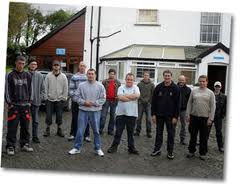
We walked slowly into the kitchen – the table was surrounded by rough looking guys wearing ill-fitting clothes. Some looked so angry, I wondered if they were plotting the most painful way to tear me limb from limb. Others just looked sad, removed, as if they were caught in the midst of a painful dream from which they had no hope of waking.

But there were two men there that immediately caught my attention.

* * * * *
John was short, built like a bull. He looked to be in his late forties, although guessing those guys’ ages was always a losing proposition. He had a boxer’s nose and deep-set, solemn eyes. His smile looked like it had to fight its way through a broken jaw and more disappointment than I could ever imagine, but it still emerged. He smiled. A lot.

At dinner that night he ate as if he had never eaten before – the volume, the speed, the appreciation with which he threw that food down, it all gave witness to something that Ben told me later.

“He’s only been clean a few weeks now. We keep him busy with farm work, and he loves to eat. Keeps his mind off things.”

* * * * *

There was another, younger man sitting at the table. His name was Graeme. His hair was as black as those Barnstaple nights. He had a few missing teeth and dark purple rings around his eyes. When he smiled, he looked like a seven year-old boy; when he wasn’t smiling, he looked like a caged wolf.

Graeme followed John around the way a new puppy trails behind the old dog. Nipping at his heels. Yapping in his ear. Playful attempts to receive some sort of affection he never had before.

* * * * *

These men would eventually become our friends. Ben and Shar were always closer to them than Maile and I, but John sent me a few letters. They both sent pictures of themselves learning to roll soft pretzels. We hoped that, someday, when they had taken time to recover, perhaps they could manage or work at one of our stores in London.

But sometimes we cannot escape from the old things in life. Sometimes the past has a long reach.

Continued

Spring, a Contest, and Creative Constipation

Two days ago the weather was beautiful here in Paradise, PA. Unfortunately, I allowed myself to believe in the hope that spring had arrived.

Yesterday it was freezing cold again.

This got me thinking…I wonder when our first 75 degree day will be? So here’s the contest for today…correctly guess the first day this year that it reaches or exceeds 75 degrees here in Paradise, PA, and I’ll send you free copies of all three of my books: Twist of Faith, Think No Evil and 83 Lost Sheep. If more than one person guesses the correct date, the prize will go to the person who commented first (in other words, don’t pick a date that someone has already picked).

Today I’m guest posting for Alise Wright. Head on over and check out my thoughts on a common cause of creative constipation and why I sometimes want to injure my writer friends.

Only 32 days until Spring!

* * * * *
(If you have never commented here before, it may take a little while for your comment to appear).

Tuesday’s Top 10: Reasons I Hate Fruit

When I was in kindergarten I wasn’t allowed to go outside for recess until I ate my fruit-filled jello. I didn’t like apples, so I sat there at the table while my five-year-old peers ran carefree through the gym, or played on the swings.

This is probably the primary reason that I hate fruit.

But there are ten more:

1) Seeds – raspberries are really the only fruit I remotely enjoy eating, but those little seeds are annoying. I’m always worried I’m going to break a tooth.

2) Cores – I don’t like cores. But my daughter never had a problem with them. Give her an apple to eat, and she’d come back to you holding a small piece of stem, having eaten the entire thing: apple, core, seeds, the whole thing. Did you know that apple seeds have cyanide in them? Why would I eat food that contains a poisonous substance?

3) Original Sin – without fruit, we’d still be romping naked through the Garden of Eden, playing with our pet lions. Now we mostly wear clothes, and lions eat us. I blame fruit.

4) Peels – there’s nothing peskier than a well-placed banana peel.

5) Pies – nothing ruins a good pie more than adding some fruit. Vanilla pie? Yum. Pecan pie? Awesome. Cantaloupe pie? Yuck.

6) Pits – peach pits look like little brains. Why would I eat something if it is going to expose that thing’s walnut-sized brain?

7) Texture – this is probably my biggest hang-up with fruit. The texture. I’m not into the springy crunch of apples, the mushy sensation of a banana, or the sandpapery feel of watermelon.

8) Fruit Cake – I used to like cake. Then I tried fruit cake. If you want to ruin a perfectly good cake, put fruit in it.

9) Fruit trees – I fell out of a cherry tree when I was young and hit every branch on my way down. This was not a pleasant experience. No fruit = no fruit trees = no pain in the world.

10) Fruit flies – these demons from the underworld come literally out of no where. One day, you have a bowl with some fruit in it. The next day, you have a bowl with fruit in it and a swarm of flies. According to my scientific analysis, this means that fruit flies are actually the offspring of fruit.

Am I alone? Am I the only person on the face of the planet who scorns fruit?

A Brief History of Love, in 617 Words

Students scurried across the large grassy area of campus. It was a hot, October day, and anyone fortunate enough not to have a class lay on the grass, some on blankets, some propping their heads on backpacks. They were surrounded by a protective layer of trees and academic buildings. The air was filled with potential and youthfulness and optimism.

One boy in particular, walking from one of the larger brick buildings towards Old Main, glanced discreetly over his shoulder at the girl, also walking slowly, about thirty yards behind him. They had five classes together, but had never spoken. He walked slower, waiting for her to catch up.

Then he noticed that she had slowed down. So he pretended to stop and tie his shoe. She slowed down even more. Finally he stood up and turned toward her.

“Hi.”

* * * * *

Four years later the boy and girl take a train from London to Paris. They leave early in the morning, when London is still quiet and dark. The train speeds across the English country side, grabbing hedgerows and pastures and even small villages and casting them back. Then darkness as the train disappears under the channel.

France emerges, feeling older and a little less friendly. The boy and girl do not speak the language. They wander the city, following a red line in a magazine to mostly small, out of the way shops. The Basilica of the Sacred Heart rises into the gray sky. Notre Dame sits patiently, waiting for another time in future history, when it will no longer be bothered by irreverent shouting and pesky strangers.

The boy and girl hold hands, walking through the rain, their shoulders pulled up towards their ears. A cab whisks them back to la Gare du Nord. The seats in the train are not good for sleeping – too straight, too rigid, but somehow the girl drifts off, her head on the boy’s shoulder.

* * * * *

One year after their first trip to Paris, five years after the boy stopped and pretended to tie his shoe on that grassy patch on campus, the boy and girl enter Paris again. This time by plane. This time they have a little boy with them, not yet one. He looks exactly like the girl, with blue eyes and a soft nose and a round face.

They stay two nights, but everyone gets sick. The boy spends the weekend finding medicine for the little boy. The girl spends the weekend in the motel bathroom, washing the little boy’s clothes which are covered in diarrhea.

During daylight hours the three emerge, pale and weak. They walk quietly through the Louvre, not out of respect, but because they are too tired to talk.

They consider going home early, but decide to stay. The French air is crisp and refreshing. They don’t want to go back to the motel. They wander the streets until the lights turn on and the waitress at the cafe takes their order. The city lights reflect off of the Seine.

* * * * *

Twelve years after the boy stopped to tie his shoe, eight years after their first trip to Paris, seven years after their second trip to Paris, they now live in Virginia. The boy stands at the kitchen counter. The girl leans against the wall.

They have run out of money.

Upstairs they can hear the little boy playing with two little girls. All three children look exactly like the girl. A baby boy, fresh to the world, sleeps in a baby swing.

“Now what?” the boy asks the girl.

* * * * *

The story continues HERE

Five Writing Lessons I Learned From “Dumb and Dumber”

Believe it or not, Dumb and Dumber had more to offer than a couple of rad bowl cuts (speaking of which, I hope you caught the excellent “Bowlin'” video featuring Chris Tomlin, Tyler Stanton and Tripp Crosby).

If you can get past the scenes of frozen snot, exploding farts and of course the most annoying sound in the world, there are a few gems hidden in there, things that every writer needs to pick up on. 17 years later, here is what I remember:

1) Always keep your reader guessing. Lloyd trades in their awesome doggy-mobile for a moped. He pulls up beside Harry, who is walking along a deserted highway. Harry sees the moped, and you’re waiting for him to go off on Lloyd. But they kept me guessing:

“Just when I thought you couldn’t possibly be any dumber, you go and do something like this… and totally redeem yourself!”

2) 3rd Person Omniscient can be a fun point-of-view to write from because your reader knows more than your characters, and you can use this to your advantage. For example, when a thug sneaks into Harry and Lloyd’s apartment and cuts off the head of their parakeet, we know it’s a reference to the horse’s head in The Godfather…but Lloyd sees it as just another piece of bad luck:

“We got no food, no jobs… our PETS’ HEADS ARE FALLING OFF!”

3) As I mentioned in Five Writing Lessons I Learned From Napoleon Dynamite, creative dialogue can help your reader learn more about your characters, as well as inject some humor:

“Yeah I called her up. She gave me a bunch of crap about me not listening to her, or something. I don’t know, I wasn’t really paying attention.”

4) Flannery O’Connor said that anyone who survived childhood has enough material to write for the rest of his or her life (via Anne Lamott). And this exchange in Dumb and Dumber proves it:

Lloyd: You’re it.
Harry: You’re it.
Lloyd: You’re it, quitsies!
Harry: Anti-quitsies, you’re it, quitsies, no anti-quitsies, no startsies!
Lloyd: You can’t do that!
Harry: Can too!
Lloyd: Cannot, stamp it!
Harry: Can too, double stamp it, no erasies!
Lloyd: Cannot, triple stamp, no erasies, Touch blue make it true.
Harry: No, you can’t do that… you can’t triple stamp a double stamp, you can’t triple stamp a double stamp! Lloyd!
Lloyd: [hands over ears] LA LA LA LA LA LA!
Harry: LLOYD! LLOYD! LLOYD!

5) Sometimes, if you’re story is going no where, try flipping it on its head. Like this awesome trailer, where Dumb and Dumber becomes Inception:

What were your favorite scenes from Dumb and Dumber?

Light Sabers, Giants and an Earthload of Unhappy People

I think we are born to imagine, born to dream. Before my kids ever learned to talk, they were climbing in boxes and trying to drive them away, dancing to music no one else could hear, and wanting me to pretend to be a monster. One of the coolest things about kids is that this propensity to imagine always ends in creation. Their unfettered thoughts and dreams lead to new things, tangible things.

We are wired to create.

And, for a while, this creation happens. Imaginary battles lead to the transformation of sticks into light sabers, trees into giants and the spray of mist whipped up by a spring breeze becomes an angel.

For some reason, though, we stop creating. Madeleine L’Engle, in her book “Walking on Water,” quotes a statistic that at the age of five, 90% of the population measures “high creativity.” By the age of seven, the figure has dropped to 10%.  And the percentage of adults with high creativity is only 2%!

Most adults I know have lots of ideas. But when it actually comes to doing something about it? Not so much. Sure, they make stuff at work, they write proposals that bore them to tears, they join committees and attend meetings and put together memos. But the stuff they dream about, the stuff they want to create, gets trampled by the to-do list separating them from that next raise.

* * * * *

I’ve personally come across hundreds of people with a book idea, but only a dozen or so who ever followed through and started writing. And of those who started, I only personally know a few who have ever finished.

I’m sure the same can be said of painters, entrepreneurs, photographers, builders, actors, preachers, professors…the list goes on. Everyone has a dream, an idea, a thought, but how many of us have followed through?

How many haven’t just imagined, but created?

* * * * *

But I thought we just established the fact that we are, from a very early age, wired to create? What happens to an earthload of people who are wired to do something, have the inclination to do it, but, for whatever reason, never do it?

Frustration.

Anger.

Boredom.

Feelings of entitlement.

Depression.

Despair.

Suicide.

* * * * *

I’m not saying that the physical act of creation would alleviate all of the aforementioned things. But I do know some people who claim that their writing saved their life. I’ve seen folks, whose lives have been shattered by death or broken relationships, salvage the remains by creating art, or starting a business, or pulling together a charitable organization.

What would you create, if you let yourself return to a state of high-creativity?

How has creativity healed or freed you?