We decided it was time to laugh
in the face of our collective sickness
and walk downtown for ice cream. But
at the corner of Prince and James we looked
north and saw the gathering clouds, dark, like
recycled nightmares or the villain in a silent movie.
We’re probably going to get wet, I said. We should probably turn back. But I saw in the eyes of my
children that no amount of common sense
would prevail. I shook my head. I did not want
to get wet.
Still, we walked south, and the wind began to blow
and we fled from block to block, pushed ahead by
advancing clouds. We quickly ordered our ice cream
while old blossoms from earlier in the spring
scuttled by, afraid and out of place.
Finally we turned north, face to the clouds, holding small
bowls of joy. The kids squealed when the rain began
to fall, and we jogged all the way home from Chestnut,
ice cream melting,
rain splattering heavy dots on the cracked sidewalk
Sam going from tree to tree
hiding in the cold shade of April like a butterfly
or hope.
We came into the house and sighed and stood beside
the warm radiators, eating ice cream, laughing off the
storm. Leo’s face was wet and Abra coughed and we all
grinned. This is the definition
of hope, I think,
this willingness to head out
even when the storm is already on its way
knowing you’ll have to turn into those dark
clouds on your way home.
My friend died last week. He was a good man, in every sense. I found out about his passing on Facebook, and when I first saw his name, I kept repeating it over and over again to myself because surely my brain must be short-circuiting. He can’t be dead. I must be confusing that name with someone else. There must be someone else with that same name, or a name like it.
But it was him. Later I found out his passing was sudden. He was 67.
I know we tend to say these things about the deceased, but he really was a remarkable man. You see, he grew up in a conservative Mennonite community, but later in life he was the personal assistant to Jerry Falwell in the early days of Liberty University, and he watched as the Religious Right was born. From there he worked for Chuck Colson. As our ever-twisting journeys would have it, he ended his life as an Episcopalian, happy to wrangle theology with anyone who had the time. But not only for the fun of it – though he was always kind and inquisitive – no, he was in it for the Truth. He was a seeker. He referred to himself as an Evangelical on the Canterbury Trail, and I guess that just about says it all.
I had spent some time recently helping him put together a book proposal about his life, a book that now, sadly, most likely will not be written. But even in that process he was measured, deliberate, and above all, kind in how he spoke of everyone, even those who in his life he had eventually come to disagree with. Those very same people sent his family flowers at the news of his passing.
Where have all these men and women gone, the ones who can disagree, even vehemently, yet retain the respect of those sitting on the other side of the table? Can friends still disagree on important topics?
His memorial service was on Monday, and this is where it gets interesting. You see, I have a book currently being shopped around to publishers, a young adult novel I wrote about death and life and living forever. Ironic, I know. I had received an email that a particular publishing house would be considering my book on Monday, the very same day as my friend’s memorial.
During the service, I listened to what all of these wonderful people had to say about my friend, and I kept thinking about what it means to live a good life, and all of these thoughts were swirling around with this sort-of-anxiety I was feeling about whether or not I’ll get a publisher for my book.
What does it mean? How important can a book deal possibly be in the face of our mortality? What is a good life?
* * * * *
Though I have been busy, perhaps overbusy, all my life, it seems to me now that I have accomplished little that matters, that the books have never come up to what was in my head, and that the rewards…have been tinsel, not what a grown man should be content with.
Wallace Stegner, Crossing to Safety
* * * * *
My friend Seth is always reminding me that the book deal is never going to do for me what I want the book deal to do for me. The problems I have now will still be there on the other side of the book deal. The relationship issues. The personal shortcomings. The anxieties. Nothing will magically erase them.
Seth is a good guy, but sometimes, when he says this, I want to stick my finger in his face and say “Shhh!” really loud. Because the truth of the matter is, we all have those things we aspire to. Or most of us do. And we have those things precisely because we are frightened about what we would have to confront if we faced our lives exactly as they are, here and now. We’d rather focus on a goal, and we nudge ourselves into believing that that goal, accomplished, will change everything.
But it will not.
The book will not do for you what you want it to do.
The relationship will not do for you what you want it to do for you.
The successful business will not do for you what you want it to do for you.
The promotion will not do for you what you want it to do for you.
This is not to say we should not pursue these things. It is only to say that we should pursue them with our eyes open.
* * * * *
My friend did not seem to live according to this popular method of grasping. He was motivated, and he had things he wanted to accomplish, but from my perspective, he was one of these rare individuals who listened when I talked, who sat with me in the moment. He was present.
I thought of this as I took communion at his service, as we followed the cross out to the church yard and said the Lord’s Prayer, as we turned and silently walked away from the broken ground now housing only the evacuated chrysalis of a great man.
I think this is something that those who are gone will teach us, if we will listen, if we will step out of our hectic lives long enough to let their message sink in. This is our one and only life, and so few things are truly important. So few.
Can we sift them from the rubble, these crucial things?
It is a relief to me, and it is a sorrow, the way these places wait for us to come back, the way they welcome us as if nothing important has been lost. And we go about our business, trying not to look directly at the empty space that once held a crucial thing: an old oak tree, or a fishing buddy.
I tell my children to cast in the line one last time. I fix my stare on the small plastic bobber, and I pretend that nothing has changed.
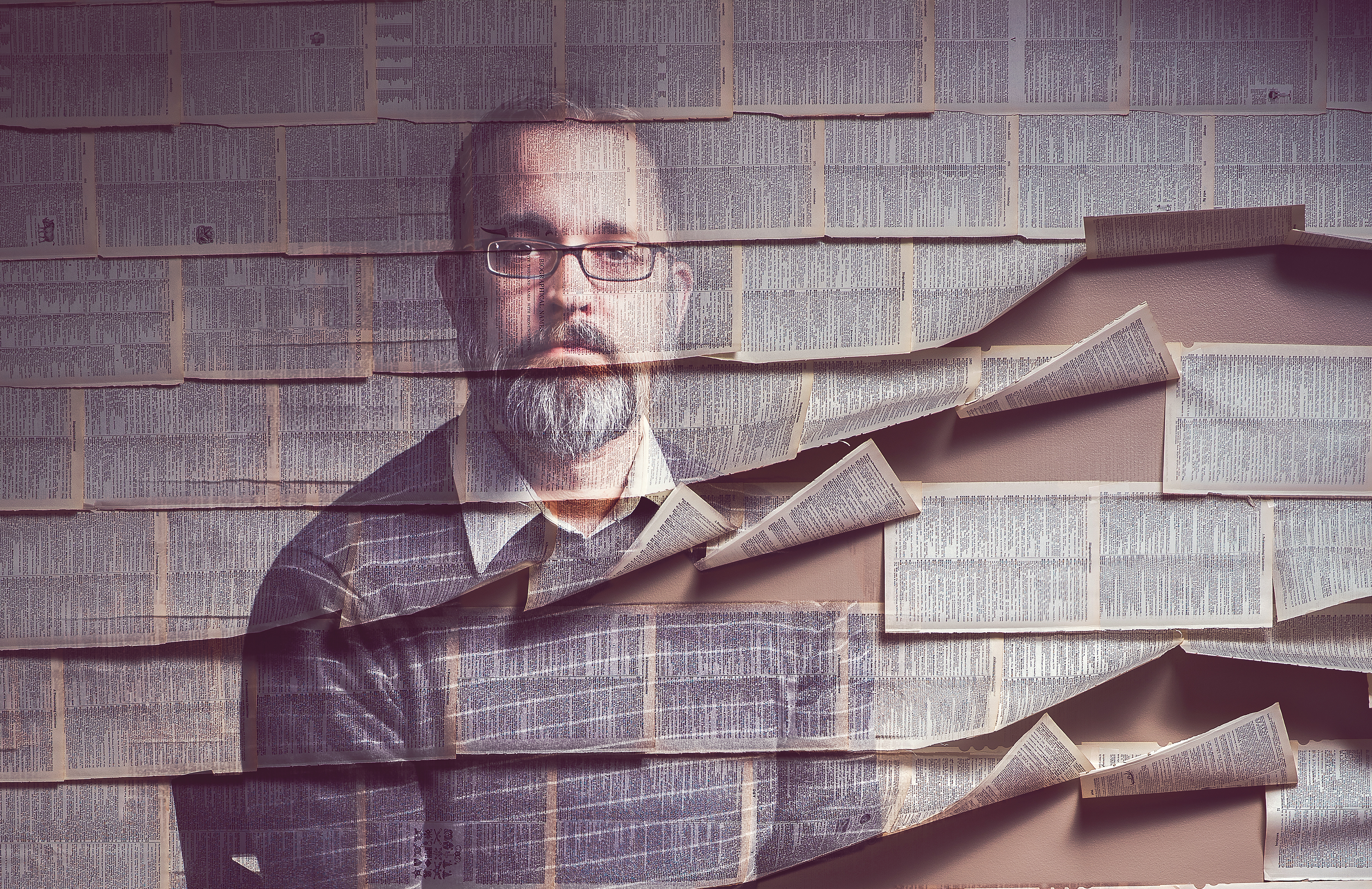
This photo, by John Sanderson of Sanderson Images, won a portrait contest with Maine Media Workshops.
A few months ago, my photographer friend John Sanderson approached me with an idea. He wanted to start a new line of services at his studio involving editorial-style brand portraits.
What?
That’s right. Editorial-style brand portraits. He wondered if he could set up a shoot and take my picture. I’m not a huge fan of having my photo taken, but I figured I could use some new headshots, so I agreed. The next thing I knew, he sent me a questionnaire with the oddest questions. One of them was, “Somebody you’re not related to.”
Me – “That’s not a question.”
John – “Just put down whoever comes to mind.”
Me – “Bono.”
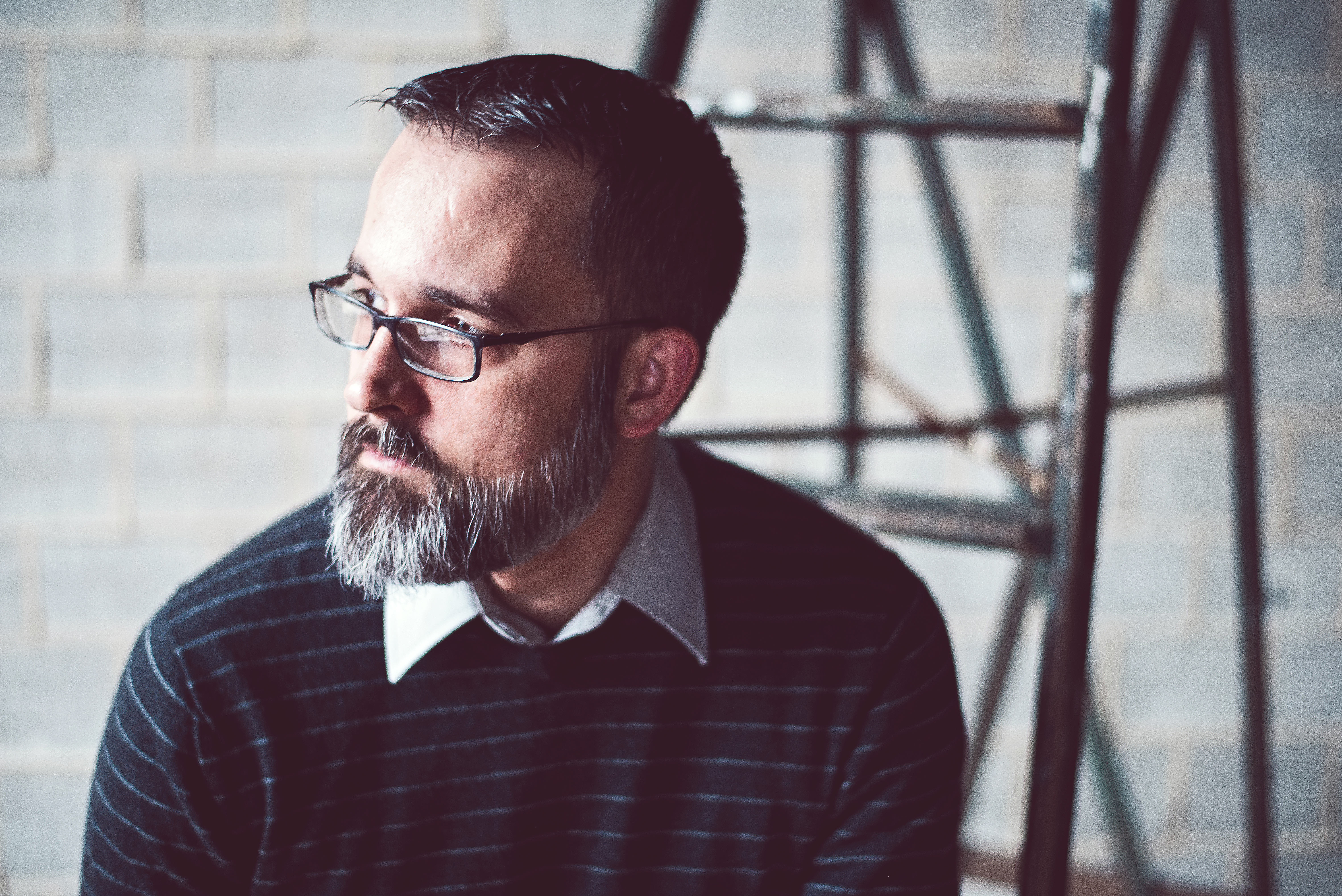
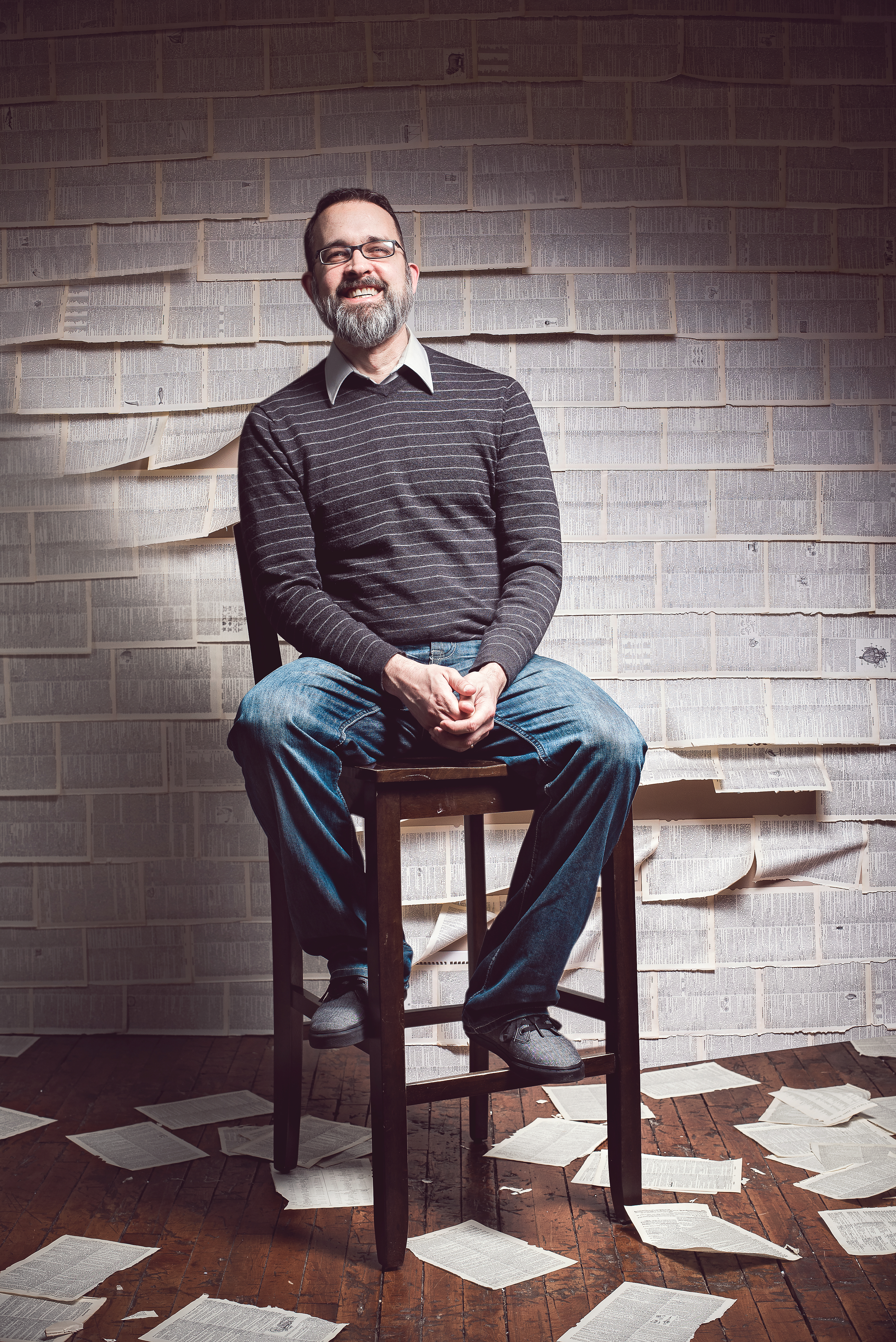
John took my answers to his vague questions and went through his own personal creative process that eventually led to him creating a backdrop for my photo shoot…made up of individual dictionary pages taped to a large frame. And an old ladder. And a paper airplane. It was amazing. Here are just a few of the photos he created:
John and his wife Kim are extremely talented. To find out more about this style of photo shoot or to see some of the other incredible services they provide (weddings, engagements, family sessions, interior and exterior for luxury marketing, and all kinds of other stuff), check out their photography HERE.
I’m at a unique place in life, experiencing things I don’t remember experiencing before. On one hand, I’m more confident than ever in my call as a writer, and I’m content with where I am: I have an agent; I have (relatively) steady work; I have a wonderful writing community. On the other hand, I feel unsettled. I have one project currently being shopped around to publishing houses and am working on a book proposal for a second project, one that gets to the heart of what I’ve been experiencing for the last four years.
Waiting is hard. I’ve had two or three rejections so far on the first project, and those are not easy to receive. As the waiting continues, I find it difficult to focus, difficult to do anything but stare at my inbox, eager for the ping of the next incoming message, the potential email that will validate my writing. Validate my story-telling. Validate…me?
Ouch.
Rejection is difficult. Waiting is difficult. Hoping is perhaps the toughest thing of all. Yet everywhere I turn, I am being reminded that I should not give up.
My friend Sarah Bessey shared the following on her Facebook page after speaking at the Festival of Faith and Writing last week:
…this is a moment of full circle redemption. Eight years ago, I experienced the death of all my dreams to write at this very Festival of Faith and Writing. It was hard and beautiful and reorienting. Writing simply became a place to meet with God, no expectations attached. So it’s hilarious to me that I’m now on stage, all these years later, to proclaim the truths I’ve learned: we’re all unqualified and qualified to preach the Gospel and to write about God.
The death of her dreams was “hard and beautiful and reorienting.” Reorienting. Maybe we all need that, to be shaken from our present course and redirected on paths that lead somewhere better.
* * * * *
Two weekends ago, I listened to the keynote speaker Robert Liparulo speak about a similar topic. Twelve years before, he stood at the precipice, wondering if he should quite writing the novel of his dreams, the one he was working on but barely halfway through. Quitting seemed very easy to him at the time.
But he didn’t give up. He decided he would at least finish what he had started. Three million copies later, he’s rather glad he kept on.
* * * * *
Seven years ago, Bryan Allain and I began having breakfast together once a month, and it became an immense source of encouragement for both of us. He wanted to get out of his day job, and I wanted to make a living as a writer (well, most of the time that’s what I wanted, but there were many times when what I really wanted was a regular paycheck and health insurance).
But we kept moving forward. We kept taking that next small step. Now Bryan makes a living as a writer, supporting authors as they launch books and create new projects. And I’m moving forward as well, testing the waters, trying new things, helping people tell their stories.
* * * * *
Something Robert Liparulo said has stuck with me: “It’s a tragedy when people give up on their dreams.” I think it’s true, but giving up is also so easy, so simple. Usually, when I want to give up it’s because the mountain of my dream rises up through the clouds, and I can’t imagine ever arriving at those heady heights. I can’t imagine the days, the weeks, the years it will take to chart my course and scale those sheer rock faces.
That’s when we give up. When we stare up at a peak we can barely see.
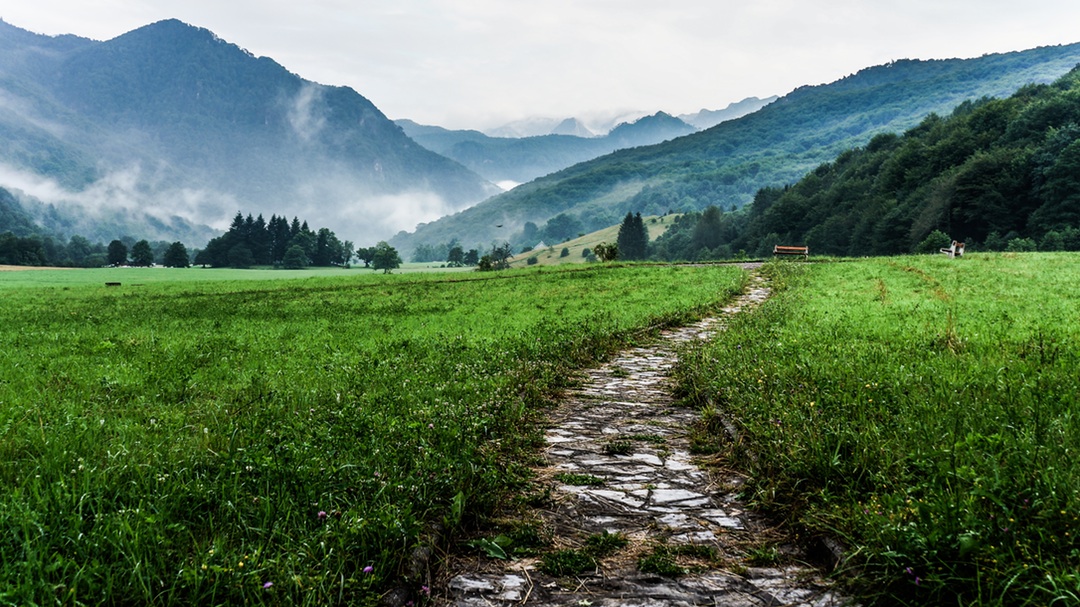
Stop it. Stop focusing on the dream, and start focusing on the next small step. The next chapter. The next page. The next word. Finish the business plan, the outline, the funding letter. Take the next photo. Paint the next brush stroke. Look at the path, the one that’s grown over, the one that few others have traveled before you.
Then take the next step.
* * * * *
Bryan Allain and I recently took our seven years of breakfasts talking about the writing life and made three free videos about practices that will help improve your life and your writing: Silence, Discipline, and Community. You can get access to those three free videos HERE.
There was a small trailer in Springfield, Missouri, with garish furnishings, the golds and browns and reds of the late-70s clashing in an artificial sunrise, like Middle Eastern mosaics. Or maybe everything is that color in my memory because that’s the filter of those 70s photos, the golden hue clinging to everything. We lived there from 1977 to 1979, but I have three or four solid memories from those two years. It seems a paltry offering.
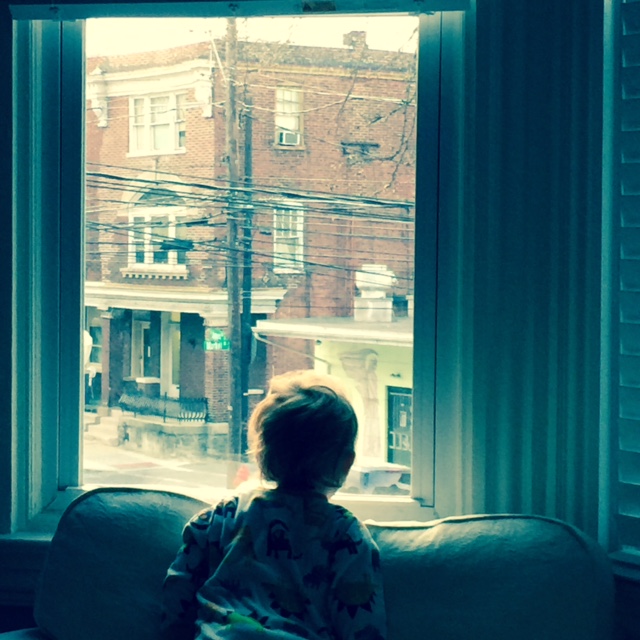
I took a photo of Leo the other day as he stared out our bedroom window onto James Street. I was his age when we lived in that trailer in Springfield. It’s hard to believe I was once that little child, looking out into the big, wide world.
There was a door at the back of the trailer that led out into a space without steps, just a long drop to the yard. It was as deep as the cavernous abyss that Gandalf stands over and says, “You shall not pass!” That back door led into nothingness.
In my mind it is always dusk there in that Missouri trailer, always the end of the day when the sun wilts behind the hills and the grass is a blue shade of green. I don’t remember mornings there, and I don’t remember nights – only the cool blue of dusk as the sun is setting. These are my earliest memories.
I was only two, and I see those years through deep water. Images come back to me even to this day, delivered like unexpected lightning bolts when I pick up a wiffle ball or take the first suck of one of those ice pops in the clear plastic wrappers. I know there was a neighbor boy who let me ride his small motorcycle and play on his Atari 2600 – Pitfall Harry and Pacman. I remember wandering across the narrow street to his house and a kitchen that was a bit different than our own.
The clearest memory I have is of my Grandpa Beiler looking up at me. I stood, framed in the back door, the one without any steps, and he raised his arms to me, and I jumped down to him. It was a leap through the deep reaches of space, a leap for the ages. I imagine that he always smelled of KR and cough drops, though that could be my imagination. Was it him who always had bubblegum in his pocket, Big Red and Juicy Fruit? Was it him who popped out his false teeth and made strange, Munsch faces at me?
Later, when I was five or six and we had moved home, he paid me 25 cents to comb his hair on Sunday afternoons. He would usually fall asleep, or pretend to, football on the television behind me. But that comes later.
The strangest part of all is that I went back to that small Missouri town a few years ago, and someone pointed out the old trailer park where I had lived. I drove back the lane. It was tidy and clean, but not anything like I remembered it. For one thing, in my memory, it sat at the crest of a long, sloping hill, and behind our trailer – in my memory, mind you – the fields swept away, far and beautiful, always down, ending in a panoramic, prairie vista.
In reality, the trailer park was small, much smaller than I remembered. And there were no sweeping views behind the trailer where that old door to nowhere would have led. No, there was just a small, grassy back yard, and then a line of withered trees. Where did I get the that image of a never-ending view? Where did I get that vision of an unfolding slope and a Little House prairie?
Sometimes I wonder if our memories are more truthful than the facts. To me, as a child, that backyard went on forever. Perhaps it always would have, if I never would have gone back there to see it again. And who would have known the difference? I think I like it better the way I remembered it and not the way it is.
I wish I could unsee that line of withered trees.
To read this series of posts from the beginning, click HERE.
To stay up-to-date regarding the books I’m writing and to receive bonus blog posts, sign up for my twice-monthly(ish) newsletter HERE.