The Biggest Uber Tip I Ever Got (or, Money Isn’t Everything) #RideshareConfessional

Photo by Anthony Delanoix via Unsplash

I pull up outside the bar, squeeze my car up against the curb on the corner and wait. A bouncer stands on the steps talking to two women. It’s 8 o’clock, a perfect summer night, and the sky is fading to steel blue. Flat, gray clouds hang low in the east.

A middle-aged man comes out of the bar and holds up his index finger to me, then sidles up next to the women talking to the bouncer. He flirts with the older woman. They chat for a few minutes. Meanwhile, I wait. After a few more minutes I put down the passenger side window to try to get his attention. When you have to wait around for a fare, it can kill what you might make that hour.

“Don’t you leave me!” he shouts over to me. There’s nothing kind about his voice. It is the voice of someone used to shouting, used to getting his way.

“I’m going to head out soon!” I say, laughing, only half joking. He storms over towards me. My blood pressure rises. I consider driving away while he stands there, waving to him through the sunroof.

“What did you say?” he says, squinting his eyes. “You are not f***ing leaving me!” He throws his phone into the passenger seat, pulls out his wallet, leafs through a deck of bills, and tosses a twenty at me. It falls to the passenger side floor. I do not pick it up.

He goes back to his conversation. Putting his phone in the passenger seat was actually an expert move. I’m not going to throw it back out the window at him, although I’d like to. I’m not going to get out and confront him because he’s unpredictable, at least partially drunk, and I’m a non-confrontational 9 on the Enneagram. Besides, the $20 is still on the floor. That’s what I usually make driving for Uber in a fairly decent hour.

He nudges his body up against the younger woman, puts his arm around her shoulders. She shifts uncomfortably. His hand drops, but catches her waist on the way through, a passing glance, a pressure point impossible not to feel.

A few minutes later he finally comes back to the car, loud, boisterous, owner of the world.

“Can you believe this guy was going to f***ing leave me?” he shouts to his friend who climbs into the back seat.

“I’m sure he can’t wait around forever,” his friend says quietly. Finally, a voice of reason.

“I need to make a pit stop,” he says. He bends over and picks up the $20 bill off the floor and hands it to me. “Here, this is yours.” I shrug and take it, balled up in my fist on the gear shift. He directs me to another bar.

“I need you to wait,” he says. “I’m just having one beer. I will make it worth your time. Do not f***ing leave me!” And he’s heading into the bar, and I’m in the car, typing this, thinking I’d rather be at home with Mai and the kids, no matter the $20.

* * * * *

Ten minutes later he comes out of the bar alone and climbs into the car. I confirm the address and we start driving. I just want to get him home and get on with my night.

“I can’t believe you were going to leave me,” he says, starting in on the same old topic. He asks me how often I drive.

“Fifteen to twenty hours a week,” I say. “Sometimes more, sometimes less, depending on my other work.”

I ask him what he does.

“I’m a business man,” he says. “I’ve made a lot of money. A lot of money.” His voice turns suddenly introspective, and, surprisingly, he is not bragging. He says it as a statement of fact, the same way someone might say, “I could stand to lose some weight,” or “I had salmon for dinner.” He takes a deep breath.

“I’m on my way home to my girlfriend. I was married. I have some kids. They won’t have anything to do with me, not now.” Now he is back again, chuckling, but in between each laugh is a tiny spark of something. I realize what it is: disappointment.

“Turns out I’m good at making money and terrible at making a family. So I’m on my way home to my girlfriend.” I have never heard someone trying so hard to convince themselves they are happy.

We talk for a long time and he is surprisingly candid. He fluctuates quickly from regret to abrasive confrontation. Talking to him is like being the lion tamer in the circus – circling, constantly assessing, now firm, now retreating. We pull up outside his house.

“Thanks for waiting,” he says, standing up out of the car. The street is tree-lined and dark and someone in the distance is mowing their yard. I can hear the mower. I can smell the grass.

He stands outside the car for a minute, pulling himself together.

“I can’t believe you were going to f***ing leave me,” he says with a wry grin on his face, his body swaying from side to side. He pulls out a $100 bill and throws it onto the passenger seat before slamming the door and walking into his house. The bill flutters to a rest and sits there, bent, folded. I realized this was probably a perfect picture of his life: knocking people over, being his brash self wherever he goes, and then leaving a trail of hundreds in his wake.

All in all, I made $129 on what would normally have been a $6 fare. I take the bill and put it in my middle console, and I drive home, because it’s been a slow night, and I’m tired, and money is not everything.
My Ramadan Meal, and Finding Peace in Unexpected Places

“Come by tonight, any time after eight o’clock,” my Syrian refugee friend told me earlier in the day, so after I drop off an Uber fare in his part of the city around 8:30pm, I head for his house. The street is dark and quiet. The sun has only recently set. When I get out of the car, I can hear children playing a few streets over. Solitary fireworks go off in the distance.

I ring the doorbell, and I hear it echo inside the house. Everything seems quiet, but I wait. The narrow blinds bend upward as someone peeks through to see who is ringing their bell so late. It turns out to be a little someone, with tiny fingers. I hear one of his four boys shout something in Arabic. Everything in Arabic sounds urgent to me.

The door opens, and there he stands in a white undershirt, jeans, bare feet. He smiles a wide smile and I can see why he called me earlier in the week about finding a dentist that would accept his insurance to replace a missing bridge. We are still working on that one. We shake hands. He welcomes me in. I can tell they are eating, and immediately I feel guilty.

“Did I interrupt your dinner?” I ask.

“No, no, no. Come in,” he says. “Come in.”

His wife comes around the corner from the dining room and welcomes me with her kind, quiet eyes. She bows her head slightly. “Come,” she says. “Eat.”

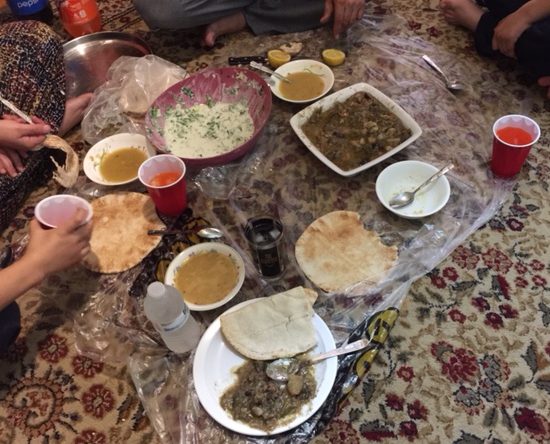
Their four boys accompany me into the dining room like puppies, bouncing around and smiling up at me. The oldest leads the way, and when we arrive, and I see the spread of food on the floor and hear the Muslim prayers coming through the cell phone set up on the counter.

Of course, I think. It’s Ramadan. Is this why he invited me over after 8, so I could eat with them?

IMG_2871

They are one week into their month of fasting from food and water during daylight hours. Now, they are enjoying their first meal of the day. To be honest, it smells amazing. But I just finished eating a celebratory meal with my own family not two hours before. We ate in honor of the last day of school.

“Sit, sit,” my friend insists, beckoning towards a space vacated by his oldest son, and as I try to figure out the politest way possible to tell them I don’t have to eat – I just finished eating dinner, I couldn’t possibly fit another thing in my gullet – his wife is filling a plate for me, mounding up all that delicious looking food into a huge serving. I sit on the floor along the clear plastic liner, and I am not very flexible, so sitting cross-legged isn’t the most natural position. She puts the dish in front of me – flat bread and some kind of stew or curry filled with vegetables and beef and a thick broth.

We eat mostly with our hands, mopping up the juices with the bread. I use a spoon they give me, when necessary. The boys have already finished. The prayers come to an end on the phone. We talk about work and how school is going. We try to creatively communicate words like “lamb” and “six-cylinder” and “dental insurance,” and every time we make a successful connection we laugh and smile, as if we have just learned each other’s language in its entirety. Then, we stumble through another sentence, another conversation. Communicating with each other is a determined act, a kind of fighting against the darkness, especially in these times.

My stomach is bursting from my previous dinner but the food is so good it’s not difficult to find room for it.

The boys laugh about something, and I can tell they’re laughing at me. I smile and shift awkwardly again on the floor.

“Okay,” I ask my friend. “What’s so funny?”

“You’re not used to sitting like that?” he asks with a small grin on his face. I realize I have been shifting my position every few minutes, trying to get comfortable. I laugh. The way they sit – it’s cross-legged, but it’s different, because their feet are tucked up under them. The boys laugh unreservedly now. I can’t do it. I can’t sit like that.

“No, no really. What happened to your table?”

“We only had it for a few weeks before I took it apart and got rid of it.”

“This is how you eat in Syria?” I ask.

“This is how we ate in Syria, on the floor,” he says, smiling, nodding, taking another large bite.

I nod and follow suit. I can’t imagine how wonderful this would taste after an entire day of not eating or drinking anything. It shows a lot of devotion, a willingness to fast for an entire month. I think my friend already looks like he has lost some weight, and only one week of Ramadan has passed.

“Do you miss Syria?” I ask. He nods, and for a moment his eyes well up. He clears his throat.

“The boys, they miss his mother especially,” his wife says.

“Their grandma?”

She nods. “Yes, their grandma. They Skype each week.”

The food is finished and my friend invites me onto the back porch. We sit on the couches on their covered cement slab. He takes out a cigarette and inhales a long draw, sighing out the smoke. He tells me about a new job he is trying out, driving for an egg company on the weekends. He asks my opinion on purchasing a more fuel-efficient vehicle. I explain to him the best way to find a dentist through his insurance, if they even cover dental, and promise to help him make calls next week.

Soon, his wife brings out coffee for us. Because I ask, they admit that it is difficult working where they do, in the hot dry-cleaners, when they cannot eat or drink all day during Ramadan. The coffee – it is more like espresso – is the color of dark chocolate and she serves it piping hot in tiny mugs with lots of sugar. The boys come out and the youngest takes his Big Wheel from the shed and rides up and down the sidewalk, playing with neighbors, their wheels rasping, their voices calling out to each other, alternating between Arabic and English. My friend tells me he’d like to find a place outside the city, now that they have a car, have jobs. He’d like to rent a place where he can have a garden, grow potatoes and carrots and … what is it called? Corn? Yes. Corn.

The night falls. The stars try to break through the city’s light pollution.

“I really have to go,” I say, finishing my coffee. “I have a lot more driving to do tonight.”

“No! No, Shawn, stay,” he insists, but this time I stand up. I thank them for dinner. They promise to have our entire family over soon. I tell them they don’t know what they’re wishing down upon themselves and they laugh. They wave to me as I walk back around the outside of the house to my car.

Every time I leave them, I feel I have been given so much. Every time I leave them, I feel they have given me a small gift of peace, a kind of shalom that is absent from so much of our culture these days.

It is good to have friends who live quiet, peaceful lives.

When She Wanted to Go Back #RideshareConfessional

Photo by Jez Timms via Unsplash
Photo by Jez Timms via UnsplashThe

The woman came through the hotel doors first, approached the car, and opened the rear passenger side door. She stood there for a moment outside the car, nervously smoothing her dress. The man she was with walked around the back of the car and climbed in the opposite side, sliding in smooth, not bumping into any edges. The woman got in reluctantly, and I saw she was young, maybe late 20s.

Her eyes flitted here and there, while his were like laser beams, never wavering. When she spoke, there was always the scent of an apology on her breath. When he spoke, he dismissed the world with every syllable.

Thirty seconds after the ride began, she said in disappointment, “I left the card on the side table in our room!”

“Oh, well,” he said curtly.

I glanced in the mirror.

“It would just take a minute,” I said.

“We’re going to be late as it is,” he said.

“But I hate not having their card with us,” she said, and again I slowed, figuring he would reconsider, realize we had only just left, and change his mind.

“We’ll be late,” he said, staring at his phone.

I have a small car, but somehow there was a lot of space between them in the back, and she tried to make small, positive comments, anything to start a decent conversation, and he answered in sound bite snippets. And they sat there in the back of my car as we drove to the wedding, him staring at his phone while she stared out her window, looking for who knows what.

Be Careful Around the Water with Your Little Ones This Year

Photo by Carlos Dominguez via Unsplash

I couldn’t fall asleep Monday night. I couldn’t get the image out of my head of him standing on the bottom of the pool, water up over his head, eyes wide open, waving his arms up and down like a baby bird learning to fly. I couldn’t stop thinking about what that day might have become for us.

I went over to his room for the third time, checked his breathing, kissed him on the cheek.

* * * * *

Earlier that day, we sat in the 68-degree weather, holding our arms tight to our sides while the kids swam in my uncle’s heated pool. Sometimes, when a breeze blew over the water, steam actually rose from the surface. Not exactly what you hope for on Memorial Day weekend, but the kids were so excited to swim, so there we were.

Our older four are accomplished swimmers. No worries there. Poppy is nine months old and was much more interested in the dog running laps around the pool than getting into the water. But Leo.

Leo is almost three years old. He desperately wanted to get into the water, but for some reason (lack of a nap that day? First swim of the year?) did not want to put on his floatees, his water-wings, his armies. Whatever you want to call them. So, he sat on a seat by the water, wrapped in a towel, and watched the kids splashing around.

Eventually we told him he could sit on the steps with his feet in, but he couldn’t go into the pool. He is about a foot shorter than the depth of the water. He seemed happy to be there. He seemed content to watch. We would watch him.

How quickly we can lose track of what a child is doing! There were probably ten of us adults sitting there, not fifteen feet away. We laughed and talked and, goodness, we had no idea how close we came to disaster.

* * * * *

Please. This year, be careful around the water with your little ones.

* * * * *

“Dad!” my oldest child shouted. He’s thirteen. He had been hanging out around the edge of the pool while the others were in the deep end. What if he had been with the others? What if he had been in the bathroom? What if he had stayed home?

I looked over at him. He was lifting Leo up out of the water by his armpits, about ten feet away from the steps. Leo was red in the face, coughing up water, sputtering, gasping for air. He hung there in the air like a puppet, limp.

“He was under the water!” Cade shouted. Maile ran over and scooped him up, held him close in a towel. We could hear the water rattling around in his lungs. He coughed again. When he talked, it was in a raspy voice.

“I was falling and Cade saved me,” he kept saying, over and over again. “I was falling and Cade saved me.”

Later, when our nerves had calmed a bit, we asked Cade what he saw.

“I thought it was one of the other kids, swimming under the water. Then I saw his arms flapping at his side. That’s when I knew it was Leo.”

* * * * *

I don’t want to dramatize this into something it wasn’t. We are all fine. Nothing terrible happened. It was quick and painless and within a few minutes Leo was back to his old self.

But these things happen so fast. Please be careful this summer. Be on the lookout, not only for your own, but for other little people who might be having a hard time.

* * * * *

He woke up at four in the morning. Instead of putting him back into his bed, I spread some pillows and blankets on the floor and we slept there, the hum of the fan settling us both.


Six Reasons to Raise Your Glass and Toast the Internet

Photo by Kats Weil via Unsplash

Remember when I started James Street Review last year, a site where kids review kids’ books? And remember how it petered out after about two months because I had too many things to do? Well, my son decided to pick up the reins, and along with his cousins and a few friends, he’s now running James Street Review. Head over there today and show them some support as they release three new book reviews and kick off the summer reading season. You can check out James Street Review HERE.

* * * * *

I had a great time chatting with Steve Wiens on his podcast, This Good Word. We talked about my recent trip to Iraq, writing, and my upcoming book release. You can listen to that conversation (and explore some other fascinating guests he’s had) HERE.

* * * * *

From Seth Haines:

“They lean in after asking the question as if I might whisper the same secret life whispered to me just before I left my 12-year career. The question behind the question, the one they weren’t asking, was more akin to this: How did you get the gumption to leave the daily grind, the nine-to-five, The Man?”

Read more HERE.

* * * * *

From Tsh Oxenreider:

“All me lately. I’ve got a lot of projects on my plate, so I’ve been work work working nonstop. Not good for my soul—or my work either, actually. My work requires inspiration, but if I work too much, inspiration vanishes. Vicious circle.”

“Here’s where I go when I need a jolt of creativity.”

Read more HERE.

* * * * *

From Emily Freeman, definitely one of my favorite posts I’ve read anywhere in a long while:

“I wonder how the world and our daily lives would be different if we approached our tasks, our relationships, and our everyday work with a willingness to, in the words of the poet Henry Newbolt, build for the years we shall not see?”

Read more HERE.

* * * * *

And finally, an amazing post about Mr. Rogers:

Won’t You Be My Neighbor? Reconciliation and Foot-Washing in Mister Rogers’ Neighborhood

What the Priest and the Nun Were Looking For – The Iraq Journals, Part 5

FullSizeRender

We drove up a narrow street in Qaraqosh, Iraq, practically an alley, and our driver stopped the van when he could go no further. A large group of soldiers stood at the entrance to the church, as if on the lookout for something, and they eyed up our vehicle. They held their weapons nonchalantly, the way men might hold briefcases or umbrellas. Just as we came to a stop, a motorcade of cars strung their way through the alley. The also stopped beside the church. A group of people got out, and one of the men was dressed in the black garments of a priest or a bishop.

He shook the hands of every soldier, of every person who approached him. He entered the church and was followed by a small crowd. We got out of the van. Walking in the street felt exposed, vulnerable. I glanced along the roof line of the surrounding buildings, but they were nothing more than rubble. There was no lone sniper, no incoming mortar. We followed the man and the crowd into the dark church.

There were no lights, and the sky outside was gray, so everything was in shadow, but it was impossible to miss the blackened granite walls. ISIS had coated those walls in some kind of fuel, something that would burn for hours. The columns were not as charred but were covered in ISIS graffiti. The altar had been desecrated. Anything holy or symbolic had been shot to pieces.

We walked through the church and into the courtyard where, again, anything beautiful had been smashed. ISIS had turned the courtyard into a firing range. There were reports of ISIS crucifying Christians in that part of Iraq, beheading children. The church building itself felt like it was in mourning, weeping for what had been lost.

We wandered around, stunned, feeling lost. A light drizzle fell from the sky, and something in me wanted it to pour, wanted the heavens to open and for a rain, no, a flood, to sweep it all away. All the burned things, all the disgusting symbols, all the bullet casings, all the memories of what had happened there. But no heavy rain fell. Only a light drizzle that blurred my glasses and sent us into one of the wings of the church.

There, we found a priest and a nun rummaging knee deep in debris. The room they were in had been destroyed. Bunk beds lined the walls. I thought they must be looking for something valuable – they seemed so desperate to find whatever it was they were looking for. They moved rubble and ceiling tiles and plaster. Parts of the walls that had fallen in. All the closets had held was strewn on the floor. We asked them what they were looking for. The priest held up half of a flannel board.

“We need the other half to this flannel board,” he told us through a translator. “We need to find it so that we can tell Bible stories to the orphans when they return.”

I walked out. Someone else in our group followed me, began to walk up the stairs.

“Don’t go up there!” someone told them urgently. “That floor hasn’t yet been cleared for landmines and IEDs.”

We went back in the room and we helped the priest and the nun look for their flannel board. There are still so many good people in Iraq, people looking for all the lost things. So many good people.

We didn’t find the flannel board. We said we would send them one.

Back in the courtyard, one of the soldiers asked to have his photo taken with us. We gathered together and tried to smile. The rain came down again. We walked out into the street, through the blackened church. the priest was leading the people in a church service, and they took communion.

The street was lined with broken houses, destroyed buildings. The church’s steeple was nearly falling down. We got back in the bus, and they drove us out of that broken city.

* * * * *

I sit on the floor again, another night in Lancaster. The boys are nearly asleep. The light outside is gone. I think back on my time in Iraq and it seems like a dream, or something I did twenty years ago, though it was only last month. I think of the people I met, and they are like characters in a book. But while I sit here in the quiet, the fan humming, over there they must live with their blackened churches, their bullet-strewn courtyards. Their nightmares. They must go on rebuilding, being good people, praying for peace.

I pray for peace. I pray for peace. I pray for peace.

God, where are you?

But I know where God is. He is in Iraq. I saw him there, in the blackened church, handing out the Body and the Blood. I saw him there, in the wing of the church, searching for a lost flannel board. I saw him in the faces of the people filing in to attend the service.

As we drove away, he waved good-bye, the hand of a small child in the street.