Every Day As a Writer, I Have To Tell Myself Not to be Afraid

No.fear from Flickr via Wylio
© 2008 Vincepal, Flickr | CC-BY | via Wylio

Every day as a writer, I have to tell myself not to be afraid.

There are plenty of voices in my head trying to convince me to get a real job, one with medical benefits and a regular pay check. There is the voice that tells me nothing I’ve ever written has really been that great, and there’s no chance that anything I write in the future will be anything special either. There’s the voice reminding me of every bad review, every clients’ criticism of a first draft, every rejection.

Today I stared out my window and I thought about fear. What would my life look like if I gave into it? I’d work 9 to 5. I’d watch a lot of television (because watching television is such a great way for me to forget about everything I’m afraid of). I’d encourage my kids to stay inside, to not try anything new, to keep their expectations low.

I’d stare out a lot of windows.

I wouldn’t let anyone read anything that I wrote – I’d stop writing.

I’d never say hello to anyone, for fear they’d think I was stupid, or naive, or ugly, and wouldn’t say hello back to me.

Fear has a way of leading us in a concentric path that grows smaller and smaller until we are so far inside of ourselves that we are nothing more than a small point surrounded by an unfathomable darkness. There is no question of engagement, no question of opening up. And if we follow fear long enough, it will swallow us up.

Ironically, the best response to fear is not to be unafraid. The best response is to embrace it.

Try new things.

Write or paint or draw. Start a new business or make a new friend. Take a walk. Get outside of yourself.

This is how you move through fear – by moving and by expanding your circle of movement.

Every morning as a writer, I have to tell myself not to be afraid, and then I have to do something about it. So I open a new page and I start typing.

My newest confrontation with fear involves starting a Kickstarter campaign to fund a novel I wrote over the last fifteen months. And I have to admit – I’m terrified…that it’s no good, that no one will like it, that people will snicker about me behind their backs. But I know it’s time to stop being afraid.

You’ll be able to support the launch and publication of this novel starting on Monday, October 20th, so stay tuned for more on that.

What are you afraid of?

These Painful Renovations (Or, Our New Life in the City)

IMG_1179

We are slowly, slowly finding our rhythm here in the city. The mornings are quiet and cool now, and the traffic creeps past on James Street. Our neighbor Paul sits quietly on his porch doing a crossword puzzle, watching people walk by, sometimes taking a nap. To the other side, our neighbors are renovating the old, neglected row house, filling up dumpster after dumpster with plaster and lathe and old counters and rotten floorboards. Broken sinks and chipped tiles. It is a complete emptying so that they can begin new, from the foundation of each room.

Maile schools the kids in the morning and then the afternoons are filled with activities: co-op and art class and Latin. Nearly every evening, we walk the couple hundred yards to the local Y. The kids play, Maile goes to exercise classes, I swim. We walk back through evenings that are increasingly dark, under bright city street lights and past the neighbor two doors down who is giving his front porch a facelift.

I get my hair cut across the street. There’s a tattoo parlor on the corner and an egg roll place across the street. The kids love it when, previously unannounced, we say, “Let’s go to Souvlaki Boys!”, the Greek restaurant on the corner of Queen and James. We walk for ice cream or to the park. My aunt lives a few blocks away, and she walks up to babysit or to join us for dinner.

On Sunday we walk to church, to St. James which is so different from any church we’ve ever gone to. It’s an Episcopal church, so for this boy who grew up in the Evangelical circles, it’s different. But our kids love the children’s program, they love taking communion every week (as do I), and they love the walk. Those Sunday morning walks are quiet. Few cars cruise the streets. Few people sit on their porches, but those who do look up at our passing crowd, seven now, with Sam usually riding on top of the stroller and Cade and Lucy up ahead, chatting.

“Good morning,” we all say.

“Good morning,” they say back to us.

And there is something holy about that, your family passing by a stranger on a quiet Sunday morning in the city, saying hello, and being spoken to.

And it seems to me that even in the midst of this beautiful new routine, there have been hard weeks: when our car was hit-and-run; when I was hospitalized or diagnosed with Crohn’s a few weeks later; when we decided to find a new home for our dog. These things are difficult. But then I hear, through the walls, the renovations going on next door, and I’m reminded that the best transformations always begin with a complete stripping away of the old.

Enlighten the darkness of my heart, I pray along with St. Francis, and a layer of plaster is pulled away. Sunlight shines through the empty space, filtering through the dust. These renovations are painful ones, but the transformation to come will be breathtaking.

“I Never Went Back to Church After That”

IMG_1350

This place is the land that never changes. Years pass, but as soon as I step foot on the fairgrounds it’s like I’m twelve years old again. We’re still slicing ham and cheese and we’re using the same old dough mixer that we used 25 years ago when we first started making soft pretzels. Doug and Jeff still bring our Coke and Keith the electrician comes by to hook us up to power. The Ferris wheel goes up in the same place, like a slowly turning North Star, and the same crackling voice makes announcements over the loudspeaker.

Of course, some things change. Our friends Jim and Suzy aren’t here anymore. Our tent is bigger than it used to be. The fairgrounds are safer at night.

And this year the Trash Man didn’t show up.

His name is Pete and he is an old man who reminds me of my grandpa. He wore those collared shirts mechanics wear, with his name on a small patch just above his heart and navy pants no matter how hot it was. His eyes were set deep and his skin was tan and worn. A few years ago we had a long conversation, for the first time. It went something like this.

* * * * *

You can read the rest of today’s post over at A Deeper Story.

On Buying a Dog, Colonoscopies, and What It All Really Means

Surgery from Flickr via Wylio

Rising up out of the murky waters of anesthesia, I realize they are wheeling me back to my small room. I lay there, coming to my senses. I am at the doctor’s office. I just had a colonoscopy. Maile is in the waiting room.

The doctor comes in and asks me how I feel. He reviews the images with me, but only a few phrases stick in my mind: “very advanced stage of Crohn’s disease”…”removed multiple polyps surrounding what looks to be the early stages of a fistula”…”recommending medication you would have to take through an IV once a month at the hospital.”

I nod, nod, nod, knowing this is when you should ask questions, but my mind is still not there. I make an appointment for three weeks down the road for another consultation, then walk out to where Maile is waiting for me.

* * * * *

I lay in another bed, this time my own. I stare at the ceiling and listen to the traffic going by on James Street. The ceiling fan spins. Maile gets up in the darkness, retrieves Leo, and feeds him. He is three months old with his whole life ahead of him. This is how the night passes when you stare at the ceiling.

There’s something wrong with me, something that can’t be easily fixed, something that doesn’t have a cure or a surgery. It’s something I will have until I die. Maybe I can control the flare-ups, maybe I can’t, but it will always be there.

This is a strange thing to comprehend, when you are 37. It brings to mind many things, and moving slowly to the forefront is this glaring thing called my mortality. I will die.

Most days it’s easy to forget that we will die. Most days it’s easy to think we will live forever. But then, every so often, you are brought face to face with the breaking down of your body, the erosion of this physical existence over time, our mental fragility, and it is not easy.

I lay in bed, staring at the ceiling.

* * * * *

Two days later I bought a dog.

I am not a spontaneous person. I spent six months researching laptops before I bought my last one five years ago. I rarely make big purchases, go on last-second trips, or drop by unannounced. I am rather hobbit-ish in nature, and while I enjoy a good adventure from time to time, any day spent alone in my office is a good day.

For a week or two leading up to my colonoscopy, I had been talking about getting a dog. Maile’s response was lukewarm at best.

“We have a baby,” she said. “We just moved.”

“It would be nice for you to have a dog in the house when I’m away,” I suggested.

She stared at me.

“I’m not getting a dog,” she said. “YOU can get a dog. But I’m not getting a dog.”

For some reason I chose to only hear the middle part of that, so on the Friday after I had my colonoscopy, I went out and bought a boxer.

I don’t even know who I am anymore.

When I called Maile on my way home and told her about our new boxer Clementine, she burst into tears.

Have you ever had a good friend ask you a question that was so on target it took your breath away? Have you ever had a friend whose insight into your life left you feeling rather naked?

A few days after I brought home THE DOG, Maile looked at me across the table and asked me one of those questions. It came during a particularly emotional conversation. Maile may have cried. I may have sighed a lot. Then she asked me,

“Do you think you got the dog to distract you from this Crohn’s disease?”

Yes, that’s the sound of the wind getting knocked out of me.

* * * * *

There are dozens of things I could have been diagnosed with that would have been worse. Crohn’s is not a death sentence, and I’m hoping that with meditation and exercise and a diet change and prayer (and as little medication as possible), I can go into remission and stay there. My aunt is battling cancer; my friend’s father is grappling with ALS; others I know deal with chronic pain and severe disabilities. Crohn’s is none of these.

I think, at the end of the day, the reason the diagnosis affected me the most is that it reminded me that I will not be here forever. I don’t think this is a bad thing to be reminded of. I think it’s something we all need to think about, from time to time. But when a simple reminder of that fact feels like such a huge blow, I have to wonder.

What is it about the way I see and live my life that makes it so difficult to ponder my death?

* * * * *

So.

It’s been a rough seven days. Last Tuesday my truck got hit-and-run while parked on the street in front of our house. On Saturday the van we were borrowing (while my truck got fixed) broke down and left us stranded while we were trying to get to a retreat. Today we found a new home for our dog, a sad day, and when I went out back to get the rest of her stuff I realized my bike had been stolen.

I’m starting to feel like I’m living in a country song.

But even after all of that stuff, I still remember how I felt walking out of the hospital after my recent three-day stay. I still remember how happy I felt to be out, to be alive, to be walking down the street on a beautiful summer day. Alive. I felt very alive, but more than that, I felt very thankful and determined to live a life that valued the things that are important to me, not the things that are urgent or demanding my attention or even the things everyone else thinks are important.

I don’t want to lose that feeling. That thankfulness.

That is what I keep coming back to.


When the Church Creates, Not Little Christs, But Little Accountants

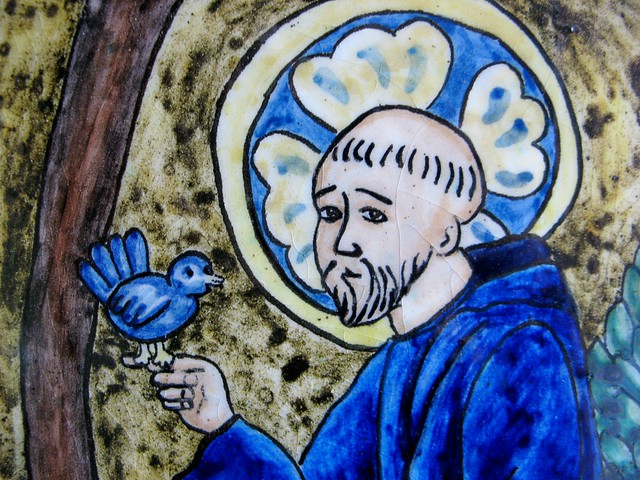
St. Francis of Assisi from Flickr via Wylio
© 2007 Randy OHC, Flickr | CC-BY | via Wylio

My four oldest children and I walk slowly along the sidewalk on our way to church, the morning sun just beginning to rise above the buildings that line Queen Street. Maile is feeding Leo and they will walk to church later. The city is quiet on Sunday mornings, like the silence after a long sigh. Nights here are busy, cars always moving, people coming and going from one streetlight to the next. But on Sunday morning you could just about walk down the middle of the street and no one would notice.

There is a man sitting on his front stoop, newspaper in hand. He looks up at us through defeated eyes. I say hello. He nods and looks back down at his paper. Abra runs ahead of us, skipping over the cracks in the sidewalk. Sam reaches up and holds my hand. So does Lucy. Cade tells old stories about our family, stories that have become a kind of folklore.

There is the story about when Rosy the Rabbit tried to eat Sam alive. There is the story about how Abra found the hidden stash of 4,652 chicken eggs under the log pile. They talk about the house where we lived on Belmont Street, how Abra fell and hit her head on the bus during our cross-country trip, how I was the only one to see the bear at Yellowstone.

Story after story, and I realize something: every time these stories are retold, they reinforce our family identity. They strengthen the foundation of acceptance and love that these children feel in our home. I laugh and ask more questions.

“Do you remember the time…”

* * * * *

We arrive at St. James and I drop them off for children’s choir practice, then wander into one of the neighboring buildings. There’s a class being held on St. Francis, so I slip in and listen. Father David hands me a card. On one side is a beautiful image of a crucifix surrounded by images of prayer. On the other side this is written:

Prayer of St. Francis
Before the Crucifix

Most high, glorious God,
Enlighten the darkness
of my heart
and give me true faith,
certain hope
and perfect charity,
sense and knowledge, Lord,
that I may carry out
Your Holy and
true command.

* * * * *

“The evidence of our Christianity,” Father David says during the sermon, “is not found primarily in the financial gifts we give to this church. The evidence of our Christianity is found in our coming together and offering of our selves, our talents, and our time to one another and to the world.”

I think he is right. The primary act of Christ on this earth was not the giving of financial resources, but the giving of himself. I think the American church, in spending so much time asking for money and so little time asking that each Christian give themselves, is missing the mark and creating, not little Christs, but little accountants.

* * * * *

We walk home and Leo starts to cry a little because he is hungry. The sun is a bright light behind us now, high in the sky, hot for a late September day in Lancaster. Sammy runs towards a trash can to throw away his water bottle, and he trips and falls, scuffing his hands. He cries, I pick him up, and the rest of the kids circle around him.

“Are you okay, Sammy?” one of them asks.

“Did you hurt yourself?” another one inquires.

He is okay, and we continue our walk. When we get close to the house we see my parents sitting on the porch, waiting to eat lunch.

* * * * *

Late that night I take out the dog (yes, we have a dog – that’s another story), and listen to the city at night: trucks rumbling through, sirens screaming from the hospital, someone shouting to someone else out on James Street. And I think about one line from that prayer on the card Father David handed to me:

that I may carry out
Your Holy and
true command.

This God Who Can’t Wait to Punish Us

Men walking away on the beach from Flickr via Wylio
© 2011 Valentin Janiaut, Flickr | CC-BY | via Wylio

We are at liberty to be real, or to be unreal. We may be true or false, the choice is ours. We may wear now one mask and now another, and never, if we so desire, appear with our own true face. But we cannot make these choices with impunity. Causes have effects, and if we lie to ourselves and to others, then we cannot expect to find truth and reality whenever we happen to want them. If we have chosen the way of falsity we must not be surprised that truth eludes us when we finally come to need it!

-Thomas Merton, “New Seeds of Contemplation”

When I was a senior in college, I decided not to play soccer, which doesn’t sound like a major decision, except I had self-identified as a soccer play for fifteen years. One of the most difficult aspects of quitting was letting go of what other people would think about me – I wasn’t a soccer player anymore. What would everyone else identify me as? It felt like a vacuum had formed, a space of nothing, and I didn’t know what to fill it with.

Sometimes we identify not with what we do but with what we have or own. Maybe your identity has been wrapped up in owning a business or having a particular kind of vehicle. What would happen if you lost the major things that you have? How would that affect you?

One of the greatest temptations we will ever face is to be who we think everyone else wants us to be instead of being who we are. Our identity becomes what everyone else thinks about us. We worry…what if everyone realized I’m not as conservative or as liberal as I’d like them to think that I am? What if my friends realized I have doubts about my religion (or my non-religion)? What if people don’t take me seriously?

Henri Nouwen says that most of us go through life finding our identity in what we have, what we do, and what other people say about us. The problem with that is each of these will someday fail us – we will lose everything we have, we will stop doing what we are known for doing, and other people will inevitably say bad things about us from time to time. What then?

Nouwen suggests that we find our identity as “The Beloved.” One loved by God. This can be difficult though, when we’ve been taught for so long that God’s love is conditional on our behavior, that he is ready to zap us at our next mistake.

Who am I?

These days, I find my identity as a writer, but even that feels like a slippery place. What if I have an off day, write poorly…does that mean I’m not a good person? What if people don’t like something that I write…does that mean they don’t like me as a person? As long as I find my identity in what I do, that identity has a weak foundation, one that can crumble at any moment.

Where do you find your identity?