“Andi, this just doesn’t go anywhere. It doesn’t have any depth. It’s boring.”
I think that’s what she said, the editor who had accepted my query about an article on international adoption, when she flat-out rejected a piece I had put months of my life into.
Months.
Her rejection of my words, my work, me. . . yep, there it was, she was rejecting me. And her rejection – justified, reasonable, true because the piece really was vapid – was just a tiny ripple that came before the big one.
My husband and I had been married for almost 3 years, and I was ready. Ready for that baby, that bundle of Guatemalan joy – the son we would name Diego.
We talked, we found an agency, we chose our country, we chose a name.
I even bought the hardware for a crib set that my father would build. Mom and I picked out fabric for the layette she’d make for his room.
Then, my husband left.
I wish I had been able to see in my own desperate article the way I was bracing against what I must have known – somewhere – was coming. But I didn’t see it . . . in the article or in my marriage.
And when rejection came – a ripple and then a tidal wave – my feet were washed out from under me, and I lay crying in a puddle on the floor.
***
5 years later, I am in Breckenridge, Colorado with one of my dearest friends. My mother has died a few months earlier, and my friend has invited me to take some respite with them for a while.
We are walking to an outlet mall, and she asks how I am after the divorce. I tell her that I’m finally beginning to feel like myself. She says – with her years of work as a counselor tied tight to her heart – “5 years. It takes most people 5 years to get over a loss like you experienced.”
Later that weekend, I sit in a lovely restaurant in that gorgeous resort town and cry over the fact that I may never have children.
***
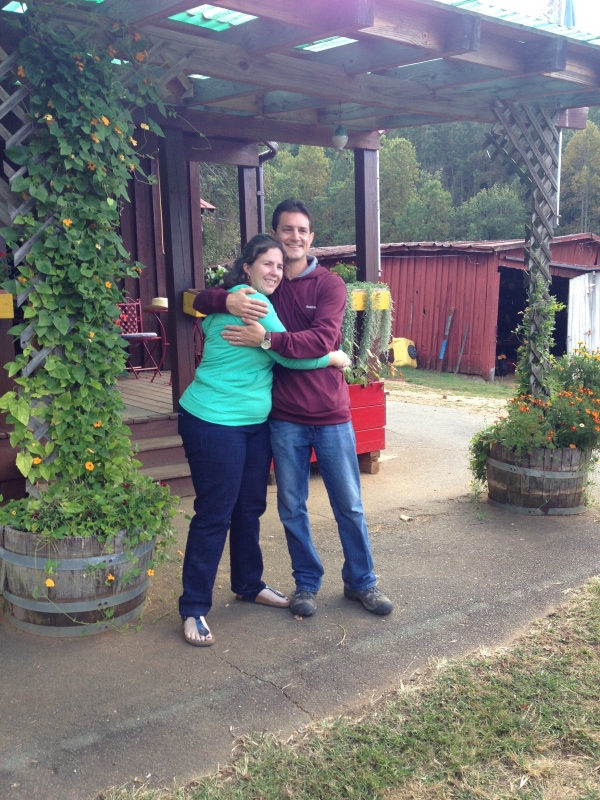
2014. I am in a farmhouse with a cuddly dog asleep on the sofa and three cats snuggled against the hot water heater. Outside, two puppies, four goat kids, two kittens, 14 chickens, and two guineas are roaming this place of my dreams – the one my first husband did not take very seriously – in the dream or me.
My husband now – a dream himself – is on his way to work 50 miles away, a commute he takes on without complaint because it builds the life we share in this place completely.
We do not have children . . . not yet, but we both want them. Deeply. And they will come, we pray, when the time is right.
Because that is the story of rejection. It is often a story of timing, and of accepting the “not yet” even when it comes with the tidal-wave force, even when it leaves us puddled on the ground.
I know – now, 9 years later – that the “YES” of now can pick me up and carry me on with promise and more life than I ever imagined when Mom and I picked out that nursery fabric. Then, it felt forced, pushed, like that adoption article.
Now, the journey feels steady, unresisted, because now – with this man, the love of my life – is the time.
And Dad still has that crib hardware.
Andi is hosting a Writers’ Retreat at her farm in southern Virginia from July 18-20. If you love to write, you should consider attending. I will also be doing a reading there on July 19th, the Saturday night of the retreat, so if you can’t make it for the entire weekend but would like to come to the reading I believe that is also a possibility.
For more information on the retreat or the reading, click HERE. For Andi’s blog, click HERE.
You can also check out some of the prior #OvercomeRejection posts here:
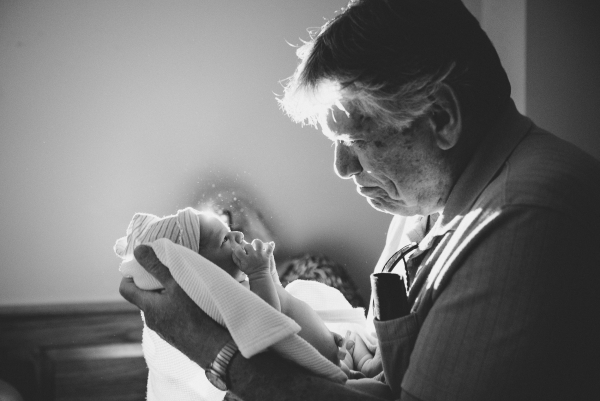
Baby Leo being held by Maile’s father. Photo by the wonderful Kimberly Sanderson of Sanderson Images.
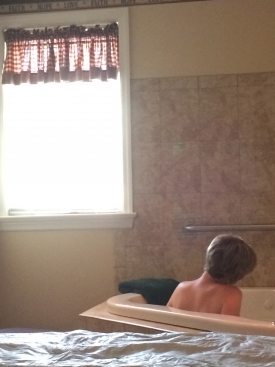
Maile kneels in the large tub, sitting back on her ankles, her knees spread apart. The water is still. She leans forward against the side of the tub, facing the corner of the room. She doesn’t make a sound, at least not until the next contraction comes. Then her voice starts in a quiet hum, growing louder and only slightly higher as the contraction peaks.
“ahhhhhhhhhhhhhhhhhhhhhhHHHHHHHHHHHHH…”
She takes a deep breath and exhales, and the world has come back. For a moment there was nothing but the contraction, nothing but finding a path to the other side of that growing pain. But she is through. For now.
I kneel beside the tub and wait, my knees on a foam mat, my head in my hands. Waiting is like prayer. Kneeling there in the dim light, a summer thunderstorm gathering outside, my wife in the tub humming through each contraction, I have this revelation: it’s no wonder older traditions worshiped the female form, this vessel of beauty and power that brought forth life, seemingly on its own.
It’s no wonder older traditions worshiped the goddess. But perhaps those ancient goddesses needed priests in order to hide their humanity. Because we are, all of us, human.
“I need to go to the bathroom,” Maile says quietly, urgently, and I help this goddess from the (holy?) water and into the adjoining bathroom. At some point her determination turns to uncertainty.
“I remember this,” she says. “I remember this point where you suddenly think, ‘I have decided I don’t actually want to do this anymore.'” She looks up at me with her big blue eyes. “I’m at that point.”
“You can do it,” I say, because what else is a husband supposed to say at that point?
She nods and bites her lip in pain, then the breathing.
“ahhhhhhhhhhhhhhhhhhhhhhh…”
* * * * *
Earlier that same day, about ten hours earlier, Maile woke me up. She stood at the foot of the bed, a visiting angel.
Do not be afraid.
“I’m having contractions,” she said, smiling. “They’re about ten minutes apart.”
I was suddenly awake.
“And I think we have to change the baby’s name,” she blurted out, cringing. “It just doesn’t feel right. I don’t think I can do it.”
What’s a husband supposed to say at that point? She’s having my baby, she’s having contractions, and she wants to change the name. Of course. You can do whatever you want. You can buy whatever you want. You can leap tall buildings in a single bound.
So we had to come up with another name. And he was on the way.
* * * * *
“You’re doing great,” the midwife says to Maile after four and a half hours.
“But I’m not,” Maile whimpers. “I want to push but I don’t think it’s time yet.”
“Would you like me to check you?” the midwife asks.
Maile nods, and the midwife pushes her fingers up inside, up into the source of life, the center of the pain. How often that is the case, that the center of our pain will also become the source of life. Maile grimaces, then groans, then cries out.
“Okay,” the midwife says, adjusting her reach, feeling around. “You still have two small pieces of your uterus covering baby’s head. If you push, that might start to get inflamed and then you won’t dilate fully. Can you breathe through the contractions for just a little while, give that uterus a chance to fully dilate?”
Maile nods, then closes her eyes.
“Here comes another one,” she whispers.
“ahhhhhhhhhhhhhhhhhhhhhhhh…”
* * * * *
There is life in all of us, things that need to be birthed. Dreams. Desires. There is something that has been forming over time, something crucial to us, and it wants to come into being. It cannot stay hidden forever.
But let me tell you – I’ve seen babies being born, and I’ve tried to live out a dream, and none of them come into being without labor. There are contractions, and there is what seems an impossibility, and there is blood. Just when the birth is closest, the fear is greatest. Just when you think it will never happen, the midwife says those words.
“Okay, you can go ahead and push.”
* * * * *
But we hadn’t reached that point yet.
“Ask her to check me again,” Maile whispered, now on all fours, now on her side, now clinging to the headboard of the bed. Now back on her side again.
The midwife checked.
“The uterus is still in the way. If you want me to, and only if you want me to, I can reach in during your next contraction and try to slip it out of the way.”
Maile nods. Anything. She grits her teeth.
“Here’s another one.”
The midwife reaches in while Maile contracts. Maile makes a sound that’s somewhere between a shriek and a shout. The contraction seems to last forever, and the midwife works her hand around. The contraction ends. Maile gasps for breath, while the midwife examines her.
“There’s just one more small part of your uterus on baby’s head,” she says. Her voice is so calm, like still water. “After that, you’ll be good to push. Just breathe through this next contraction. One more. You can do it.”
Maile’s eyes are closed and it looks like she’s fallen asleep. Completely still. Then her eyes press tight and she bites her lip. It’s coming. She cries out again as the midwife works, more urgently this time. The contraction fades and Maile closes her eyes. The midwife smiles.
“You’re all clear. You can push. Go ahead and give us a push.”
Maile’s tank is empty, but there is a goddess in her still, and she bears down. I stand beside the bed and hold her leg up so that she can push on her side. This is it. This is the moment. She pushes and I can see the baby’s crown coming into the light. Then the baby’s hair, lots of it, and the head is nearly clear. The midwife reaches down and without a word gently pulls out the cord and unwraps it from around the baby’s neck. We have five children, and that is always the strangest moment of all, the time before the last push, when baby’s head is there, eyes open, waiting.
“Give us another good push,” she says, and I wonder where that calm voice is coming from – another world, perhaps. Another universe. Maile responds, and out slips a bundle of bones and displaced joints and skin and then it’s coming together into the form of a child. The cord is purple and red and the consistency of rubber. They are attached, the mother and the baby. They always will be.
For you created my inmost being; you knit me together in my mother’s womb.
He lay there for a moment, the boy without a name, and he didn’t even cry. He just stared up at me, his dark eyes wide open. It was as if he was saying, Go ahead, have a good look. I’m here. It was surreal, that moment, when he should have been crying but he wasn’t, when he looked at me as if he knew me, as if he was a new part of me being born into existence for the first time.
I wondered what I saw when I was first born, what my eyes took in, what my skin felt, so fresh to the world.
The goddess lay on the bed, bleeding, smiling as if nothing had happened. The naked baby boy was on her naked body, already rooting around for food, and all was right with the world.
* * * * *
We asked everyone to leave the room and we talked about the name in hushed tones. All of our children have been named after characters in books, but this boy would be named after two authors.
Leo. As in Tolstoy.
Henri. As in Nouwen.
No pressure, buddy.
I’ve always seen Henri Nouwen as a fellow pilgrim. More than almost any other person, his words have shaped my view of a God who loves. I always remember his words about birthdays:
(Birthdays) remind us that what is important is not what we do or accomplish, not what we have or who we know, but that we are, here and now. On birthdays let us be grateful for the gift of life.
* * * * *
The boy lay there and Maile was smiling and I was overwhelmed. I had my phone out and was texting family and friends and then I was on Facebook and oh the ache I felt when I remembered my dear friend Alise and how she recently lost a baby at birth, her little Elliott. I opened up the picture she had sent me of her little boy just after he was born. He was so beautiful, even though he was already gone. I showed the picture to Maile as she sat there holding Leo.
Maile asked me a question with tears in her eyes, a question that I don’t have an answer for.
“Why do some mommies get to go home with their babies while others do not?”
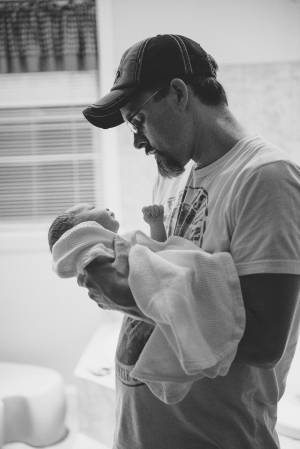
Me and Leo. Photo by Kimberly Sanderson of Sanderson Images.
There is life, and there is death, and the two are so entangled here, so interwoven and twisted together that sometimes you can’t see the end for the beginning. I sent Alise a message, telling her that Leo and Elliott will always be connected in my mind. She wrote me a kind, honest message in return.
I thought also of another friend, whose rejection post I am going to share later this week about getting married, wanting to have children, but not yet being able to conceive. Her words are beautiful and deep and wise. She was among the first to congratulate me on the arrival of Leo, and she is always among the first to “like” photos we share of him.
This is life. What can we do but laugh with one another? What can we do but weep each other’s tears? Sometimes both at once?
The day after Leo was born, Elliott’s mother Alise wrote this beautiful letter to Leo, and she quoted Frederick Buechner:
“Here is the world. Beautiful and terrible things will happen. Don’t be afraid.”
* * * * *
I woke up this morning with this boy on my chest. This little lion. His arms reach down each side of me, as if he is trying to hug the world. His breath is so gentle it is barely visible, the way a falling leaf stirs the air around it. I try to count the hairs on his head. I note the tiny formations that make up his lips, his earlobes, and they are a swirl of cells that will grow and change for as long as he is alive.
This is the third installment of a story I’ve been throwing up here on the blog, just for the fun of it. If this is the first time you’ve seen it, I recommend starting in the beginning, which you can find HERE. I know I had said this would be the final chapter, but the story doesn’t seem like it wants to end right now, so I guess we’ll see.
I thought about that drawing for weeks, the image burned in my mind. Her finger up to her lips.
Shhh.
One night, after my wife had fallen asleep, I crept up into my daughter’s room. She was asleep, but her breathing was labored. Her allergies were coming on hard – swelling eyes and raspy breathing – and none of the usual medicines were doing any good. I pulled the blanket up and covered her arms, kissed one of her rosy cheeks, then turned to the picture. I hadn’t looked at it since the day we had moved in.
I picked it up and carried it over to the window so that I could see it more clearly in the moonlight. There she was: the large eyes, the cute little bonnet, the parasol over her shoulder. And that hand behind her back.
Shhh.
She didn’t say anything, though, not this time. She just looked at me, as if she was waiting for me to ask the right question. I took the picture back downstairs, down through the second level, down to the first level, through the kitchen, and then down to the cellar. That first step was a long one, and I reached my foot down to meet it.
I left her facing against the rough stone walls of the basement. I closed the basement door. I locked it. I slept much better that night.
* * * * *
A few days later I set out to clean the gutters that lined the front of our house. All around me the city of Virgil was alive with morning commuters and beeping traffic. The air was heavy and humid, and thunderclouds gathered in above the brick buildings, filling in all the negative space. It would be another warm day, and then it would pour, and then it would be another cool night.
The gutters had been neglected for so long that small plants had begun to grow in the dirt and leaves. I propped my ladder up against the metal surface, then climbed up, rung by shaking rung. I got to the top and gripped the edge of the gutter tightly with one of my gloved hands and used the other to scoop out all that muck and then drop it on to the sidewalk below.
Through the window to my daughter’s room, I could hear her coughing, and it concerned me. I made a mental note that we would have to take her to the doctor that afternoon. She didn’t sound right. It didn’t sound like “just allergies.”
I slipped and the ladder shifted to the side. My heart rate spiked and I grabbed on to the gutter with both hands. Thunder rolled in the distance. Small spits of rain started falling, and I could hear each heavy drop, spaced out, like the ticking of a clock. The morning traffic had died away, and the coming storm had emptied the streets.
“Whatcha doin’ up there, mister?” a voice asked, the voice of a little boy. I steadied myself and looked over my shoulder.
“Cleaning the gutters.” I turned back to the job at hand.
“I’m just taking a walk.”
“You know it’s going to storm, right?” I said to him over my should, without looking down.
“Do I know you, mister?” the boy asked.
I turned again and stared at his face. He did look kind of familiar. He had jet black hair that fell down over his dark eyes. He was pretty scrawny, the corners of his shoulders poking against his t-shirt. He was like a bunch of sticks held together by cloth.
“I don’t know. Do you live close by? Maybe I’ve seen you around.”
He laughed. Then his eyes grew big and his voice got all excited.
“You’ve had the picture!” he said, the same way a little boy might talk to a famous athlete once he recognized him.
“The picture?” I asked, but I knew what he was talking about. Right away. I knew.
“Man, you shoulda kept that thing,” he said. Then he shrugged and started walking away.
“Hold on!” I said. “Just a second.”
I started scurrying down the ladder but my foot got caught up in one of the rungs, and I fell backward in that slow motion movement that happens when something is going terribly wrong and you know it but it’s too late to stop it. My back hit the sidewalk, and I almost passed out. The impact knocked the breath out of me, and my vision got fuzzy. Red and black explosions. I thought if I stood up it would keep me from passing out, but I didn’t get any further than rolling over on to my stomach.
“You okay, mister?”
I nodded, gasping for air that didn’t come. The boy stood there quietly, oddly unaffected by my fall. Most kids his age would have been scared, or would have run for help, but he just stood there. Then he bent down and patted my shoulder.
“You’ll be okay,” he said. “You should have been more careful.” He wasn’t talking about the ladder.
“What do you know about the picture?” I asked, still gulping in air.
“It’s a shame you got rid of it,” he said. Where did he get this idea that I didn’t have it? And how did he know I had it in the first place?
“Have you been spying on us while we were moving in?” I asked.
“Nah,” he said, standing up and shrugging. Just then we both heard my daughter coughing from the upper floor window. It was raspy and deep.
“Like that,” he said, shrugging again. “She coulda really helped you with stuff like that.”
“Stuff like what? Who could have helped me?”
He sighed, then turned and walked away.
“What do you know about the girl in the picture?” I asked.
“It doesn’t matter,” he said, stopping and turning towards me. “The picture’s gone now.”
“You wait right here,” I said. “I’ll go get the picture. Then you have to tell me about the girl.”
I ran inside, back through the house, then down into the cellar. My back was tightening up from the fall, and that made me limp. But when I got to the bottom of the steps, the picture was gone. Nothing but a blank stone wall where I had left it. I ran back up the stairs.
“Georgie!” I shouted. “Where are you?”
“Up here,” my wife said from the middle level, and I ran up the stairs.
“Where’s that picture?” I asked, dashing into the room, limping, breathing heavy. She looked at me as if I might be losing my mind. I wondered if I was.
“What picture?”
“You know what picture. The girl. The one I don’t like.”
“Oh, that one,” she said, smiling. “I’m sorry I’ve been trying to force that picture on you. I was thinking more about it, and, you know, if you don’t like it, we don’t have to hang it up.”
She moved towards me and put her hand on my waist, drew me close.
“This is your house, too,” she said.
“So where is it?” I asked.
“The picture? There was some kid in the alley,” she said, turning away from me. “I set it out back by the trash, and he asked if he could have it, so I said sure, take it.”
“It’s gone?” I asked, and I’m surprised I could even get those words out. I had never been so devastated in all my life.
“What wrong, Jim?” she asked.
“Did he have black hair?”
“Who?”
“The kid you gave the picture to.”
She paused.
“Are you okay?”
“Did he have black hair?” I asked again. She squinted and looked at me through questioning eyes. I could see she was beginning to wonder if I had gone over the edge.
“Did he?” I asked for the third time.
“Yeah, I guess he did.”
I turned and ran down the steps, out the front door. The rain came down heavy and lightning split the sky. Drops fell from each rung of my ladder and trickled down the sides of it, like small waterfalls. I looked both ways, deep into the city of Virgil. Nothing.
I ran out into the rain and looked across the street, down one of the long, side alleys that some cars used as a through street. There he was, the boy with the black hair, walking slowly away from me. I dashed from the sidewalk and into the road. I never heard the car. I never even felt the impact when it hit me.
Today marks the release of Atlas Girl by Emily T. Wierenga. Here’s a short section of what promises to be an excellent book:
* * * * *
Chapter 2
Leaving Home: CANADA, Edmonton, Alberta
September, 1998
“The journey of a thousand miles begins with a single step.” ~ Lao Tzu
Mum had said to sit close to the bus driver, so I sat as far away as possible.
And now an Ojibway man in a red bandana and stubble cheek was snoring on my shoulder.
He smelled like communion wine, the kind my father served in glass cups which we slid empty into the pew’s tiny cup holders.
He smelled like beer, like the late August summers when I was entering puberty, cleaning up the Corn Fest fairgrounds in my Sunday dress with my family. The beer cans all clanging like empty songs against each other in their black garbage bags, and it was what good Christians did. Cleaned up after sinners’ parties and marched in pro-life rallies and it was always us, versus them. And all I ever wanted was to be them.
But always, we were taught to be kind to them, and so I let this man sleep on my shoulder in the Greyhound bus headed west while I tucked up my legs and tried to shrink inside my 18-year-old frame.
Tried to close my eyes against the cold of the window but it had been two days since I’d hugged my younger brother, Keith, and my sisters, Allison and Meredith; since Mum—whose name is Yvonne, which means beautiful girl— had held me to her soft clean cotton shirt and her arms had said all of the words she’d never been able to voice. The Reverend Ernest Dow, or Dad, had loaded my cardboard boxes full of Value Village clothes onto the bus and kissed me on the cheek and smiled in a way that apologized. I was the eldest, and I was the first to leave. But then again, I’d left long before getting on that bus.
Emily T. Wierenga is an award-winning journalist, blogger, commissioned artist and columnist, as well as the author of five books including an upcoming memoir,Atlas Girl: Finding Home in the Last Place I Thought to Look (Baker Books). She lives in Alberta, Canada with her husband and two sons. For more info, please visit www.emilywierenga.com.
I don’t remember much about my family’s move to Laredo, Texas in 1981 – I was only four years old. I’m sure it wasn’t easy for my parents, leaving their family and friends, leaving these lush green fields and old back roads and creeks they used to play in barefoot, when they were children. Lancaster has a way of drawing you in from an early age, and it sinks its talons in real deep. I’m sure it wasn’t easy to leave.
While I don’t remember the move itself, I do remember Laredo. I remember the first trailer we lived in, a single-wide planted in a treeless dust bowl of a trailer park. I remember the little, blue, plastic pool my sister and I sat in, filled with water from the cracked hose. I remember how we used to get impetigo, a skin infection that thrives in the heat and humidity and dust. The dilapidated trailer didn’t help with this, and it was so hot, so we moved.
I remember the second trailer, a tan one in another trailer park.
I remember hearing that there was a swimming pool in our new trailer park. My mother packed us up for a walk through the mid-day heat. Now that I have children of my own, I know what a production that can be: changing into swimsuits, slicking everyone up with sunscreen, grabbing a few pool-friendly toys and maybe a lawn chair. She probably carried all of this plus my two-year-old sister. I probably walked, dragging my towel through the dusty dirt roads, eyes peeled for red ants wielding cross bows with fiery arrows.
The next image is my life’s metaphor for disappointment: an empty swimming pool, slimy green and full of lizards, surrounded by a rusty chain-link fence and tumbleweed. We walked back the way we came. I’m sure my mom was pretty down about it. She probably went inside and cried while I drove my hot wheels trike around the cement slab beside our trailer, the rumbling plastic wheels sounding like far-off thunder.
* * * * *
I remember when dad and I made up our own set of signals. The Nerf football was as big as my torso, but somehow I hiked it through my legs to him and ran the passing route into the kitchen. “1″ was a long straight pass, sometimes caught all the way back in the hall. “2″ was short, and dad threw a laser, digging the pointy end of the football into my bony rib cage – I never liked “2″ very much. “3″ was hook right. “4″ was hook left. “5″ was fake short and go long.
Dad called the plays inside that trailer for hours, and I ran the routes.
* * * * *
He used to take me for rides on his motorcycle out the dusty trailer park lane, to the highway and back. I remember one time we saw a road runner: a real live cartoon in my three-dimensional world. I never even knew such a thing existed.
I see pictures of my dad now, when he was 24, with a mustache that looks like something he glued on to cover up his baby face. He looks like a kid in those picture. He was a kid, thirteen years younger than I am now, starting a church in a place where he couldn’t even speak the language, his wife and two young children along for the ride.
* * * * *
There are a few things I learned from my dad over the years. I learned that if God puts it in your heart that it’s time to move on, it’s a mistake to stay one more day, no matter what you’re doing or how you might try to rationalize it. I learned that taking a job just for the money is something people do when they don’t know the real value of things. I learned that living, really living, usually happened when you had no idea what the next day held, or where your pay would come from, or where you might be going.
In other words, living, really living, only happened on the other side of trust.
I’m proud of my dad, because when he resigned on Sunday from his position as pastor of a church he loves, of a church he founded 11 years ago, he didn’t leave because of a scandal. He didn’t leave because he was asked to leave. He didn’t leave because he found a bigger church or a better paying church.
No, he left because it was time. He left because that still small voice told him it was time. With nothing on the horizon, no employment or promised position, he walked away, simply out of a desire to trust that God’s leading is enough.
Oh, that we would all be so sensitive to that Voice!
* * * * *
Living my father’s kind of life has literally taken me around the world, both when I was a kid at the mercy of his decisions, and now as an adult, as my wife and I have taken on much the same approach. It’s a good life, this life of trust, this life of willingness to follow. It’s a hard life, not knowing, not always having, not always living the same as everyone around us.
But most of all, I guess, it’s an alive life. An abundant life. An invigorating life.
Thanks, Dad.
* * * * *
I’ve been sharing some fiction recently here at the blog. Part 1, entitled “Shhh”, can be found HERE. Part 2, “The Man Behind the Drawing,” is HERE. And Part 3 will be posted this Friday. Enjoy!
Today I’ve written a short piece of fiction. If you can hang in there until the end, you’ll see that it goes along with last week’s piece (which if you missed, you might want to read first by clicking HERE).
Virgil was one of those small cities that felt both bright and dark. Light and heavy. On a Friday afternoon you might see a pleasant family of four walking along the cracked sidwalks, licking ice cream and smiling. Later that night you might see a shadowy figure slip into a side alley leaving a trail of blood like a scuff of red chalk on a blackboard. You just never knew.
Manny Maude would go looking for the darker side of Virgil, later that summer. Not many did that. Most who went into Virgil were content to catch only the light that reflected off the thin veneer, the lightness. But Manny would have his reasons for going. He had lost something that meant a great deal to him, and when you lose something, where do you look? In the dark spaces in between.
But that comes later.
If you traveled east on Route 29 out of Virgil, you’d have this feeling that the city was floating away, being replaced by mostly cornfields and ramshackle farms owned by farmers waiting to be bought out by the next big warehouse owner. There wasn’t any money in farming, at least not around Virgil, and all the sons of the farmers had left a long time ago. Some became truckers and others got blue collar jobs in the city and a few even went to college, although that much learning was cause for concern.
The only people left were the farmers slowly retreating before the thickets and weeds and wild raspberries. They plowed less land every year, and their wives died of heartache, and so the farmers were left rocking on their porches, looking out over their crumbling domains, reminiscing, or humming the old hymns to themselves, the slow ones about There is a River We Shall Cross Over and Oh, the Blood of Jesus.
If you kept driving east through that farmland for about forty miles, until even the farms started thinning out, replaced by small groves of trees and large, abandoned estates with rotting outbuildings, you’d drive up over two steep hills. In the hollow between the hills, that’s where 15-year-old Steve Borders crashed his father’s Mustang at three in the morning. He might have survived the wreck, except his girlfriend Ginnie Maude had screamed right before they made impact with the deer. Her scream had startled him more than the deer itself, so instead of hitting the deer head on and totalling the car (but walking away), he swerved off the road and slammed into a telephone pole that had just been put up the day before.
Ginnie Maude survived, even though she lost most of her right ear and bled like a spigot left on. She ended up working at Fran’s Diner the rest of her life, right there where 29 hits 82, what the locals call the North-South Highway. She fried up burgers or eggs and sometimes she took orders at the bar, but she never wrote anything down. Her memory was exquisite. There was a trucker named Eric Shaw who came through on a regular basis, and she slept with him from time to time, because she was lonely and because she never quite got over the loss of Steve. The locals didn’t approve of this arrangement, and neither did her grandfather, but sometimes folks get to a place in life where it doesn’t matter what people think.
Ginny’s grandfather, Manny Maude, was a farmer in those parts, and just about the time Ginnie got pregnant her grandfather signed over his farm to the great Trek and Banks Corp. They manufactured the plastic interiors of cars and were looking to expand. The owner of Trek and Banks had grown up in the city of Virgil – there was something of the shadow about him – and he had his eyes on Manny’s farm, right there at the corner of 29 and 82, an ideal place for shipping goods all over the country.
Manny had held out for at least ten years, but the money became too good to walk away from, his wife had died a long time ago, and he had no reason to keep the farm which, let’s be honest, was looking more like a forsaken wilderness than any kind of productive land. Manny’s son, Ginny’s father, had moved away a long time ago, and he showed no interest in the family farm. In fact, Manny hadn’t heard from him in years.
Manny Maude, having sold his farm, was a millionaire, and he had never been so depressed in his life.
After Manny sold the farm, his days settled into a routine, but to call it a routine wouldn’t be doing it justice. It was a rock solid schedule, interrupted by nothing, changed for nothing.
He woke up at 5:43am, even though he had set his alarm for 5:45. He put on the coffee, then went and took a quick shower, got dressed, brushed his teeth, and, with the aid of his cane, hobbled back out to the kitchen and poured himself a cup of coffee which he drank while he fried up two eggs, over easy, and two strips of fatty bacon. He poured himself a second cup of coffee which he drank while eating his bacon and eggs, sitting by the window, staring at the beams and concrete slabs which had been put in place for the new Trek and Banks warehouse. When completed, the warehouse would sit less than fifty yards from his house and completely block his view of the distant hills.
He put his dishes in the sink, then went out on his front porch where he sat in his rocking chair and watched the sun come up. The workers arrived. The tractors and the bulldozers and the cranes roared to life. He daydreamed every morning about how it would feel if the foreman would come over, carrying a thick stack of paperwork, and ask him to please sign these, they were aborting the project and the land was his again. But that never happened.
That’s not entirely true. It did happen once, in a dream, and a little girl, only a toddler, came walking out of the largest warehouse. She had a tiny little parasol over her shoulder and walked with one hand behind her back. He couldn’t tell if she was being prim and proper or if she was hiding something. She walked slowly through the haze of his dream, slowly over the crumbled ground and the sad fields. She walked slowly, and just when she got to him, he realized she had the paperwork behind her back, paperwork that would make the property his again, which was silly for more reasons than one, but mostly because of how small she was.
Then he woke up.
After he sat in the rocking chair and watched the sun come up, he walked out to one of the small outbuildings where he had started his new hobby: drawing. He had purchased a drafting desk, one that had a slanted top, and had placed it right up against a small window in the upper floor of the shed that faced the construction site. But when he was drawing, he never even looked up.
On that particular morning he was staring down the barrel of his 84th birthday, he pondered the drawing in front of him, one he had been working on for weeks. It was a picture of that little girl, and he couldn’t quite get the eyes right. Over her left shoulder she held a parasol, and he was just finishing her other arm, right where her hand vanished behind her back.
That drawing had seemed to take on a life of its own. The longer he worked on it, the more real she seemed, as if she had a story, as if her history was hidden somewhere there in that farmland forty miles outside of Virgil. As if she might actually be able to give him back his farm.
On that morning he looked at the picture, and he wondered to himself,
Now what in the world is she holding behind her back?
* * * * *
Thanks for reading. If you enjoyed it, please click “Like” or share with your Facebook friends. You can read the next installment HERE.