When the Millstone is Tied Around Our Own Necks

Old Millstones from Flickr via Wylio
© 2013 Andrew Bowden, Flickr | CC-BY-SA | via Wylio

I’m in bed with my 6-year-old daughter Abra, waiting for her to fall asleep. She rolls over and pats me on the shoulder as if to say, “Everything will be okay.” Then she faces away from me and tucks her hand under her pillow.

Outside of her room, the sun has set on a cool summer evening in a beautiful little city in the United States. Trees line the streets here, their night time shadows drifting along the sidewalk. When I sit on my porch during the day I watch cars stream by. Doctors and nurses walk past my house on their way to the hospital down the street. Teens hang out on the steps of the tattoo parlor. An old, African-American man waves to me, smiling, nodding his crown of silver hair. I wave back.

Not too many days ago, fifteen hundred miles south of my city, small children rode into another small town on a large bus. They were greeted by a mob, many of whom were Christians, demanding they be returned to where they came from. We have no room here. There is no space for them.

Our certainty and our anger give us the strength to pick up even a millstone, and we attach it to that bus and throw it into the bottomless sea, and the rope begins to grow taut, but it is nothing to us because this is our land.

We forget that the other end of the rope is around our own necks.

Don’t be cruel to any of these little ones! I promise you that their angels are always with my Father in heaven.

Halfway around the world the missiles and the rockets are fired and children are killed. 1,760 Palestinian children have been killed since the year 2000, along with 132 Israeli children. We argue on Facebook and post videos and the massacre continues. Hospitals are hit. More rockets fired.

What are we doing for the least of these?

In America, we have less and less time for the least of these. We barely have time for our own families. So we race from work to home to sports to our television sets and the least of these are crying out all around the world, all around us while we collapse into bed, too tired to feel the rope tightening. The millstone is growing heavy.

“What are we doing for people here, in our community?” Maile asked me last night, and I didn’t know what to say.

What are we doing for the least of these?

We feel bad. Of course. But we turn them away.

And he will answer, ‘I tell you the truth, when you refused to help the least of these my brothers and sisters, you were refusing to help me.’

So we march and we shake our fists and we talk about things like immigration policy and national pride and “why-can’t-the-person-on-the-other-end-of-the-phone-line-talk-English-for-God’s-sake” and we celebrate in the exhaust and dust of a retreating bus, children’s faces pressed up against the window.

We call ourselves Christians, but we don’t even recognize the true identity of the one we’re protesting, the one we’re refusing to help.

* * * * *

I walk downstairs and check on my 5-year-old son. He is already asleep. He smuggled some Legos into bed with him, and they fall out of the covers when I move to tuck him in. His face is peaceful.

This is America the beautiful.

My Middle-of-the-Night Ambulance Ride (or, This is Life)

photo-26I woke up at 1am and I couldn’t stop shaking. Every muscle in my arms and legs, my back and neck, convulsed and shook. I was freezing cold. I pulled the comforter tighter around me and tried to warm up, but the shaking seemed to move deeper inside of me, and soon my breathing was coming fast and shallow.

I stood up out of bed and nearly collapsed. I mumbled something to Maile, something incoherent. What I meant to say was,

“I’m freezing cold. I’m going to go get in the shower.”

But I’m not sure what I actually said. I stumbled out of the room and down the hall. The shakes made the stairs difficult. I depended on the bannister. I turned on the hot water in the downstairs shower and stood in the steam, then undressed and got in. I still couldn’t stop shaking. My breath dried out my mouth, and soon I was gasping for each gulp of air.

I can’t keep this up, I thought. In five minutes I might not be conscious.

I pulled the shower curtain back and shouted.

“Maile!”

I sat down in the shower because my legs were giving out. In all the shaking I banged my head against the tile wile. I wondered if she would be able to hear me above the fans and the air conditioner.

“Maile!” I shouted again. Panic.

This isn’t it, right? I mean, I’m sick, but this couldn’t kill me. Right?

I felt myself nearly pass out. I gathered myself and shouted for Maile as loud as I could. I heard her footsteps come out of the bed, down the hall, down the steps. The bathroom door opened.

“Mai,” I said, between the gasps and the shaking that made my voice waver. “You have to call 911.”

* * * * *

That’s how I found myself in an ambulance on the way to Lancaster General Hospital. When I arrived they stuck me with two IVs, one with icy cold fluid I could feel oozing up my arm. My temperature was over 103. My heart rate clipped along at 140. My blood pressure didn’t even have two numbers. It was 41. They packed ice around my body to bring down my temperature.

Cat scan. Chest x-ray. Antibiotics. By 6am they wheeled me up to a room on the 8th floor of the hospital. I slept on and off, my IV machine beeping, nurses coming in every thirty minutes to check my temperature, my blood pressure, my heart rate.

By the time the morning came, I felt weak but calm. Outside my window I watched the life flight helicopter come and go a few times a day, landing on a section of the hospital roof a few floors behind me. In and out. Life and death.

* * * * *

My room was divided by a curtain, and on the other side was a man in his 80s. He had fallen at his house, and they weren’t sure why, so he was under observation.

“The doctor says I can go home this afternoon,” his wavering voice said quietly to one of the nurses.

“I’m sorry, Mr. Garvey, but you’re not going home today. Remember? We’ve already talked about this. You’re being transferred to physical therapy for ten days.”

Silence. The nurse leaves. Then, a few minutes later, the old man’s voice ventures out in the now-empty room. I can’t see him. I can only hear him behind the curtain. I’m pretty sure he’s not talking to me.

“The doctor says I can go home this afternoon.”

* * * * *

The doctor spoke in matter-of-fact terms. No big deal. It is what it is.

“You have a six-inch section of your small intestine that’s severely inflamed,” he explained. “And in the center of that section it’s almost completely closed. You need some rest and we’re going to try to bring the swelling down. Liquids only, for now, and we’re going to keep you in here until you can eat some solids.”

* * * * *

Three days later, I walked out of the hospital. We live two blocks away. The sun was warm but the day felt cool for July, and as I walked out of that place, no longer tethered to my IV cart, I was very aware of each free step, each breath. I stopped at a bench along James Street and just sat there for a moment. The world felt like it had slowed down.

Leaves scuttled across the sidewalk. Cars spun by. I wanted to stop each person in the street and remind them that they are here, in the world. They are walking around. The sun is shining, for goodness’ sake.

Man alive.

I got home and no one was there so I sat on the front porch and watched the traffic go by. I was reminded again, in a way I hadn’t been since my trip to Istanbul 18 months ago, that all of this busy-ness we create is a mirage that cloaks reality. We spin our webs and the storms blow them down and we spin again, ceaselessly rubbing our hands together, never stopping to look. Never stopping to live.

So I sat there and I waited for my family and the day passed and that night I held ten-day-old Leo on my chest, his eyes heavy, each blink taking longer than the one before. His breathing came in short, jerky spurts, then slowed into an even rhythm as his dreams melted into night.

This is life.

Christianity, Trampled Underfoot

Silhouette Skyline London from Flickr via Wylio
© 2013 Simon & His Camera, Flickr | CC-BY-ND | via Wylio

I’m taking a week away from the blog. In the mean time, here’s a popular post that I wrote and posted two years ago, recycled for your reading enjoyment. Tune in next week to hear all about my colon issues. Yay!

I think the Internet makes it more difficult than ever to be myself. Messages bombard me, persuading and cajoling and berating.

“Listen to this!”

“Agree with me!”

“Think the way that I think!”

Even worse, if you’re a people-pleaser like me, you find your true identity evaporating in an attempt to keep everyone happy, to prove to everyone that you somehow agree with them. In an era where your beliefs make you smart and important in the eyes of those with whom you agree, it is tempting to walk that subtle line of conformity. It is far too easy to be devastated by the unkind contradiction of a stranger.

We are a culture where the individual is quickly defined by what she believes. “He’s a democrat.” “She’s a libertarian.” “He believes in legalizing same-sex marriages.” “She’s pro-life.” “He’s an Eagles’ fan.” “She doesn’t like Nutella.” And after hearing even one of these pieces of information about someone, it’s so easy to fill in the rest of the gaps, to turn them into a caricature, to reduce them to a flat character about whom we know everything we could possibly need to know.

Beliefs: the litmus test of our culture.

And, as has been the case in far too many instances, Christianity conforms to culture. Christians of every ilk set up idols of particular beliefs, polarizing themselves into camps of Correct and Incorrect. This, it seems, is where we find ourselves in the waning days of 2012: grasping desperately for beliefs, as if holding dearly to the right ones is the last thing keeping our civilization from complete and utter annihilation.

Beliefs have become our salt and light. Taking the “correct” position on every issue imaginable has become our way of declaring the Good News. It’s no wonder church attendance is dwindling and the broader culture is becoming increasingly disenchanted with Christianity – when the message of Good News has been watered down to consenting to various positions or beliefs, the Good News transforms into the Right News. Which is actually rather annoying, and not much fun to listen to or to help spread.

Most of us Christians today, mistaking “right belief” for saltiness, have lost the very trait of saltiness about which Jesus spoke: love. Helping the poor (and not JUST voting for the candidate whose policies we think will benefit them). Jesus’ saltiness means having a love for our neighbor that transcends whatever belief system we espouse.

When Jesus encouraged his followers to be salt and light, these words weren’t couched alongside some sort of list of correct beliefs. No, his exhortation to be salt and light comes during his Sermon on the Mount – it’s mixed in with wisdom on the importance of the posture of one’s heart; he names as “blessed” people who are merciful and meek and peacemakers (adjectives describing action, a way of life), not those possessing or understanding of correct doctrine.

Jesus more closely associates salt and light with good deeds than good beliefs. Soon after the salt and light metaphor, he challenges the cultural paradigm of loving your neighbor and hating your enemy and says, “But I tell you, love your enemies and pray for those who persecute you.” He never said, “Make sure someone knows what you believe before you help them.” He never said, “Love them only after they fully understand that you believe what they are doing is wrong.”

This is salt and light: not right beliefs, but love.

I’m afraid for Christianity today. I’m afraid that we’ve gone so far down the path paved by “correct” beliefs that we have lost the only trait that could make us truly salty: radical love, not only for the poor and downtrodden, but also (perhaps more incredibly) for one another.

But if the salt loses its saltiness, how can it be made salty again? It is no longer good for anything, except to be thrown out and trampled underfoot.

Are we Christians good for anything anymore? Can we still be salt and light through our deeds, our acts of love? Or, leaning increasingly on our beliefs to serve as that which makes us different, are we suitable only to be trampled underfoot?

When the Coach is Wrong (An #OvercomeRejection Post)

Train from Flickr via Wylio
© 2011 bigglesmith, Flickr | CC-BY | via Wylio

Today’s post by Angela Oberg is one most of us parents can relate with – the sense of rejection that’s felt when your child is rejected. Or maybe it’s the same sense of rejection an author feels when their book is rejected. Or a worker’s effort.

The game was about to start.  I looked out over the field and did not see her.  I looked over at the sideline, and there she sat, on the bench.  Again. It wasn’t that she did not get playing-time or was not good at the game, she was.  Even so, this soccer season more often than not, my daughter seemed to start the game sitting on the sidelines.

As an adult I have learned how to deal with rejection, or so I thought.  However as I saw the potential for rejection start to unfold for my child, I was not about to sit on the sidelines.  It took everything in me to stay in my seat and not stomp over to the coach and demand he put my daughter in the game. Just as I was about to pull myself up out of my fold-up chair, I saw my daughter come out on the field.

As I later shared this experience with a friend, she listened thoughtfully and then was kind enough to confront me with some truth. She suggested, “Maybe this is not as much your daughter’s struggle as it is your own.”  She was right; I had allowed my fear of rejection to affect how I parented. I wanted to protect my children from any experience that hinted of rejection.  And in middle school and high school there are plenty of opportunities for this; team tryouts, clothing choices, relationships with friends, just to name a few.

I remember one instance specifically; it was a conversation I had with my older daughter.  She shared with me some difficulties she was having with a friend at school.  I asked some questions and in my questioning without realizing it, planted seeds of doubt and insecurity which only moments before were not there.  Rather than help my daughter navigate her friendship struggle there and then, I allowed my past experience to color her experience in a way it should not have.

As I continued the conversation with my friend, I knew that to help my children navigate fear and rejection; I needed first to be free from my own.  Only then could I help them objectively, my past no longer affecting their present.  My friend graciously suggested we pray, and as we prayed, I could feel those old feelings of fear and rejection slowly slip away.

Later that day, standing by the sink doing dishes, I thought about how I want to live the opposite of rejection, and how I want to parent there too.  I went in search of the word opposite rejection, and when I found it I could not help but smile. The word was acceptance.

At our church once a year, every individual (who wants to) can go front to the stage and pick an envelope containing a card with a word on it.  These words at first for many may not always make sense or carry much meaning, yet sometime during the year, the word usually finds its way into our hearts.

Can you maybe guess what my word was, this particular year?

Acceptance.

You can check out Angela’s blog HERE.

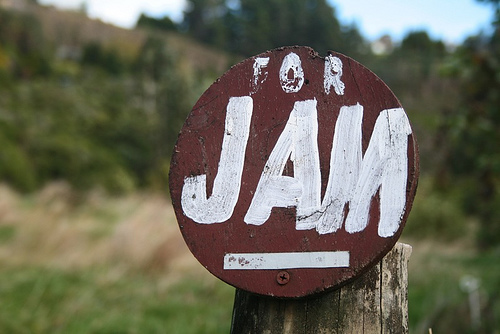
Reluctant Jam (Or, Accepting Failure)

jam

Today’s post comes to you from Alice Chaffins, a wonderful person, writer, and friend. I am happy she can fill in here during my week away from the blog. Enjoy.

The tools and ingredients were laid out on my counter. Gram’s potato masher, our biggest stock pot, sugar, pectin, and loads of fresh blueberries. We had picked 22 pounds of blueberries the night before and I couldn’t make and eat enough cobblers or pies or cakes to use all of those berries. And while I don’t consider myself a particularly good cook, jam isn’t terribly complicated to make, and I’ve made it before with some success, so I thought that would be the best way to use a portion of our harvest.

I carefully mashed, measured, boiled, and added the ingredients together. I watched the mashed berries morph from an unappetizing brownish goo into a beautiful dark indigo sauce. It smelled amazing, but as I added the pectin and sugar, it didn’t seem to thicken. I ladled it into the jars that I had prepared and hoped that it would begin to congeal as it cooled, but a few hours later, it still looked far too runny to be considered jam.

As the afternoon went by and I could see that what I made wasn’t setting, I went online to see if there was a way to save reluctant jam. One site to let it stand for 24-48 hours to make sure that the pectin had plenty of time to activate. Before the directions on how to remake the jam, the author also said that it was okay to adjust your expectations. Maybe call it preserves or syrup instead and let the ingredients be what they would rather than trying to make them something else.

So I gave it time. I waited for the jam to thicken on its own. After 48 hours, I dumped the contents of the jars back into my pot and tried again. Once again, I followed the directions at the site, adding more pectin and letting it boil well past when I thought it might start to scorch the berries. I ladled it back into new jars, but once again, I had a feeling that this jam was not meant to be. Hours later it was clear – this was a failed experiment.

I’m not sure what went wrong. Maybe I miscounted the cups of sugar that I added. Maybe it was a bad batch of pectin. Maybe I tried to make too much jam at once. Whatever the issue, this particular combination of berries, sugar, and pectin was not cooperating and doing what I was asking. Instead of jam, I have 7 jars of really delicious fruit topping for ice cream.

Failure doesn’t feel great. Often we can look at the process that led us to the place where things just didn’t turn out right and see our missteps. But sometimes things simply don’t go according to plan. Even when we have all of the right tools and ingredients. Even when we follow the steps exactly according to the directions. Even when we go back and try again and again and again.

Sometimes there are failures. The book doesn’t sell. The illness doesn’t abate. The prodigal child doesn’t return home. For all of our efforts, we don’t get the desired results. It can be disheartening. Sometimes it damn near crushes us.

When I failed at my first marriage, I just wanted to crawl into a corner and stop. I thought I had done everything right, but in the end, I was an adulterer. I was a liar. I was a bad wife, a bad mother, a bad person. I was tempted to define myself solely in terms of that failure.

Accepting that failure was one of the hardest things I’ve done, but it was necessary for me to become the woman that I am today. It was necessary for me to evolve into the woman I will be tomorrow.

I don’t know what to tell you about your failures. Maybe you need to keep going. Keep working, keep hoping, keep persevering.

But maybe you need to accept the failure. See what lessons you can learn, what tidbits you can save, and let the rest go. Adjust our expectations for what is acceptable and move forward.

Acceptance can be difficult, but it can allow us to try something new. It can teach us about ourselves. It can allow us to see the goodness that still was a part of the journey.

To check out more of Alice’s work, please click HERE.

My Family, Peeing on the Narrow Curb of the Baltimore-Washington Parkway

Maryland State Route 295 from Flickr via Wylio
© 2009 Doug Kerr, Flickr | CC-BY-SA | via Wylio

Here’s a post from three years ago that made me chuckle. This week I’m taking a little break from the blog, so I’ll be reposting some old stuff as well as sharing a few posts from others. Enjoy, and tune in next week to hear all about my exciting ambulance ride and three-day hospital stay.

I’m sitting in our bed. Maile is asleep. I just heard thunder outside (either that, or the neighbors up the hill are shooting fireworks again). Two lights are on in the house – the one beside the bed and the one in the hall. That hall light is for the kids, because how would they find their way to our bed in the middle of the night if it was completely dark? They rarely make the trek, but they also like to know that, if they need to, they can.

Our living room is a wreck – looks like our minivan over-ate and then threw up in there. Suitcases and tote bags and plastic bags filled with dirty clothes are lined up. There’s a bag full of peed-in clothes – I’ll get to that in a minute. We got home late, so tomorrow is clean up day.

The first half of the drive went fast. By 1pm we had arrived at Andi’s house in Bremo Bluff, Virginia where she served us a beautiful lunch and we got to meet and hang out with Laurie and Jack Jensen. Later on, when home came within reach, we asked the kids what their favorite part of our two-week trek had been: without hesitation their voices chimed, “Andi’s house!” The tractors, the dog, the cats, the frogs, the blackberry picking…all of it made for a great halfway point.

The second half of the drive, the five-hour stretch from central Virginia to central Pennsylvania, stunk like feet. Somewhere on the Baltimore-Washington Parkway, 3-year-old Abra started saying in her most hysterical voice, “I have to make a pee! I have to make a pee!” At that moment I knew we were in trouble – she is notorious for waiting until the last second to make her intentions known. Maile pulled on to the very narrow shoulder, then up over the curb and into the grass.

I jumped out, but as I opened my door I heard her frantic cry change.

“I have to pee! I have to pee! I have to…I peed! I peed! I peed!”

Oh, my.

So I got her out and stripped her down and cleaned her with the miracle fleece (baby wipes). I sat her naked on my seat and began looking for the bag with her clothes.

“I have to pee!” Cade shouted.

“Me, too!” Lucy yelled.

So I helped the entire family pee, right there on the narrow curb of the Baltimore-Washington Expressway. Cade and Lucy climbed back in. I couldn’t find Abra’s bag so I dressed her in some of Cade’s underwear and one of his pajama shirts. Then I tried to remove Abra’s baby seat from the back of the van.

“Aw, Dad, you dripped pee on me!” Cade shouted.

Oh, my.

I handed him some wipes. Seats were rearranged. The rest of the trip seemed spoiled – everyone was tense, hungry and irritable after having to pee on the side of a highway.

But that seems so long ago now. The house is quiet. A few minutes ago I snuck over to their rooms to stare at their four sleeping faces.

Oh, my.