What I’m Waiting For

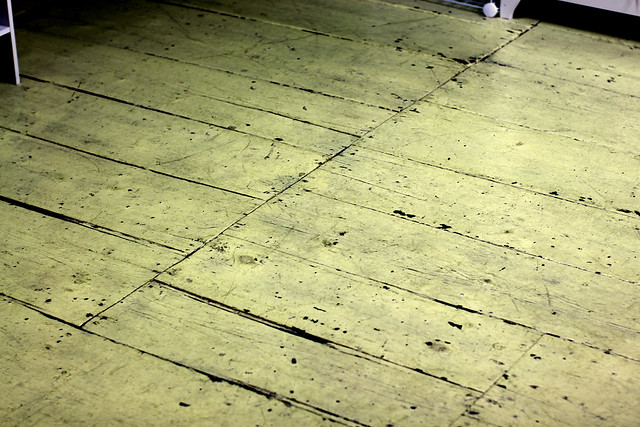
Frederick Eleganza Yarns Floor from Flickr via Wylio
© 2009 Mr.TinDC, Flickr | CC-BY-ND | via Wylio

After two weeks I ease back into this rhythm. I hear the kids playing in another part of the house, their distant echoes comforting. I hear the traffic going by on James Street. I hear Leo begin to cry, and I hear Maile’s footsteps pass along the creaky floorboards in the hall, and then Leo stops crying. The tree in the back yard makes a shushing sound as autumn arrives.

There is always too much to write, and there is never enough. The words are easy to come by, and they elude me.

Today someone asked me what I do for a living. The answer comes quickly now, and without even thinking I say, “I’m a writer. I co-write and ghost-write books for people.” But what does that mean, actually? I know, I know, I’m over-thinking things.

Right?

But that still doesn’t seem like enough, even though it’s what I wanted for so many years. It still feels like I’m waiting for something else, something new.

* * * * *

We are, all of us, waiting for something. I’m waiting to hear back from various people regarding a book proposal I sent out. My kids are waiting for their school day to be over. My parents are waiting to sell their house. I have friends waiting for a baby to arrive, waiting for a relationship to work out, waiting to hear back regarding a job. In winter, the tree waits for spring.

In my experience, waiting can be harmless. It can be something that lies in the background of life, something I know is there but pay little attention to.

But it can also easily paralyze me. Life can become about the waiting, and if I’m not careful everything besides what I’m waiting for falls to the side. While waiting to hear back regarding this book proposal, my life can easily devolve into a series of meaningless activities, all of which feed the waiting: checking email, checking Facebook, re-reading the manuscript, etc etc etc. And even if I escape these activities that surround the waiting, my mind can still turn over and over on itself, wearing a rut difficult to escape from.

What are you waiting for?

* * * * *

I take a deep breath. I sit in silence for five minutes, just five minutes because that’s all it takes to jump the rut of waiting. That’s all it takes to find a new rhythm, slower breathing, a form of peace that doesn’t always make sense. Five minutes sitting on the floor with my back against the door frame, and in the silence I remember the things that are beautiful in my life: the sound of feet creaking floorboards, the sound of children’s voices, the sound of autumn arriving. These are things here and now, things I don’t have to wait for.

The Man Who Wouldn’t Shave His Beard

Arizona State Fair 2008 - Vivitar Ultra Wide & Slim XPRO from Flickr via Wylio
© 2008 Kevin Dooley, Flickr | CC-BY | via Wylio

The man walks up to the counter of our stand at the fair and I know he will be a talker. I don’t know how I know this, but after years of waiting on people, I know. It is like a sixth sense. Perhaps it is something in the eyes, something lost or weary. Perhaps it is something in the shoulders, something heavy.

“You know,” he says, rubbing his beard like a sage, “I’ve been out of work now for 18 months. I’ve seen a tough stretch. A tough stretch indeed.”

He pauses. I wait.

“You sure you don’t have any pumpkin pie?” he asks, a sidetrack, a rabbit trail.

“No, sorry about that,” I say. “We don’t have enough space to carry refrigerated pies.”

“Oh, I’d just need one,” he says. I don’t say anything, because I know he doesn’t want to talk about pies.

“I love a good pumpkin pie. So anyway,” he says. “It’s been a tough stretch. I called up to York fair and they said the carnies hired people on a temporary basis, you know, to help set up the rides and run the food stands. So I showed up and applied and worked for two days.”

“Did you enjoy it?” I ask.

He shrugs.

“It was work,” he says. “It was money. But after two days, that woman comes to me and says I can’t work for her and keep my beard on.”

He laughs.

“Can’t keep my beard on! Well, I’m not shaving, not my beard, and I told her so, so she told me to take a hike. I called down here to Frederick Fair and applied to work down here for the week.”

“So you’ll be here this week?” I ask.

He nods.

“And they’ll let you keep your beard?”

“Yep, I’m running a fryer, just making french fries and corn dogs. That sort of thing. I done it before and I suppose I’ll do it again.”

He rubs his beard.

“Said I could keep my beard, you know. I have to wear a hat though. Can’t stand wearing hats, but I suppose I can respect her, wear the hat. I could use the money.”

He walks away. I can tell that, for this man, walking away from a conversation is like peeling off a scab. But I also know I’ll see him again. It’s something in the way he walks away, the slow movement of his gaze, or the way he shifts his hat nervously.

What I Looked For Among the Winter Trees

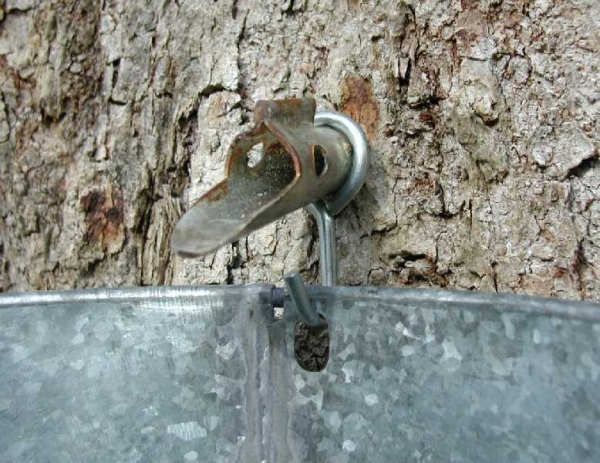
08_hang_the_bucket_P2110014
I searched the forest for the yellow strips of plastic we had tied around the maple trees. The cold wind slipped in and out of the oaks and the yellow buckeyes and the dead cedars blight had killed years before – they stood there, silver sentinels, spooky and branchless. When we cut them their insides were an orange-red, and they smelled like memories.

The spring was coming, or so everyone said, and I was trying to catch spring as it ran up the maple trees. I carried my drill to the first piece of yellow tape and pushed it in, forming a hole. I tapped the spile into the tree trunk with a rubber mallet and hung the silver pail on the hook, imagining the sound the sap would make when it ran.

Drip.

Drip.

Drip.

The sound of spring on the way. The sound of hope.

* * * * *

I sit in a hotel room in Maryland. My dad sleeps in the neighboring bed – my son is beside me. Every year we come here to Frederick, Maryland, and every year it goes more or less the same. Every year we see mostly the same people, do the same things, set up on the same day, tear down on the same day. But it’s never exactly the same – every year we are, all of us, one year older. It’s easy to forget that. It’s easy to forget that time has passed.

But time does pass, slow, methodical, like the dripping of sap into a stainless steel bucket. Time.

Friends convinced me to try to sell my novel to a publisher, so contacts were made. Emails sent. Proposals written. And now the waiting. The wandering through trees of a nearly-spring idea; the cold wind that rustles thought; the forgotten melancholy that only hope can cause.

Hope is a wonderful thing during the early phases, when everything is motion and planning. The movement, the concrete nature of expectation, gives a kind of certainty to hope, a sense that “but of course it will all happen the way I want it to.” But as time passes and hope slips out ahead of you, disappears among the trees and you have to wait for it to come back, that is when winter seems the longest.

That is when it seems like the sap will never run.

* * * * *

How can we keep hoping, those of us who have walked this road so many times? What will bring us back to the trees for the fifteenth time, the twentieith time, to check if the sap has run?

It’s the knowledge that once you’ve identified the trees, and tapped in the spiles, and hung the buckets, and walked back through the cold forest, at some point the sap will run.

The sap always runs, eventually.

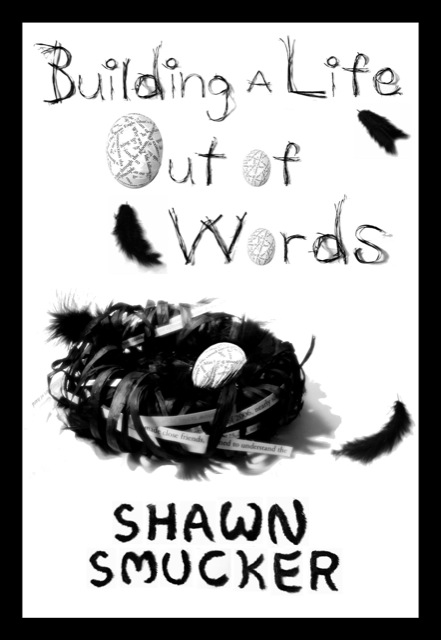
“Building a Life Out of Words” is FREE Today

shawnebook
I was looking through the ebook I published a few years back, Building a Life Out of Words, and I suddenly realized the things I wrote about happened exactly five years ago. It all started on September 4th, 2009.

So for today and tomorrow you can get the Kindle version of that book for free. It tells the story of how Maile and I lost everything we owned and moved into my parents’ basement. Oh, and we were $55,000 in debt…and I decided to try and make a living as a writer. It just keeps getting better, doesn’t it?

You can find it HERE.

(Also, if you’ve already read it, perhaps you could click HERE and review it for me on Amazon? Every review helps the book get more publicity over there.)

When We Visit the Lake Where Her Body Was Found

Lake Linganore from Flickr via Wylio
© 2008 Karen Highland, Flickr | CC-BY-SA | via Wylio

We walk along the lake, out to where a jogger found their daughter’s body almost twenty years ago – nine months after she first went missing. The elevated, cement pier that lines the lake is cracked and crumbling in spots, and when I look over the edge, when I consider jumping into the water, my stomach leaps. It’s a good ten feet down, and I’ve never liked heights.

“Those houses over there, those weren’t here when she did it,” the mother of the girl explains. “And there were trees all along that ridge so you wouldn’t have been able to see the cars on the highway. I always found it odd that no one saw her jump in, but when you come out here you can understand, I guess.”

The water is an emerald green, and tan leaves float on the flat surface.

“Divers did a search over by the beach, but they didn’t find anything,” the father of the girl explains in a flat voice. “And they did an extensive search down by the dam, in the drainage culverts. They thought maybe her body would be in there.”

We keep walking and the day feels as heavy as a summer storm. Out in the lake a mom paddles a kayak with two children, each of them wearing brightly-colored life vests. They laugh and splash each other with their paddles. We keep walking, dead leaves crunching underfoot.

“This is where they found her,” the mother says quietly, and the three of us stand there, and for a little while no one says anything. Sometimes you just have to stand in one place and not move. Sometimes being still is the way you deal with life, the way you consider the past.

“I haven’t been back here since it all happened,” the father says, and there is a hint of surprise in his voice, like the ripples a fish makes when it rises to the surface. It’s as if he’s only just now realizing it.

“Me neither,” the mother says. “Oh, but wait, I did come back here once.” And we hold those nearly twenty years since it happened in our hands, and we think about what has happened in twenty years, and those years, they seem like nothing. Like air.

Then we stand in silence again, and the black clouds drift towards us and the eastern sky is neon blue. It has no idea a storm is on the way. We, too, pretend not to see the darkness coming.

But we cannot stay on the pier forever. You can visit the past, but you can’t build a house there. So we walk back to where the past joins a trail on the bank and walk on the dirt, all the way back to the present. Poison ivy lines the path, and crumpled beer cans from where the teenagers hide among the trees at night. The lake has a long sandy beach and a wooden frame where people stack their kayaks and canoes. We get back into their car and drive away.

“How did it feel to be back there?” I ask the mother later, and she smiles, sort of chuckles to herself, then holds her hand up against her chest.

“I felt it,” she says. “I felt it right here, and that’s why I kept putting my hand up.” I hadn’t noticed. I had been too busy staring into the water, wishing it could tell us the story.

She sighs.

* * * * *

I drive the two and a half hours home and when I come inside I have this sudden urge to hug my children, so I track them down throughout the house, one at a time. Leo stares at me while I kiss his plump cheeks. Cade and Lucy are older now, so a normal hug will do. Sam and Abra, I wrestle them to the ground and Sam punches me and I hold his arms down and tickle him and Abra jumps on top of both of us and they scream and Sam nearly gives me a black eye at one point. Later I lay between the two of them and read them a story and sing their favorite songs: Great is Thy Faithfulness and There’s Just Something About That Name.

The rest of the evening we go about our normal lives and I think back to where I was that day, the conversations I had, and I remember something the father told me.

“I know things now that I wish I didn’t know, like how one of the first things a psychiatrist will tell you when your child is a threat to themselves is to remove all the sharps from the house. I didn’t even know what she was talking about when she first told us that. Sharps? And I know the method that divers use to search a lake in the middle of winter. I know the state of a body after it’s been in the water for nine months. It’s a whole list of things, the things I wish I didn’t know.”

I think back on his words while we go about our normal lives tonight, and I think to myself that normal lives are underrated.

Help Me Decide: Should I Use a Pseudonym For My Fiction?

Red Masked Josh from Flickr via Wylio
© 2006 Bill Stilwell, Flickr | CC-BY-SA | via Wylio

So, what’s in a name?

When I write fiction, I feel like an entirely different person, certainly not the same individual who writes the projects that I write for other people. There’s a separation in my mind. Healthy? I don’t know, but there’s the fiction writing me, and there’s the writing books for other people me, and the two feel very separate.

Which is why I always imagined that when I finally wrote a novel, I’d write it under a different name, a pseudonym, something like Shawn Merrill (Merrill is actually my first name). Why?

1 – It feels like a different person writing, so a different name feels appropriate.

2 – I’d like to keep a soft line between the writing I do for other people and the writing I do for myself. What if I write something in my fiction that turns people off from using me to write their nonfiction?

3 – The novels I write are not “Christian.” Ugh. I hate using that term to describe writing, or books, or music, but it’s how people talk about these things. I think I’d feel more free to write the fiction I want to write if it wasn’t as closely tied to the writing I’ve already done, which has been mostly Christian memoirs.

4 – If someone loved my fiction and looked up my author page, I don’t think they’d be interested in reading the nonfiction that I’ve written. And probably vice versa.

On the other hand, someone I was talking to recently discouraged me from using a pen name. She said that the world needed more Christians writing “secular” fiction, and that I should embrace the tension.

What do you think?