What Kind of a Mother Leaves Her Children? – Miriam’s Story, Part 2

download
Photo by Maria Stiehler via Unsplash

To read part one of Miriam’s story, go HERE.

* * * * *

What kind of a mother leaves her children?

We sat there in the silence of that question, Maile, Miriam and I. It is such a heavy question, layer upon layer. Sadness over doubt over regret over guilt.

Tears formed in Maile’s eyes, and still no one said anything. It was warm for November, and the air moved gently around us. Miriam’s stories collided so strangely with that otherwise normal day. I could tell Maile wanted to reach over and hold Miriam’s hand, but she didn’t know what was proper, what was okay.

“You didn’t have a choice,” Maile whispered. “You had to leave.”

Miriam nodded in the way you nod when you don’t necessarily believe what the other person is saying.

“What happened next, Miriam?” I asked her.

* * * * *

I was very depressed. Very sad. Many of our friends and relatives had just been killed in the bombings. From my husband’s family, 22 people had died. From my parents’ family, five had been killed. Plus I had two or three friends who were killed.

Again my husband tells me to go to America. I finally gave in. I went to the US embassy in a neighboring country. Many people were trying to go there because it was so dangerous in our country. Many people want to leave.

The US gave me a visa. I don’t know why or how. It seemed like a miracle. After I got back from applying at the embassy and successfully getting a visa, my husband brought the children to the crossing point to pick me up. I would go home for a short time until we arranged for my travel to the United States.

I saw my family right there at the border crossing. My husband and my children. They were right there, and I just wanted to go to them, but four or five people with guns came to me.

“You have to come with us.”

They wouldn’t let me go to my family.

They took me to an office at the crossing point. My husband asked many questions but they wouldn’t tell him anything. They held me for five hours and took my bag and the officer asked me many more questions.

“Why were you at the US embassy?” he asked.

“I want to go see my family in America.”

“No, you are a spy with them,” he insisted.

“But I have permission to travel!”

“Why would they give you permission? No one else is getting permission! You are not allowed to go to America. You are a spy. Don’t leave the country, and if you write anything about this, we will kill you.”

Then he leaned in close and whispered into my ear.

“You have to say goodbye to your kids.”

I was very sure then that he would kill me that day. I thought that was it, that my life was over. But for some reason they did not kill me.

After that they let me go home. I don’t know why. I couldn’t sleep.

My husband said, “Miriam, you have to leave. Not just for a while. You can’t come back here. They will kill you soon.”

“I can’t,” I said, weeping. “I can’t leave. I can’t live that far away without my children!”

“You can go,” he said. “You have to go. You will be alive there. You will be safe. You can speak with your kids. To be far away from your kids is better than to be a dead woman for them. You have to leave.”

So I made the decision. I left, but I think it was very bad for me. I regret it. I miss my children. I often think I made the wrong decision. But I can’t go back now. They keep asking my husband where I am. He says I am not there. They say he has to bring me back or they will arrest him instead of me. Then what will happen to my children?

My sister told me I could apply for asylum here in the United States. I finally have asylum, and now I can bring my husband and my children. But at first he didn’t want to leave our country.

“This is our country,” he said. “This is our life. Our home. Everyone we know is here. All of our family is here.”

I think he still hoped that things would change.

But he can’t live without me, and the kids need me, and nothing is changing there. It is only getting worse. So he came around to the idea of living here.

“Okay,” he said. “I will come to live with you in any country.”

* * * * *

Miriam paused. I looked at my phone. We had been there for an hour and a half.

“We should probably get you home,” I said, and Miriam smiled, nodded. I stood up and went to get our kids. When I came back, Maile and Miriam were talking. We all got into the truck. The radio came on and it felt strange, again, to think that there we were, driving down the road on a beautiful day while all around the world people like Miriam lived a nightmare.

During the ride home we talked about what she liked in America, what kind of food she missed, what she was hoping for. We asked if she would come to our house for dinner sometime, and she smiled, as if the thought made her happy.

“Yes,” she said. “I would like that.”

When we dropped her off, I got out of our vehicle and walked over to the sidewalk. Maile got out, too.

“Thank you so much,” I said. “Thank you for sharing your story with us.”

She smiled. I got back into the truck, and I watched through the window.

“Can I give you a hug?” Maile asked. Miriam nodded, smiling wide. I said it in the post about us meeting, but I’ll say it again here: seeing a white, blond, American woman in American clothing hugging a Middle Eastern Muslim woman wearing her headscarf and robe is an image I won’t forget for a long time. It is something we don’t see enough.

We are, all of us, more alike than we can even imagine.

* * * * *

Church World Service helps refugees like Miriam with many things. Relocation, integration into society, finding employment and housing, and covering the legal fees to apply for asylum, immigration, and green cards.

In fact, CWS legally represented Miriam pro bono because she had no money to pay an attorney. Asylum applicants who have a lawyer representing them have a 70% success rate; those who do not have representation experience only a 17% success rate. Without CWS, it’s likely Miriam would have had to return.

Here’s how you can help:

  • Will you give $10, $20, $50, $100 or more to help cover the legal costs for asylum-seekers like Miriam? If you can do that, please go HERE to make a donation towards CWS’ legal services.
  • Local refugee families are currently in need of dressers to store their clothing in their new-to-them accommodations. Please let me know if you have extra dressers or bedroom furniture, and I will coordinate delivery.
  • CWS is in need of local family law attorneys willing to take on cases like Miriam’s pro bono. If you are willing to do this, please email me.
  • Would you be willing to get to know the refugees who live close to you and be part of a team who supports them as they try to start over in a new place? If so, please email me!
  • Like the Church World Service Facebook page.
*I am not an employee of CWS and any political or religious views expressed by me or the refugees I speak with do not necessarily reflect the views of CWS or its employees.


 

A Muslim Refugee in Amish Country – Miriam’s Story

download
Photo by Milada Vigerova via Unsplash

“We can change your name, if you’d like,” I said as we sat down at a small picnic table in Long’s Park. “Would that make it easier for you?”

The Muslim woman across from us wore a red, patterned headscarf and her clothes were covered in a long black robe. She glanced up when I spoke, then away. Her hands came together on the table, mostly still but sometimes moving, resettling, beginning again.

She nodded, her dark eyes flickering between me, Maile, and the table.

“Are there any women’s names from your country that you’d like me to use?” I asked her.

She smiled at the thought of renaming herself.

“Please change my name,” she said. “I like the name Miriam.”

She smiled again.

“Okay, Miriam,” I said, and we all laughed quiet laughs at how quickly one can become someone else. “How old are you?”

“I am 39 years old.”

That, of course, is not true. We changed details as we went. Everything she told us, everything in this story? It all happened. But there are little things about her that must not be repeated. It would be too dangerous for the family she was forced to leave behind.

“Can you tell us what it was like for you when you were a child?” I asked.

* * * * *

In the beginning, when I was just a kid in school, we had a writing class and my Arabic teacher told me I had something special when I would write. I wrote topical papers, and the teachers encouraged me to continue with my writing. From a very young age, I felt something special whenever I was writing.

I started writing plays and acted in them at my school. My friends and I did that. In high school I started writing articles about social issues, things like free speech and women’s rights. In my last year in high school I was the main character in a play about the history of my country. I still smile when I think about that time.

After that I started writing and publishing short newspaper articles. I wrote a lot about the female teenagers, what their life was like, what their life should be like. That’s when the problems began for me, because people told me I shouldn’t write about human rights, especially for women.

“We don’t want our daughters thinking about these things,” they said.

They were not open minded. After that, some people began talking to my boss at the paper and he stopped paying me to write articles. I was around 19 years old at that time.

Finally, they sent me home and told me not to go to work anymore. The government had changed, but I shouldn’t talk about that. Anyone who wrote about human rights, and especially women’s rights, was in danger. I was afraid to go outside. I stopped writing, because…actually, I don’t want to speak about that, either.

* * * * *

“That’s okay,” I said. “You don’t have to talk about anything you don’t want to talk about.”

She nodded. She took a deep breath.

“Can you tell me about your family?” I asked.

* * * * *

By this time I was married with a family, and I was pregnant. I had also started writing again. I thought of my children when I wrote these things. I wondered what my country would be like when they grew up. We didn’t want the bad government and the darkness. But when we participated in a local rally, they came to my house. They beat my family. I tried to stop them. One of them kicked me in my back and knocked me to the floor. They pushed one of my children to the ground. My child was bleeding.

After they left, I was so scared. My child’s eye was bloody on the inside, but she would recover. My husband took me to see a doctor and he said the baby was no longer alive. The baby inside of me was dead.

They wouldn’t let me go to a normal hospital because the government didn’t want paperwork to show what had happened, so I went to a secret doctor and no one spoke to me. He performed the necessary surgery. I was three months pregnant when the baby inside of me died. I was very depressed after that.

* * * * *

Silence. The wind in the trees.

When Miriam spoke of this loss, her mouth trembled and her eyes welled up with tears. She paused for a moment. I could hear children at the nearby park screaming and laughing. I wondered how she felt when she heard children playing. I wondered how she felt, driving there with us, our five kids silent in the back.

A car drove behind us through the parking lot, its wheels crushing the dead autumn leaves. Miriam’s hands came together and she stared at them. When she spoke again, her voice was quiet and on the edge of breaking.

* * * * *

It took me a long time to get pregnant again because I was so depressed. I told my husband that I wanted to start writing again about human rights because that was something that I loved to do. It was the only thing I cared about besides my family. About two years after I lost the baby, I started writing again. I used a fake name because I didn’t want anyone to know who was writing.

But the problem with that was that someone began stealing my articles and saying they were their own! And I couldn’t step up and say they were mine, because I didn’t want anyone to know it was actually me who was writing them. It was terrible. I felt so hopeless.

My husband and I sometimes argued at that time because he didn’t want me to be in danger, but I liked to write about these things. I continued to write about freedom of opinion, freedom of speech. I wrote about women having the right to say what they want, to go where they want to go. I wrote about the problems we had crossing the border, because of our own government, and the difficulty that sick people had in going out to get treatment. We didn’t have reliable electricity, no food, no gas, and not much water. The government didn’t care about the people, and I wrote about these things.

I tried to publish my first book in my country but no publishers would print it. I tried to join an authors’ association, but they rejected my application because of what I was writing about. Everyone was scared of the government. Everyone was scared to speak freely.

My husband encouraged me to collect money from our friends so that we could publish the book ourselves, so that’s what we did. Even though he was frightened for me, he could see how much it meant to me. After I had the book in hand I was so proud of it and I went around to the book stores in the city and asked if they would carry it. None of the bookstores would take it because of what it was about. Actually, a few of them took it but they hid it in the back, and if people asked about it they usually said they’d never heard of the book.

I published another book after that in a neighboring country because I wanted my voice to be heard outside of my homeland. I asked a friend of mine who was coming from that country to bring copies of the book so that I could see it, so that I could hold it in my hands, but at the border the books were taken from him. The border guards asked him if he knew me.

“No,” he insisted, “I don’t know her. I was just bringing the books in for friends. I thought they might like it. I don’t even know what it’s about!”

They didn’t give him back the books.

* * * * *

She laughed out loud at the thought of that scene, her friend insisting he didn’t know her because association with her had become too dangerous.

“He said he didn’t know me,” she said, laughing again, shaking her head. She sighed.

“I cried, then, when I couldn’t even hold the book that I had written,” she said. “But now I have to laugh. There are many things like that. Things I used to cry about that now make me smile. Sometimes you just have to laugh.”

* * * * *

I was arrested and beaten after that. I do not want to talk about it.

After that I was very sick from the beatings. I was also very depressed. My husband begged me to stop writing. I said I wouldn’t stop writing, that it was too important to me. My husband became angry with me, and I understand him for feeling this way.

“Miriam,” my husband said, “it’s too dangerous for you to stay here. Please go visit the people you know in America. Just for a little while.”

“I can’t go without my kids,” I said. “I can’t.”

Even now it’s very hard for me to talk about this. What kind of a mother leaves her children?

To read the second and final part of Miriam’s story, go HERE.

* * * * *

Church World Service helps refugees like Miriam with many things. Relocation, integration into society, finding employment and housing, and covering the legal fees to apply for asylum, immigration, and green cards.

In fact, CWS legally represented Miriam pro bono because she had no money to pay an attorney. Asylum applicants who have a lawyer representing them have a 70% success rate; those who do not have representation experience only a 17% success rate. Without CWS, it’s likely Miriam would have had to return.

Here’s how you can help:

  • Will you give $10, $20, $50, $100 or more to help cover the legal costs for asylum-seekers like Miriam? If you can do that, please go HERE to make a donation towards CWS’ legal services.
  • Local refugee families are currently in need of dressers to store their clothing in their new-to-them accommodations. Please let me know if you have extra dressers or bedroom furniture, and I will coordinate delivery.
  • CWS is in need of local family law attorneys willing to take on cases like Miriam’s pro bono. If you are willing to do this, please email me.
  • Would you be willing to get to know the refugees who live close to you and be part of a team who supports them as they try to start over in a new place? If so, please email me!
  • Like the Church World Service Facebook page.
*I am not an employee of CWS and any political or religious views expressed by me or the refugees I speak with do not necessarily reflect the views of CWS or its employees.
Angry Dave Asks, Why Should I Listen to a Podcast About Death?

12193562_1485057848463664_1900250469321674391_n

So, Episode 01 of The Story of My Death hits the airwaves today. It’s a story told by a foster mom about the triplets she and her husband took into their care and what happened after that. It’s amazing. It’s sad. It’s inspiring. And it ends with one of my favorite Caleb Wilde quotes of the podcast so far:

“As somebody who is listening, I just want to commend you on your bravery, and say that I’m so happy to know there are people like you who exist in the world.”

* * * * *

I got this message from my friend Angry Dave the other day:

I’m guessing I’m not alone in thinking I really don’t want to listen to a podcast about death. So explain to us all why we should.

Great question, Angry Dave. Here are a few reasons you should listen to our deathcast:

1 – There’s too much death denial in our culture. Listening to stories about death can help all of us come to a healthy awareness of our mortality and have a greater appreciation for life.

2 – Many of us (most of us?) don’t know how to exist around people who have had close encounters with death, especially tragic or complicated deaths. By listening to these candid storytellers, you’ll come to a better awareness of the needs of those who are grieving.

3 – The strength exhibited by the storytellers is inspiring.

4 – Why don’t you want to listen? Many of the standard answers to that question are actually reasons you should consider listening.

5 – Caleb Wilde is a funeral director, has a book contract with Harper One, and is a post-grad student at the University of Winchester completing the Death, Religion and Culture program. He’s one of the voices on the podcast and is also one of the most interesting men on the planet.

6 – Another reason to listen, in Caleb’s words (from his blog’s About page):

The metanarrative that we’ve been given is that death is entirely negative. We use war metaphors to describe our personal “battles” with terminal sickness as though we believe death is an enemy that needs to be fought. With the “death as negative” story, it’s made it easier for us to abdicate our responsibilities to the dead and dying over to the “death and dying professionals,” who have been trained to care for, beautify and hide the horrors of it.

But, there’s another narrative about death … that death can be beautiful. Death can allow us to see our own mortality, realize our finitude and pursue a meaningful life. For the dying, death can be a release of a slowly deteriorating body. Times of death can allow us to hug our loved ones, allow us to cry with our family and friends and honor a life well lived. Embracing death can allow us to embrace life. And contemplating our mortality can allow us to pursue vitality.  And when we embrace death, maybe we can take back death care.

Yes, death can be bad. Yes, death can be negative. But it can also be beautiful. And that alternate narrative needs to be discussed.

7 – People say a lot of silly or hurtful or ridiculous things to people who have just lost someone. Don’t be that person. In Episode 01, our storyteller shares 23 spiritual cliches to avoid saying to someone who just lost a loved one.

8 – Angry Dave, you look like you could use a good cry.
There you have it. Check out Episode 01, Lacey’s Story, HERE.
(By the way, it can really help a baby podcast like ours if you subscribe over at iTunes. I won’t get into the details. Trust me. There’s a link to subscribe over at our homepage.)


A Friendship: The First Three Billion Miles

11252635_10153655920568290_7770330146278470346_n
Photo by John Sanderson of Sanderson Images

Six years is no small feat.
Imagine, for example,
the distance the earth travels
in one year:

500 million miles,
give or take.

Which technically means
we have traveled
billions of miles together. I guess
that makes sense because who can
measure the distance traveled
when a friend miscarries or
nearly dies, or buries
a stillborn child,
or starts a business, or has a child,
or watches a parent grow old
right before their eyes? How many billions
of miles does it take to
revive a flagging marriage
or decide to move away or
start over again?

I know a hard year can feel
like at least ten million miles.
Pulling out of depression? A few hundred
million miles. Laughing at good stories?
at least a million miles each.

And we’ve done all these things
together. We’ve traveled those miles,
all while huddled around tables
on cold winter nights with ice
on the panes, or melting together on
summer evenings
swatting mosquitoes and watching
the children dance around the
bonfire. We’ve driven home
barely able to keep our eyes open,
fallen into bed full,
oh, so full.

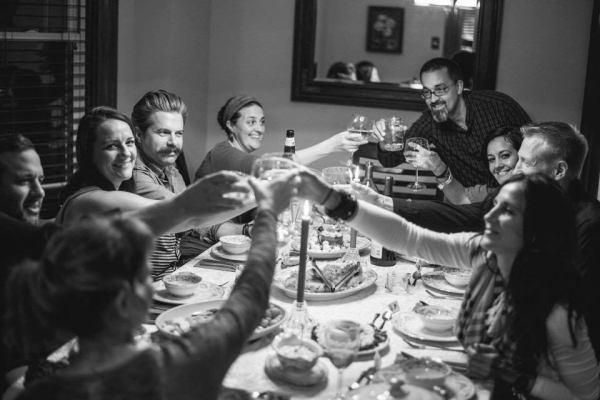
Can we raise our glasses to friends,
to more stories and food and wine,
and even, if we are brave enough,
to heartaches and disappointments
and failures? Can we toast the things
we hated but that somehow
made us stronger, or wiser, or
more forgiving?

Can we, in other words, raise
our glasses high,
on this almost winter’s night,
to another billion miles,
give or take?

Five Blog Posts You Should Read

photo-1444427169197-de497742b62d

The grief has been two-fold: mourning the death of my mother, and mourning the ways in which my relationship to God and the Church has changed.

* * * * *

As a person who is committed to a faith that is centered around the life of a 1st century Palestinian who from the beginning stood with the marginalized, the rejected and isolated, the non-normative of society, and even himself experienced state-sanctioned violence and execution, because of his life – I believe and confess and affirm that black lives matter. Muslim lives matter.

* * * * *

Mohammed, his wife, and their seven children fled from that violence. They headed north, and sought refuge in the city of Samarra for nearly a year before the effects of ISIS drove them further north to Kirkuk, where they started over yet again

* * * * *

All those things are true, and yet, I find myself dwelling on her absence, on the way someone can simply go away from our every day existence.  I haven’t seen Loretta in more than 10 years, and still, to think she is gone . . . The presence of her absence must be loud and clanging for her family.

* * * * *

Small goals acknowledge my humanity, and I like working and living in full awareness of my finite humanness. Write a book? That’s big. But write 2,000 words a day? I can do that, plus get enough sleep and hang out with my kids when they get home.

He Told Her, “An Absent Mother is Better than a Dead Mother”

download
photo by Jake Givens via Unsplash

I don’t think I’ve ever received a text like that before.

Today still works for me. I just want to draw your attention to the fact that I don’t shake hands with men. I am sorry to say that.

I wrote back to Miriam and said that I completely understood, and I thanked her for letting me know.

* * * * *

I am doing this because a month ago I read an article in the Lancaster paper about a few Syrian refugee families being relocated to Lancaster, and the comments following that article, written by my fellow Lancastrians, were not welcoming. The comments were not kind.

I am doing this because Donald Trump, the leading candidate in one of two major political parties in this country, said in a recent speech that if he was elected president he would send all the Syrian refugees back to their war-torn country.

“If I win,” he said. “They’re going back.”

I am doing this because our wonderful country, the United States, has a long and lovely history of welcoming in people from around the world. Maybe if we hear their stories, we’ll remember why.

* * * * *

We picked her up from the house where she was staying and for the first time in the history of our family, all the kids sat in the truck completely silent. I wondered if it was Miriam’s covering that was throwing them off; it had a nice floral design, set off against her all-black robe. It is not something they are used to seeing. She had dark, quiet eyes and when she smiled there was kindness there, and sadness, and strength. And maybe a little hope.

I sat in the middle seat and let Maile drive – I thought Miriam might be more comfortable in the front with another woman. Maile and I occasionally asked her questions about her life, how things are going for her here in the States, how people are treating her.

“I love Americans,” she said quietly. “Of course, my greatest wish is to go home. But that is no longer an option.”

After seeking asylum, she recently received approval to stay, which means a green card. She was very happy about this. She might be able to start a new life here. Her family might finally be able to join her, if they can get out.

If.

It took about fifteen minutes to get to the park. The drive consisted of questions, answers, and long periods of silence. I wondered if she would trust us enough to tell her story. To be honest, I couldn’t imagine why she would.

* * * * *

Can I tell you how surreal it was to sit at a wooden picnic table at a nice park in middle America across from a woman telling us harrowing stories of being threatened, beaten, and nearly killed? The weather was unseasonably warm for November. In the background our children laughed and played tag while she told Maile and I how she had to say good-bye to her own husband, her own small children.

Just before she fled, she asked her husband, “What kind of a mother leaves her children and goes to another country?”

“The children would be better off having a mother in another country than a mother who is dead,” he said quietly.

* * * * *

There were two things she struggled to talk about, two things that made her speech slow, her eyes well up with tears. The first was when she told us about the beatings she received. She was passionate about free speech and women’s rights, and these things got her into trouble. A lot of trouble.

The second thing that made her tear up was speaking of her family, her children.

I glanced over at Maile in those moments and she was crying, too. Maile, the blond-haired American with her nose ring, sitting across from Miriam, a Middle Eastern Muslim with her hair hidden under her hijab, the dark folds of her clothing hiding everything except her face and hands.

I think that if anything can overcome the evil in this world, it’s the transformation that comes when we sit and listen to the pain of those we have been told are our enemies.

* * * * *

On the way home, we asked her what kind of food she likes.

“What do you eat in your country?” we asked her, and she laughed, told us her favorite dishes, described them in detail.

“Could we have you over for dinner sometime?” I asked her. “I promise we’ll find food that is halal.”

She laughed again.

“Yes, I would like that.”

She got out of the truck when we returned to the place where she was staying. Maile walked over to her and reached for her hand.

“Can I hug you?” Maile asked, and Miriam nodded, smiled. That’s the clearest image in my mind from that day: Maile sinking into the dark folds of this woman’s robe, the two of them hugging and smiling and almost crying.

There is hope for this world yet. That is all. There is hope.

Tune in next week for Miriam’s story in her own words.

A huge thanks to Church World Service for introducing me to Miriam and somehow convincing her that she could trust Maile and I with her story. If you would like to learn more about the refugee work that CWS does, if you’d like to make a donation, or if you’d like to explore other ways you can help, please check out their website HERE. Or send me an email. I’d be happy to coordinate your desire to help with their current needs.