In Which I Feel Unexpected Affection Towards Someone I’m Driving #RidesharingConfessional

qqe158hev1i-james-sutton

Most mornings, when I’m going to drive, I peel myself off the floor where I’ve been sleeping beside Leo’s bed. He’s not been sleeping well at night. I creep out of the room, make some delicious Passenger Coffee (Union blend), throw on some clothes, and climb into my cold car. At 5am, the city is quiet and crisp, a new dollar bill. The street lights are sharp, like stars.

I pull up to a produce warehouse and wait for my fare. He comes out: an African-American kid, maybe 20, hood pulled up, hands deep in his pockets. He gets into the front seat.

“Morning,” I say, confirming his destination. “You work through the night?”

He nods and shivers, and his voice is kind.

“Morning, man,” he says. “I’m tired. And I’m freezing.”

I wonder if his work place is refrigerated, seeing that he works with produce.

“I’ve got heated seats,” I say, chuckling, reaching forward and pushing the button to turn on the heat in his seat. “But it’ll probably put you to sleep.”

“I can sleep anywhere.”

He grins from under his hood and I can feel the connection between us. He’s tired and cold, like me. He’s working hard, for himself or someone else. Third shift, man. Third shift sucks.

His destination is fifteen minutes away. After three minutes, he’s asleep, and there I am, driving this kid home from work. His breathing is heavy, his mouth wide open, like one of my kids, and as the sun rises behind us, over the highway, I feel an almost desperate tenderness towards him, the same kind of feeling I feel when I wake up in the middle of the night to take one of my own kids back to bed.

We get to his apartment building, and I can see the river. The sun rises over it. He startles awake, rubs his face.

“Sorry, man,” he says, shaking his head. “Wow, I was out. Right here’s good.”

I pull over, wish him well, and he gets out. And I go on with my day.

That Time I Drove Around Four of the Minor Gods

b_za9cgctka-ivan-timov
Photo by Ivan Timov

They emerge through mahogany
doors, out from under Greek letters,
like four of the minor gods. They are
all cardigans and collars and suit coats
like their fathers
(lawyers, doctors, accountants)
brazen laughter at past conquests
and those to come. Nothing holy
or sacred because the world
is theirs to pillage. All around them
mortals making minor gifts,
supplications. Nonetheless,
their
fire
will
fall.

We drive
through the city, me straight-faced
and listening. I am torn. I want them
to have fun, to drink one too many,
to make mistakes that will make
for good stories years from now
when they unexpectedly cross
paths. Remember that
night? But I also know that when gods
and mortals cross, the gods do not
suffer, even if they leave the mortals
in ruins. And I think of my daughters
ten years from now, or fifteen, perhaps,
somehow in the path of these laughing
gods as they take whatever
they want.

“We’ll get out here,” they shout, opening
and slamming doors in the middle
of stopped traffic, laughing and running
through the lines of waiting cars, talking
as if they know the entire population
of this city is listening. Maybe
it is. Has this world
always been man-
handled by such careless
deities? And where are the heroes
among us, the ones who will unseat
these reckless rulers and saturate
the world in
kindness and grace?

I pull away, into traffic, into
a sea of brake lights fragmenting
under the winter rain. Where
are those who will save us
from ourselves?

If you’d like to check out some of my other #RidesharingConfessional pieces, head on over to my Facebook page.

the beautiful flawed hurting mean angry exquisite world

FullSizeRender-2

I wonder
if this world has heard the expression
“to hell in a hand basket” or if it
even cares that a hand basket
especially one of wicker or wood or
straw wouldn’t hold up well in the flames
not to mention the smell it would carry
if you were somehow able to bring
the basket back home with you
after such an excursion.

But then, in the midst of this train
of thought, I hear you crying and I go
to your room and lay myself down beside
your crib like an offering,
the both of us not sleeping, the mid-day
sun burning bright lines into the blinds
the fan whirring the air into distraction.

There is another baby now, I tell
you. “Baby?” you ask. “Poppy Win?”
“Yes,” I say. “Poppy Lynne.”
Our eyes meet. You have the only other set
of brown eyes in the family,
just you and I, and I wonder if eyes
that are the same can see each other better. I wonder
if it is your lashes weighing down your lids
or if sleep is coming back.

I lift a book above
my head and try to read in the dim light, try
to outlast you. The book is sad.
The book is magnificent.

No one stops him. No shells come whistling in. Sometimes
the eye of the a hurricane is the safest place to be.*

It is too dark to read so I try closing my eyes
for a time, try to accustom them to this darkness.
When I open them again the words are clearer. I wonder
if silence is like that, if it helps us to hear more
clearly when we are surrounded again
by the noise.

You are clearly not buying it.

I scoop you up
take you back out to the world, the bright world, the
beautiful flawed hurting mean angry exquisite
world and I give you a small glass of water and you
smile, wet-chinned, brown-eyed and I say

It’s okay.

You nestle your head in the valley
of my neck and I say again,

It’s okay.

But I’m not entirely sure who
I am trying to convince.

Next week I’m releasing a free ebook of poetry called We Might Never Die. Sign up HERE to make sure you get the word when it’s available. Or, if you’re impatient, you can get the paperback HERE for $5.99 RIGHT NOW.

*italicized section from All the Light We Cannot See by Anthony Doerr

An African American Man, Donald Trump, and Listening #UberChronicles

download

A few weeks ago, I picked up an African American gentleman while I was driving for Uber here in Lancaster. I don’t initiate conversations with passengers – I always find that to be super-annoying as a passenger, when a driver won’t shut up. So I normally say a sentence or two and if they take it from there, then we’ll talk, and if they don’t, well, who doesn’t enjoy a quiet car ride? The sound of music? The rush of the road under the car and the intermittent flash of street lights as you drive along?

We started chatting, and he was soft-spoken and kind, but we had a fifteen-minute ride, so halfway through our conversation dwindled and he turned his attention to his phone. We were a few minutes from his destination when we passed one of the Republican headquarters here in the city. Now, the last thing I want to do is bring up politics with riders. Seems like a pretty fast way to get a 1-star rating. But before I knew what was happening, I asked him a simple question.

“How are you doing since the election?”

We were at a light, and I looked over my shoulder to make sure he wasn’t going to punch the back of my head. The expression on his face was heavy. He looked as if we had only just then actually seen each other for the first time. All before had been viewed through masks.

“It’s been tough,” he said, shrugging, as if he had only then decided to be open with me. He cleared his throat. “My girlfriend is white, and we’re planning on getting married. She woke me up at 2:34am and told me Trump won Pennsylvania. She was crying.”

“Sorry, man,” I said. We were almost at his house, but I felt like we had only hit the tip of the iceberg.

“She asked me if a Trump presidency would mean we couldn’t marry each other. I told her of course it didn’t mean that. I didn’t tell her it did mean things might get a whole lot harder for us as an interracial couple. I guess we’ll have to wait and see.”

“I’m sorry,” I said again. I pulled to a stop in front of his house.

“Thanks, man,” he said, with genuine appreciation in his voice. He paused, then reached up into the front to shake my hand. “Thank you.”

I had done nothing but ask a question and listen.

* * * * *

It would be easy for me, for any of us, to tell this young man that his worries are silly. Of course Trump isn’t going to outlaw interracial marriage. Right? Of course they can get married. Stop being so paranoid.

It would be easy for me to ignore any concern that my friends who are Muslim refugees have, that they will now not be joined by their families waiting in refugee camps or war-torn countries. It would be easy for me to brush their concern aside and offer up a platitude, reminding them that God is in control. What will be, will be. It will all work out.

But.

These are real worries people have. It doesn’t help for any of us to negate each others’ concerns, to say, “Well, I was worried eight years ago when Obama got elected so get over it.” I think now would be a good time for us to consider Psalm 147, to focus more on binding up people’s wounds instead of trying to convince them their wounds don’t exist or are superficial or are the same wounds we had once upon a time.

Can we start asking questions and listening to each other? Really listening? And then walking away without protesting or offering easy answers?

What All Refugees Have in Common

My new friend and Arabic translator.

I sit in my car on an unseasonably warm day in November, and I’m across the street from CWS. Church World Service. They work with partners to give hope, opportunity, and relief to refugees and immigrants relocated to central Pennsylvania. I sit there across the street from their office and stare at the golden leaves. The days are shorter now. The darkness comes early.

I walk across the street and into the lobby, into the chaos of people trying to find their way in a new place. There are people from every country you could imagine there, some speaking to each other in languages I don’t understand, some waiting quietly, pensively. One man talks on the phone, urgently, looking at a small piece of paper and reading numbers into the receiver. I spot my friend, the man who will interpret for me, and he smiles. He stands up. We shake hands. It is good to see him again.

We aren’t there long before my friend from CWS comes out to retrieve us. We follow her through a maze of offices and hallways, corridors and meeting rooms. She tells us of their expansion plans. She is clearly excited for what it means for CWS, the extra space, the added capacity. We sit in a conference room, on a sofa, and we wait.

I can’t tell you the details of the story I hear, not yet, but trust me when I say you cannot sit on a sofa with a refugee from a war-torn country and walk out into that fall day unchanged. If you would take the time to listen to their stories, these beautiful, strong, persevering people, you would see there are common things to be found in all of them. Not the details – those are always different, always varied. The common things you find are these.

They always look older than they are.

There is a kind of softness worn into their eyes, a sadness that tells you they have seen many things, and a glint like light on metal.

There is a strength and determination somewhere around the shoulders, a bent-but-not-broken arch in their spine.

There is a childlike eagerness to make new friends – sometimes you have to work to see it, but it’s there.

I thank the man before we begin our meeting for the courage it must take for him to share his story in a strange country, when he does not know what this story-telling might lead to. I thank him for his willingness to explore the possibility of writing a book with me. I tell him not to get his hopes up – book writing and publishing are no sure thing, and it may very well be that nothing will come of our time together.

My translator tells the man what I say. The man smiles and nods and answers in Arabic. My translator nods, smiles also, then turns to me.

“He says, It is impossible for nothing to come of this. He is glad you are willing to hear his story, and no matter what happens, you are friends now. That is all that matters.”

Indeed. If only I were so quick to call people “friend.”

Maybe, in times such as this, listening to each other is the first and most important step.

The Five Little Words My Daughter Said that Undid Me

img_2073

She’s tall now, you know? My oldest daughter. She’s stretching up physically, and out mentally and emotionally. She’s taking in the world and making her own conclusions. Growing up is an indescribable process. She’s so beautiful.

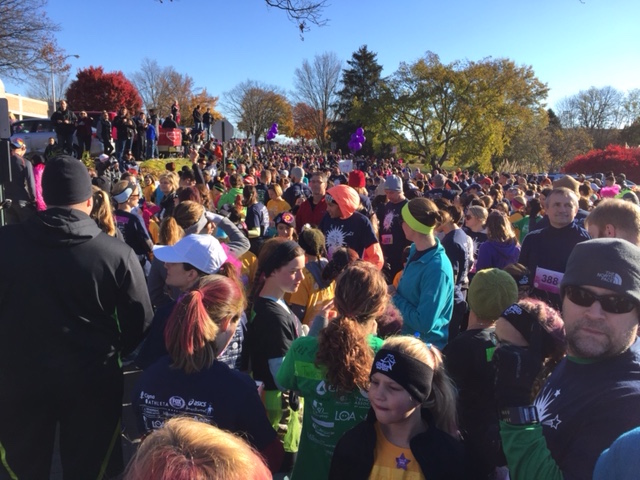
It was a cold morning and we stood on the football field with a thousand other runners, getting ready to run a 5k I had most definitely not been training for. Beside me, my daughter Lucy was having a friend spray-paint her hair with pink and purple hairspray.

They gathered our group for a photo. The girls all showed their muscles and shouted, “Girl power!” Actually, we all shouted it. One of the moms looked at me sympathetically and smiled.

“Is that strange for you to say?” she asked, laughing, clearly expecting me to say yes.

“Not at all,” I said, smiling. “I have three, strong girls.”

* * * * *

We followed the crowd around and got into our starting group. We waited. We counted down from ten to one, and the entire crowd shifted as the run began, the way a caterpillar pulls itself together and then lays flat. We had to walk for a minute or two until the crowd thinned. And then we ran.

We talked about running and her upcoming birthday and how her year is going. But mostly for those 34 minutes we ran beside each other without saying a word, just one step in front of the other, up hills and down, around bends, passing people and being passed. This is life, I think, the many wordless moments, the being together.

But there’s something from this run I won’t soon forget, and that’s why I wanted to write this. We came to an especially long hill and began the upward trek. I knew Lucy wanted to complete the race without walking – it was kind of her unofficial goal. But a hill is a hill, and sometimes our goals fall apart when they encounter these present, difficult realities.

“You’re doing awesome,” I said to Lu as we slowly jogged up the hill. And this is what I won’t soon forget. She turned and looked at me, and she said five simple words.

“You’re doing awesome, too, Dad.”

How can five tiny words almost undo you on a Saturday morning in the cold, the sun climbing over the hills? How can five tiny words shoot into the sky and cover your entire life, like the glow of firework? Because that’s how I felt. I felt like she wasn’t just talking about the hill – she was talking about me as a Dad. She was talking about me at my very best, and even me at my sometimes-shouting worst. She was talking about me when I am too demanding and me when I am just what she needs me to be.

I know she didn’t mean it to be so all-encompassing, those five little words. but that’s how I heard it.

“You’re doing awesome, too, Dad.”