The words didn’t come out of my mouth, but they came close, derailed somewhere on the way from my brain to my tongue. And they stuck there, in the back of my throat, settling like ash. I was left staring down into my daughter’s eyes, not knowing what to say, surprised at my unchecked response.
That thought had never entered my mind about anyone else before in my life, that there were people you shouldn’t pray for. Her words stirred around in my mind.
Make sure you pray for him in prison, she had said. You know, pray that he’ll have a good night’s sleep.
* * * * *
Today, I’m posting over at Deeper Story. You can read the rest of the post HERE.
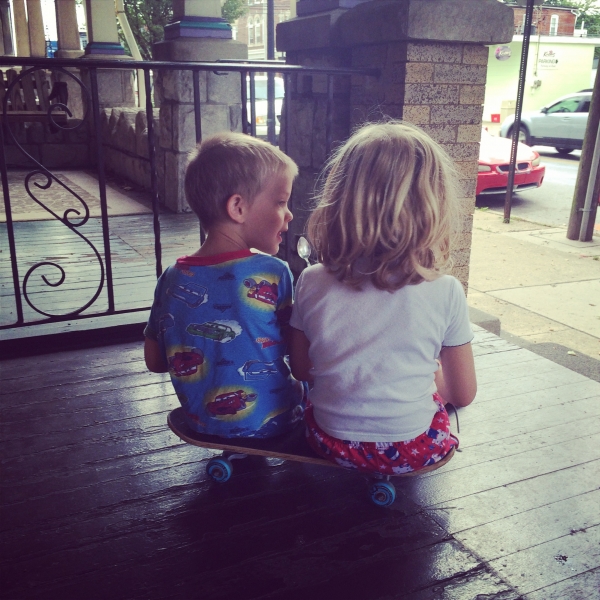
I listened through the open window, and because I stopped and waited and listened I could hear their tiny voices dancing through the summer day, accentuated by the metallic strike of a hammer on a nail, the thunk of hammer on wood (missed!), the raspy sound of the shovel as it shoved into our narrow strip of city yard. They are five and six years old, the two of them, and their voices were serious.
I listened through the open window and they talked about building a tree house out of only a three-foot long board and the ten nails I had given them earlier, five in each dusty palm, five white nails that they held like magic seeds. They raced outside and one began digging and the other began nailing and that’s how it went for an hour or so as they planned and schemed the massive tree house they would build in the tiny tree that lines our city yard. Out of one small board. And ten nails.
This is what it means to be a child: to believe that even a tree house is possible, though you’ve never built one before, though you don’t have the tools or the materials, though you don’t know why or how. To believe it’s possible.
Truly I tell you, unless you change and become like little children, you will never enter the kingdom of heaven.
* * * * *
I spoke with Kelly Chripczuk the other day and we were talking about trust when she said something that made my ears perk up, something along the lines of,
“Until you lose your identity (as a writer or preacher or student or whatever), there’s so much pressure. Too much pressure. There are people to impress and a reputation to uphold. But once you can let go of that identity, it allows you to play again, like a little child, to create things and not worry about what anyone else will think.”
To play again, I thought to myself. This is what I have to allow myself to do.
* * * * *
I immediately thought of the novel I’m releasing this winter (I’m sorry if I’ve been talking about that too much, but it’s on my mind all the time, and to be honest I’m still terrified of freeing it into the world). But after talking with Kelly, I thought, That’s it! It’s all just play, this creating and conjuring and sharing of stories.
I enjoy writing stories too much to let what other people might think stop me from writing, from creating, from producing and sharing. When it’s me and all these potentially critical readers, I feel myself drawing inward. When it’s me and and the story, just us, and I’m making things up and chuckling to myself and nearly crying, that’s it. That is a life I could live and enjoy and be at peace.
That’s me in the back yard with not enough materials, not nearly the right tools, and ten measly nails. Making plans. Digging in the dirt. Climbing trees.
And believing.
What do you wish you could start believing for again?
“But I’m ready to go home,” the man said on the other side of the curtain. “You said I could go home today.”
“That’s not true,” the nurse said in a whimsical voice, as if she was play-acting with a child. “No one said you can go home today.”
“But it is true!” the man insisted. “The male nurse with the handlebar mustache told me I could, as long as I went to the bathroom and ate my Jello.”
The nurse gave the man a tsk tsk tsk and sighed.
“We’ve had this discussion before – there are no male nurses on this floor, and none in the building with a handlebar mustache.”
That seemed to shut my roommate up, at least for the time being. We had shared a room ever since I had arrived, and he rarely stopped talking, even in his sleep. I hadn’t gotten a very good look at him though. At first I was in such rough shape that I didn’t know what was going on around me, and more recently, if I toddled past him on my way to the bathroom at night, he was usually completely under the covers, like a covered corpse. During the day he kept the curtain pulled all the way around his section of the room. But whenever he spoke I thought his voice sounded familiar, and I found myself spending more and more time trying to find him in my memory.
The hospital room was split in half by a thin curtain that didn’t quite reach the ground, and the bottom of the curtain was some kind of tan material while the upper half was mesh to let the light through. My bed was on the side of the room with all the windows, but I kept the shades drawn. After three weeks in the hospital, the light still hurt my eyes, but after I had gained some mobility and was able to push myself along on my walker, I’d slide over to the huge windows during sunrise or sunset, dragging my IV cart along with me, and look out over the city from my 8th floor hospital room.
I couldn’t see my own street, where the car had hit me, but I could see the roof of my house. I had never realized Virgil was such a green city – most of the streets lay hidden under a canopy of trees. Everywhere, that is, except just south of my house, in the center-of-the-city section of endless alley ways and dead ends. There, building after building swallowed up the pavement with their long shadows and exhaust-stained walls, staring through broken windows.
“Get out of Virgil while you can,” the man said from the other side of the curtain, and something had changed in his voice. Before he had sounded old and senile, as if his words, on their way out of his mouth, were slipping on his saliva. Now his voice was clear and measured.
“Get out of Virgil?” I asked.
Silence.
“Why should I get out of Virgil?”
“Trust me,” he said. Then he chuckled. Then he was silent.
I slid my walker along the smooth, hospital tiles towards the edge of the curtain.
“I don’t think we’ve officially met,” I said, pulling back the curtain, then freezing in place when I saw the man’s face.
Because there, lying in the bed, staring up at me…was me.
On most Fridays I post stories about Virgil, a made-up city with a host of strange inhabitants. If you’d like to check out the first story, click HERE.
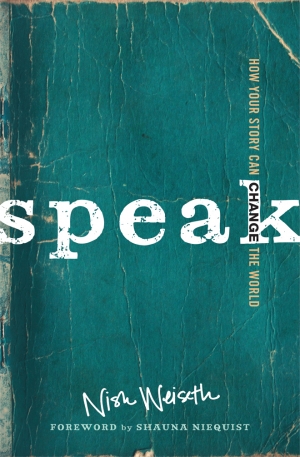
I’m so excited for my friend Nish Weiseth – her book Speak was released just a few days ago. The first question on the back cover sums it up nicely: “How would your life be different if you shared your stories rather than your opinions?” These are whirlwind days, these days just after the birth of a paperback, and this week’s #100Words are from Speak: How Your Story Can Change the World:
Here’s the reality: Some people are living the lives Hollywood movies, great novels, and stage productions are made of. Some people are living absolutely fantastical lives, to which I say, “Well done!” But the flip side is that most people aren’t living lives full of extraordinary events and circumstances. Most people are living life by daily fulfilling the obligations set before them. To most, these lives don’t seem like anything to write home about. And though you may be living what seems like an ordinary life, faithfully doing what God has placed in front of you to do means you are actually living an extraordinary story.
I love not only what Nish writes about in this book but also what she has created over at Deeper Story, a site where dozens of writers share powerful stories.
You can find out more about the book or purchase it by clicking HERE.
If you’ve read my blog at any length since I began sharing here in 2010, you’ve been witness to what feels like an incredible journey, from those early days when I didn’t know where my next project would come from, to our 10,000-mile cross-country trip, to these last two years where I’ve had more work than I ever imagined I would have.
You can learn a lot of lessons in difficult times, but you can also learn a lot during times of abundance, if you keep your eyes open.
This year I’ve had some intriguing projects, some of which I’m in the middle of right now, and the amount of work allowed us to buy a house and move into the city and has just generally made life a little easier. We used to have to check our checking account before filling up the van with gas. We used to line up the bills and have to decide which to pay and which to hang on to.
But this “abundance” has also made life very busy. Very busy. I write all day, six days a week (sometimes 6 ½), and then usually a few hours at night. I’m constantly reviewing and editing and submitting, recording and transcribing and re-writing. Right now I’m at various stages of five different books.
I’m making good money, but a thought dropped into my mind a few months ago, and it stopped me dead in my tracks.
“Is this why you wanted to be a full-time writer, so that you could make a lot of money?”
No, was my immediate response. I never became a writer so that I could earn a lot of money. I never became a writer so that I could spend the rest of my life writing other people’s books (though I do enjoy that aspect, and helping someone else share their story seems like a very worthy part of my calling as a writer).
I became a writer because I have stories to tell. Some are true stories, things that actually happened to me and other people. Some are True stories, tales that, while fiction, feel like some sort of very personal history. And in my busy-ness and occasional fear of running out of work, I lost the ability to ask people to wait.
What if I tell them I’m not available for six months and they go with someone else?
But if I’ve learned anything over the last five years, it’s the importance of living life from a place of trust and not from a place of fear. So I’ve decided to start trusting again.
Part of that active trust means not taking on any new projects until early next year. I need to finish the ones I have, and finish them really well.
Just as important, I have a book that I promised my kids I would finish before the end of the year, the first novel I’m releasing out into the world, so I want to spend some quality time revising and editing that story. (I’ll probably release that through Kickstarter, so if you’re interested in hearing about that when it happens, stay tuned here at the blog or sign up for my email newsletter over in the right-hand column of this page.)
Which leads me to this:
Why did you start doing what you’re doing?
For the authors out there…why did you start writing? Was it so that you could build a platform and create an audience and market and beg people to read your book? Or was it something else, something inside you that simply had to tell a story?
Why did you first take the job you have now? Why did you become a painter? Why did you become a pastor or a teacher or a business person? Why did you start that charity?
We are all in tiny vessels lost at sea, and even though we’re fortunate enough to find true North for brief moments of time, we will always drift from that heading. Living a good life means constantly evaluating where we have drifted, and doing what must be done to get back in the direction we are meant to travel.
So, can you remember why you started? (Seriously. That’s a real question. I’d love to hear your answer in the comments.)
Today’s guest post is brought to you by my friend Chris Hall. Thanks for reading.
Wednesdays are hard for my mother-in-law. There’s too much time in them, too many memories.
Wednesday nights, Sara and I meet her for dinner or, at the very least, take her out for ice cream. It doesn’t matter which. They’re both just a reason to get her out of the apartment.
On this Wednesday we’re eating at one of those “All American” restaurants where the menu has more pages than the last book I read and the drinks are served in mason jars. She sits across the table from us. She looks tired, like a statue that’s been standing in the rain too long.
“I came home from work yesterday,” she begins. “And I don’t know how I hadn’t seen it before, but Becky wrote on the wall above her bed.” She stops and takes a breath. Her eyes fall to the table. “She said ‘I will fight’ and wrote the date with it. April 21st 2014.”
The rest of the restaurant felt suddenly vacant. No cooks, no waitresses, no customers, no mason jars, just those words. I will fight.
“I don’t know why I’m surprised,” she said. “She was always writing things on the wall in her room when she was just a kid.
“That’s our Becky,” she sings. “She loves to push my buttons.”
The way she speaks of Becky is always an odd pairing of past and present tense. I don’t think she’s ready to speak of her in only the past yet. I’m not sure she’ll ever be.
I look at my Sara, the ink barely dried on our marriage license, and softly run my hand over her back. She’s been strong, stronger than I would be in her place.
* * *
It’s been less than two months since our wedding. The day was warm, breezy and bright with a sky like the sea from a distance. We were surrounded by fields of almost-ripe wheat, still green with the vigor of spring. My bride walked down the grassy aisle, her feet gliding over the blades until she was next to me, breathtaking. Her dress was pink, like the first blush of a garden rose. I took her hand and we pledged our lives.
We laughed, we danced, we kissed.
Perfect. The day as perfect.
. Except it wasn’t. There was an absence keenly felt, readily seen.
It was visible in the too few number of bridesmaids, on the deeply drawn lines of my mother-in-law’s face and in the empty chair at our table.
Becky had gone into the hospital five days before the wedding, racked with pain in her abdomen. We prayed for fast answers and faster healing, but it wasn’t until 2 days later that we had any answers: Peritonitis, an infection in the thin tissue covering the abdominal organs, and Sepsis.
Becky was placed in the Intensive Care Unit. She wouldn’t make the wedding. I did my best to catch Sara’s tears. The doctors were hopeful they’d caught the infection in the early stages. That was enough, enough to hold on to as we prepared for our wedding.
* * *
I like to think that Becky was born with her dukes up, ready to brawl, because that’s what she did throughout her life. She fought.
Born with a heart defect, she had open heart surgery at only a week old. Her chances were slim. Her will, iron. She grew up pushing the limits of what her ailing body could handle, dragging oxygen with her for years. At age 7 she was diagnosed with Protein Losing Enteropathy, a side effect of her heart condition that rendered her body unable to absorb proteins. Life with PLE was like putting numbers into alphabet soup. It complicated everything. By 20, she was in need of a new heart and liver. Still, she fought.
I once heard Becky talk about the future, of all the things she wished for her life, as though it were her’s to claim. There was no diagnosis that was going to keep her from trying, no handicap that would keep her from dreaming.
* * *
A week after the wedding we visited Becky in the hospital for the second time. Concern flushed my mother-in-law’s cheeks.
“Why are you worried, Mom?” Becky said softly, her words came at the expense of an entire breath. “I’m not worried. God’s going to take care of everything.”
The following Monday I was back at work when Sara called. The Sepsis had damaged Becky’s kidneys beyond repair. She was back in the ICU. After over 21 years of humiliating the odds, Becky was losing her fight.
We rushed to Philadelphia. Becky was still with us but her bouts of consciousness came in short bursts. We spoke with her, each of us reassuring her of our presence, our love.
More people came throughout the day. Friends who had been a part of her story from the outset, family who came back so soon after a celebration. They came to see Becky, to wish her farewell as she prepared to make a journey none of us could make with her. They came to comfort a mother caught in the agony between giving everything for her child and giving that child over.
“Where is God?” someone asked.
The question filled the hospital room. It was the expectation of a friend who said they’d be there only to stand everyone up. “Where is He?”
We gathered around her that night. We sang. We prayed. We spoke the words of those who have no hope left but for a miracle. It would be another one to add to the list. She just needed one more.
It didn’t come, though. Not this time. On Tuesday the rest of her organs shut down and we waited with dreadful anticipation.
Still, she fought. Just as she had done from the day she was born. Her mother fought, too. She fought to keep her will from spilling onto the white tiles. That waiting, that in-between, was the hardest thing I’ve ever seen anyone endure.
My new wife cried into my shoulder, her salty tears rooting in my skin. When I said “For better or for worse” I didn’t think the latter would come so soon.
“Where is God?”
A thousand pat answers rambled through my mind. All the promises I’d been taught, all the words of comfort I’d heard from the pulpit fell flat. I held Sara, mixed her tears with my own and hoped it would be enough.
Wednesday began with a call at 4:40am. They’d turned Becky’s pacemaker off. It wouldn’t be long now. It couldn’t be. Sara and I drove what had become the all too familiar route to the hospital.
Becky’s breaths – short, raspy struggles – came only a few times per minute now. We held our own with her between each of them, wondering if this was it.
Her mother could only be in the room for brief moments. She who had endured the loss of her husband to a brain injury, who had taken up the mantle of leader for her family, who had given all she had and more to raise her three children, was face to face with the day she had beaten back for so many years. If Becky was a fighter, it was because her mother had passed that fortitude on to her.
Becky’s last breath came shortly before 11:00 that morning. The vibrant, goofy girl who’d had such tender hold in all our hearts was gone. What remained was like the shell the locust sheds, giving the appearance of the thing but holding none of what made it.
I sat down that afternoon to write the obituary of the girl who ran to hug me every time I walked into the apartment, of the girl who had been my sister for 11 short days. Words have never been more difficult.
Becky’s memorial was held that Saturday. People from her everyday, from far away and long ago filled the church to remember her. She was loving, compassionate, brash, adventurous, temperamental and bright.
Bright. That was how I saw her. She was like a star who doesn’t care that the night is far darker and far longer than it knows.
“Where is God?”
The question clanged in my mind again, like a misshapen bell in a crumbling tower, ugly and cold. I looked up as my mother-in-law held a tissue under curled fingers, a microphone in the other hand. She shared of her grief, of her thankfulness for all who were there, all who had shared in Becky’s life.
God was there.
He was in the presence of friends around the hospital bed. He was in the songs that were sung as Becky drifted slowly from this world. He was in this church, not because it was a church, but because of those who were there, bearing his name, and comforting a grieving family. Grieving with us.
* * *
I watch my mother-in-law across the table. She finishes the iced tea in her mason jar and asks “When are you two gonna give me some grandbabies?”
Sara and I laugh. We’ve heard this a hundred times already.
“You know I’m just teasing,” her mom says. “Just don’t wait too long.”
I smile, glad to know she’s looking forward to something, and I think to myself that sometimes the fight isn’t as much about a test of will as it is the willingness to move forward, to hope.