What Over the Rhine Said When I Asked For Permission to Use Their Lyrics (or, Help Me Title My First Novel!)

Meet-Me-at-the-Edge-of-the-World-cover-large
Most of the work I’ve been doing on my novel has been between 10pm and midnight, when the four older kids are asleep and baby Leo is drifting off, either in his swing or his crib. The city is quiet then, and the fans are on, and the air coming through the screens feels like October.

Sunday night was one of those late nights when the stories were alive. I took a break from revising to think about the front matter of the book – what kind of quote or poem or lyrics would set the tone for the story? At that moment, the chorus from one of my favorite songs played on my writing playlist: Over the Rhine’s “Poughkeepsie.”

I’d ride on the backs of the angels tonight.
I’d take to the sky with all my might.
No more drowning in my sorrow,
no more drowning in my fright,
I’d just ride on the backs of the angels tonight.

That’s perfect, I thought to myself. Not only does it depict a major theme in the story, it almost illustrates one of the important scenes. I typed it out in the manuscript, centered on a blank page just before chapter one. Then I thought to myself, Wouldn’t that be nice?

I looked up Over the Rhine’s website and saw they have a licensing agent. I had wanted to write them directly, but instead I wrote the agent a short email explaining what I wanted to do.

I didn’t expect to hear back. I’ve written and co-written other books where we’ve wanted to use musician’s lyrics, and usually we never hear back, or if we do they want $1,000 in exchange for us to use their lyrics in the first 2,000 copies.

I went back to revising the novel. Then I went to bed.

The next day, around 11am, something strange happened. Over the Rhine liked one of my earlier Facebook statuses where I mentioned they would be headlining the playlist I listen to while I’m writing. Maybe you didn’t read that correctly.

OVER THE RHINE LIKED ONE OF MY FACEBOOK STATUSES.

That’s strange, I thought.

Then, a minute later, I heard the little !ding! that signifies an email magically flying through space and landing in my inbox. It was a name I recognized… Over the Rhine’s licensing agent. I felt sick to my stomach as soon as I saw his name – surely if he got back so quickly it was with some kind of a standard rejection email. I didn’t want to open the email. I sighed. I clicked it open.

I nearly fell out of my chair.

Dear Shawn, Thanks for your note.  Over The Rhine is granting you permission to use this song in the specific way you described below on a gratis basis. Kind Regards, Michael

What?

Wait, what?

It may seem like such a small thing, but to me, in that moment, it felt like I had just received one of the kindest gifts possible. And, this may sound even stranger, but it felt like the tiniest of affirmations from the universe that I actually SHOULD go ahead and publish this book.

Thank you, Linford and Karin. Thank you.

(Support one of my favorite bands of all time by purchasing their albums HERE.)

* * * * *

Here is an update on the novel, and then a request for your feedback.

I’m planning on launching the Kickstarter at the end of September, and it will run for 30 days. I’m using that method to hopefully raise around $3,000 to pay for the editing, cover design, marketing, and the creation of the digital formats of the book.

For those of you not familiar with Kickstarter, you, the reader, will have the opportunity to purchase advance copies of the book as well as some other cool rewards/services (I’ll be offering some of my other books, some writing coaching, even one package where I’ll help you self-publish your very own book)…but none of the money that people donate comes to me unless I raise the entire amount. Stay tuned for more on the Kickstarter campaign.

* * * * *

Now for the question. I’d like to get your feedback on a few different titles I’m considering. I know this is kind of unfair because you don’t really know what the book is about, but maybe in a way that’s good because I’d like to know which title sounds the most intriguing to you, the title that would make you pick up a book and consider reading it. So here are a few titles I’m considering. Let me know in the comments which you prefer and why, or what your general thoughts are on the matter.

The Day the Angels Fell

Samuel Chambers and the Tree of Life

The Last Amarok
“Our Great Big American God” (or, Why You Should Read Matthew Paul Turner’s New Book)

1*Ccdt9rOHJwen4KZPJSFlkQ

A friend of mine, on finding out that I’m friends with Matthew Paul Turner, asked me a rather pointed question one day.

“So is he as cynical in real life as he is online?”

I guess I can understand why that might be a first impression, but let me tell you this: I’ve gotten to know Matthew pretty well over the last few years and “cynical” is the last word I would use to describe him.

Matthew Paul Turner is one of the good souls in the world.

* * * * *

I was going to Nashville and a friend of mine knew Matthew. I thought to myself, now there’s an interesting fellow. I’d like to have coffee with him.

So I sent him an email. And he agreed to have coffee with a total stranger. We hit it off, spent a few hours getting to know one another, and have stayed in touch ever since.

It’s something I haven’t forgotten, that an author like him, with multiple books under his belt and a large platform, would take the time to meet with a complete unknown like me.

* * * * *

Then, a year or so later. I remember where I was when he sent me a particular text: sitting in the back yard of my parents’ house. I had no writing work at the time, very little money, and my wife and I were trying to figure out where life was leading us. It was the summer of 2012, and I was starting to wonder if my decision to try to write full time was a mistake. Then I got a text message from Matthew:

“You want to go to Sri Lanka?”

I called him and he asked me some questions and told me to hold tight. Within a few weeks I was scheduled to go to Sri Lanka with him and a World Vision team of bloggers. Within six weeks I was on the plane, layover in JFK, layover in Dubai, landing in Colombo. It would turn out to be a turning point in my life.

But one of the things I remember the most about the trip is Matthew taking pictures, always wearing his fedora hat cockeyed on his head. You could tell he loved the Sri Lankan people, and he tried everything and anything to get the right photo, because he truly believed that the difference between a child sponsorship and no child sponsorship could be the quality of the photos he took. I’d come around the corner and he’d be laying in the dirt, aiming his camera into a particular filter of light. I’d look around later and he’d be spread out on the floor of a hut, getting the little children to laugh.

Cynical? No, not Matthew. Loving. Sincere. Desperate to find good somewhere, even in the darkest places.

* * * * *

Matthew can be highly critical of the church – sometimes it stings, because it hits so close to home. But I think Matthew is critical, not because he wants to bring the church down, but because he wants to, in the end, see it built back up again. I really believe this. Beneath the sarcasm and the sometimes biting humor is someone who loves Jesus, who hurts for those who have been hurt by the church, and who wants to see people find peace and grace.

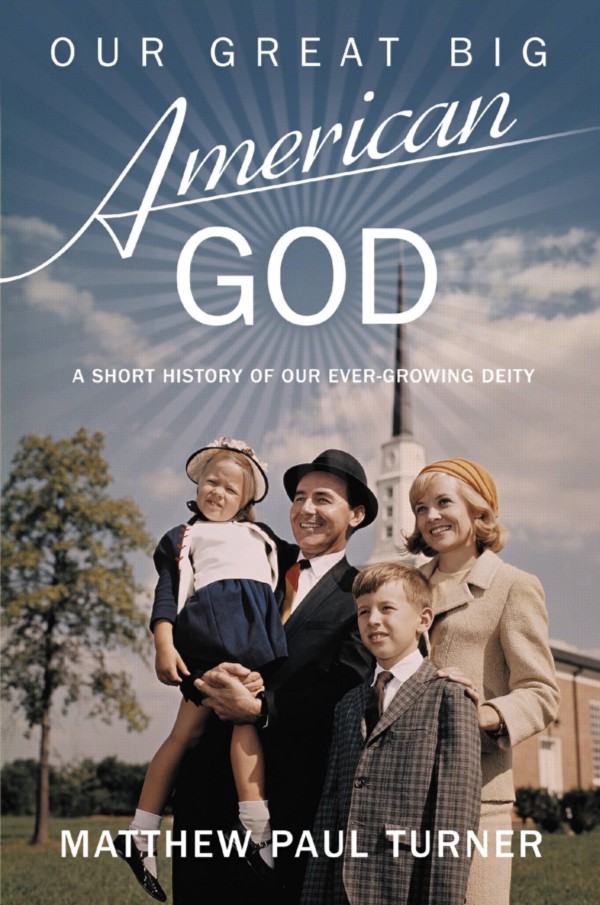
Enter his new book, releasing today, Our Great Big American God.

Here’s the description:

Whip-smart and provocative, Turner explores the United States’ vast influence on God, told through an amazing true history of faith, politics, and evangelical pyrotechnics. From Puritans to Pentecostals, from progressives to mega-pastors, Turner examines how American history and ideals transformed our perception of God-for better and worse.

Fearless and funny, this is the definitive guide to the American experience of the Almighty-a story so bizarre and incredible that it could only be made in the U.S.A. Regardless of political affiliation, it will make readers reconsider the way they think about America as a “Christian nation,” and help them reimagine a better future for God and country.

It’s a book that every Christian in America should read, because too many of us have turned God into an American, and Christianity into a nationalist movement. If you’re a conservative evangelical, this book will probably offend you. It will definitely make you uncomfortable.

And that’s why you should read it.

Thanks, Matthew, for writing the book that Christians in America need to read.

Check it out HERE.

When Ferguson is Across the Street

IMG_1080
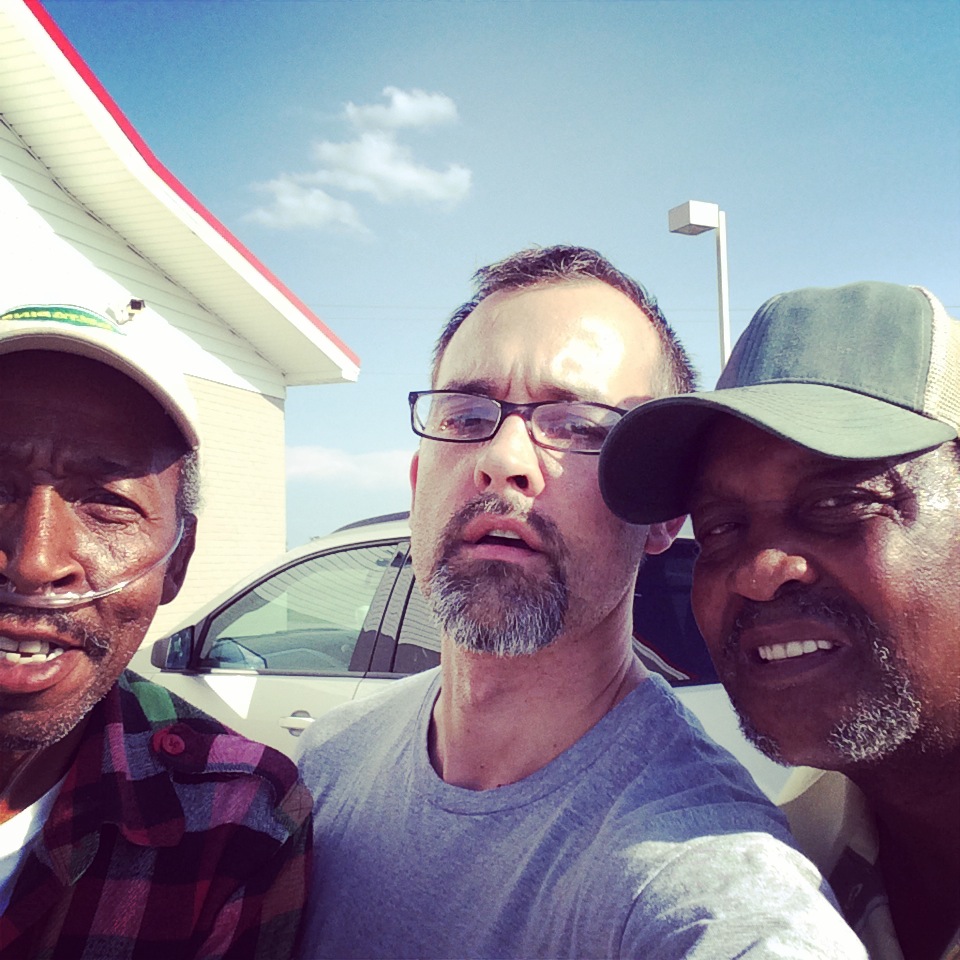
This is me straining to take a selfie with the two men who helped me when our truck had a fuel leak somewhere in South Carolina this spring. The one on the left pulled an oxygen tank around with him, and the one on the right climbed right under the truck without a second thought. Two kinder gentlemen I don’t think I’ll ever meet.

We scrambled out the door the way families do in order to get to church, with our youngest daughter proclaiming in a panicked voice, “I forgot to brush my hair!” and our middle son still protesting the decision to drive the five blocks (instead of walking through the rain). We crossed the street in frantic fashion and tumbled inside the truck. Because we drove, we parked at the library and walked through the cemetery, then dashed through the rain while Maile fed Leo before coming inside.

Slightly wet, we took a seat at the back of St. James, just as the music began. We take up an entire pew now, the seven of us, and I can become slightly obsessed with trying to maintain order in that small space.

“Abra, please be careful with the Book of Common Prayer – you’ll tear the pages.”

“No, Sam, you can’t fold that down. That’s for kneeling and praying on, not standing on. It’s not a bleacher.”

Abra leans back and bumps her head against some poor woman trying to pray behind her. Sam drops the hymnal with a bang. Finally, the children go to their class and, since Maile hasn’t yet come in, I’m sitting alone. There is the reading from Matthew. Then the prayer.

My insides feel scattered. My heart is not centered. But the person leading the prayer says one word that captures me.

“Ferguson.”

He prays for peace, and when I think of the turmoil there, swirling in the Midwest, I find myself getting emotional. There is a dead young man, and a community torn, and chaos. There is violence and there are deep wounds. Suddenly the chaos in my own life seems slight in comparison.

But what can I do? I ask, and above me the church stretches high in the air and the light filters in through the stained-glass windows but all I can hear is the silence between the prayer and the response of the congregation.

Lord of mercy, hear our prayers.

* * * * *

We drive home and we stop to get a card for my cousin and we go by the market to pick up some eggs. The four oldest kids play a game of Life together while Maile works on a few projects and I take a nap. Then Sam, five years old, comes up to the bedroom and joins me, his blanket in tow. He looks like Linus from Charlie Brown, sucking his thumb, and he curls up against me. Soon he is asleep.

What did I do to deserve such peace?

And what can someone as insignificant as me do in the face of such chaos, such confusion? What can I do to help a place like Ferguson?

* * * * *

There is an African-American man who lives across the street from us. He looks to be about sixty. He sits on his porch just about every day, watching the traffic go by. When I sit and write on the front porch, I wave to him, and he waves back.

My mother-in-law, much more of an extrovert than I am, has already met him and spoken with him. She said he’s on dialysis. She said he’s a very nice man. For quite some time now, I’ve been thinking that I need to cross the street and talk to him, get to know him. Yesterday I wondered what he thought about Ferguson. I wondered what his teenage years were like in the 60s, where he lived, and what he saw.

This, I think, is the answer to the question, “What can I do about Ferguson?”: I can cross the street. This is not all that I can do, and it feels like such a small thing, but it also feels like the place for me to start.

It reminds me of the men who helped me when our truck started leaking fuel in South Carolina. There I was, stuck at a gas station. They didn’t have to do anything. But they walked over and did everything they could to help get me back on the road.

What are you doing to bring reconciliation to the world? To Ferguson? What else can we do?

Friday Favorites: A Free Concert, A Writer, a Free Podcast, and a Free eBook

2
These people will make your life better.

1) For those of you within striking distance of Lancaster, one of my favorite bands, Jake Lewis and the Clergy, are playing a free concert at Binns Park. That’s right, free! Opening act is Atrain Xpress, and they start at 6pm, followed by Jake Lewis and the Clergy at 7pm. Check out their Facebook page HERE (and buy all the albums).

2) There are a ton of people on the Internet writing about writing, and half of them don’t know what they’re talking about. The other half are just regurgitating Anne Lamott or Natalie Goldberg. A handful are helpful writers with genuine contributions and unique insights into the writing life and process. One of these really helpful writers is Eric Wyatt. Check out his blog here: Words Matter.

3) A friend of mine, Preston Yancey, recently started a podcast. It’s on my listening list for today, and I can’t wait to hear what he has to say about “diverse topics within the Christian tradition and how they relate to everyday faith.” Check out his podcast here: Something Rather Than Nothing.

4) Finally, want to travel the world for free? Check out Tyler Stanton and Bryan Allain’s FREE eBook, “27 Tricks, Tips, and Busted Myths.” It’s all about travel hacking and how to trot the globe for no dollars. Get your copy HERE.

If you’d like to receive an update next week on my first novel (which I’m planning to release this winter through Kickstarter), take a second and subscribe to my email list in the right-hand column under the Refuse To Drown link.

For Maile On Our 15th Anniversary: A Confession

photo-30

I must confess
I painted the green table
and the yellow chairs,
the ones
we had when we first got married
fifteen years ago
when my stomach was flat
and we didn’t shy from starting movies
(and other things) after 11.
When sleep was commonplace, like mis-
matched socks,
and silence was everywhere in the house
so thick you could trip on it
or get lost in it.

Of course,
you asked me to paint the table
and the chairs
but I didn’t
think it would take so many coats to cover
all the gashes
and scars
left by a thousand Scrabble games
hot pans of Rice Crispy Treats
four years in storage while we lived
in England
unsecured trips in moving vans
then teething children gnawing and racing
their matchbox cars past bowls
of cereal that left little pale rings
like the wispy ones that circle planets.
And then there were the permanent markers
that bleed through sheets
of multi-colored paper
or the demanding bang of miniature
forks and spoons chipping away.

But the new red paint will never cover
the way we sat on those chairs,
elbows on the table,
and cried
after two miscarriages. Or the lost
friends. Or the pain
and joy
of moving on
to new places.

There are some things paint cannot cover.

Like conversations unfolding from
“Now
what do we do?”
or
“Why did you say that?”
or
“I’m not doing well.
Not well at all.”
But also
“I’m pregnant,”
or
“I got the contract,”
or
“I couldn’t do this without you.”

Someone already scratched the table
despite my many warnings of the incredible
wrath that would fall from this
August sky
but when I saw in the middle of the new scratch
that the original dark green
was still there
under the red paint
all those years
just a thin skin away
I must confess.
I was relieved.

Because these years of ours
may look like a pock-marked tabletop
scarred and scraped,
but they can never be covered over.
And that is one thing in this world
that is exactly as it should be.

I Have 22 Journals Written By a Girl Who Committed Suicide

photo-29

(Trigger warning: rape, suicide, and self-harm are discussed in this post. If these are topics that may cause you to descend into a dark place, please stop reading now.)

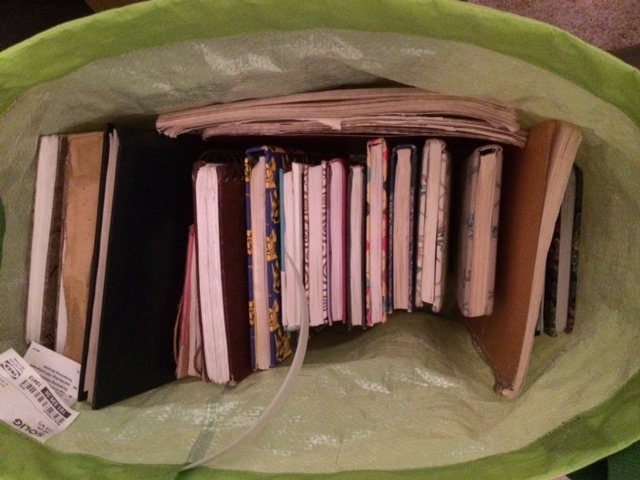
I met her parents at a Panera Bread just outside Baltimore to talk about turning their daughter’s life into a book. It was our second meeting. Afterwards we walked out into the parking lot and I went with them to their car. Her mother popped open the trunk and handed me a heavy bag full of journals.

“I’m really nervous about taking this with me,” I said. “I don’t normally take original material from my clients.”

I paused.

“I’ll guard these very closely,” I said.

We stood there, and I stared at the bag, heavy in my hands.

“I know you will,” her mother said. I reached in and took the bag out. i gave her mother a hug with the arm not holding the bag and shook her father’s hand.

“Oh,” she added, “I wouldn’t let your children look at those. They can be rather…dark.”

I nodded.

“See you in a few months,” I said.

* * * * *

They’re in my office now, those journals. They are various sizes and colors, some the typical journals you might buy at a book store, others handmade and decorated with artwork. The girl whose handwriting flows from one year to the next started writing them when she was thirteen years old and continued on until she was twenty.

They seem alive. Sometimes, when I go into my office and close the door, I’ll stare at them, and it’s like they have a pulse. They breathe. Because that is her life, right there, those scribbled words that stretch from page to page. It’s an organism, one that tells over and over again, no matter how many times you read it, the tale of a girl who had a disease we struggle to understand.

There are the stories of the two times she was raped. Her sense of never fitting in at school. Her self-harm. Cutting. There is the story of telling a counselor about her rapes, a few years after the fact. There is the spiraling downward, and the suicide attempts. There are the cries for help, the anguish, the confusion. There is desperation.

There is medication after medication after medication. Treatment. Psychiatric evaluations. Counseling sessions. Times when she seemed to be doing better. Times when she wanted to give up. She called her Depression “The Beast” and “The Imp” and she chronicled her life with these strangers. They were things she couldn’t live with, things she couldn’t live without.

Then there was her final journal entry, when she expressed that within a month all would be well – she would either be better, or she would be dead. And you can tell that there is immense relief, almost joy in that glimpse of the end of the struggle.

There is the last picture she drew, one of her alter ego flying away from the scene of her funeral on colorful wings over a church with stained-glass windows.

Then she walked into a lake, and they found her nine months later.

* * * * *

What can we do for those who walk among us but cannot bear this thing called life?

* * * * *

A friend of mine, Ami, only a few days ago retold the story of her own recent suicide attempt:

I don’t know what made me decide on a Sunday morning in early June to take a palmful of Tylenol before walking out the door to go to church like I do every Sunday. I didn’t wake up that morning knowing that I was going to try to die that day. When I was asked at church if I was planning on doing anything, I didn’t know that I would go home and take another handful of Tylenol.

I don’t know why I took that second overdose.

To those of us who have a loved one battling suicidal thoughts, these words can be scary. We want to know what to do to prevent it. We want to know what we can do to keep this thing from happening.

I don’t know the answer. I don’t think there is “an answer.”

* * * * *

When I was young, suicide was talked about in hushed whispers, the unpardonable sin. The Amish, the community from which my ancestral roots sprang forth, used to bury those who committed suicide on the spot, not even marking the grave. They were forgotten, or at least smoothed over, their history lost in a field beneath the tree where they were found hanging, or outside the barn where their blood was spilled.

Those lucky enough to receive a proper burial were deliberately buried outside the graveyard fence, symbolic of their excommunication from the church, albeit after death.

This is no different than many we hear today who talk about those who commit suicide as being “cowards,.” Such a label erases the person, erases the struggles.

“Selfish,” some will say.

“The most self-centered thing you could ever do.”

But I’ve read twenty-two journals of a girl who could not bear to live, and I do not see a weak person. I do not see a selfish person. I do not see a coward. In fact, she is one of the bravest people I’ve ever had the chance to know – she battled her illness for eight long years. Having read her life and the thoughts that continually went back and forth inside of her head, I don’t think I could have lasted eight years under that kind of torment.

I’m eager to tell you her story so that you can see these things, too. Maybe it will change the way you view this disease. Maybe, like the mud Jesus told the blind man to put on his eyes, her story will help you to see.

* * * * *

This is a long post, but the point I’m trying to make is actually a very short one.

Be kind.

Remember that none of us can comprehend the pain of another person.

Speak well of those who could not bear this life, or do not speak at all.