I Started Driving For Uber. This is What I Discovered.

download

Last week I started driving for Uber. You know, the ride-sharing service where you use your own car to drive people from here to there. Things are a little bit slow on the writing front, and even though the advance on my three-book novel deal was very generous, it wasn’t enough to put me in early retirement. I still co-write books for a living. If you need a writer, hit me up. After all, I’ve got six kids and a wife to take care of.

So, anyway, in an attempt to continue cobbling together an income as an independent, creative person, I started driving for Uber. I was plenty nervous before my first fare – what if the person wanted to talk? What if the person didn’t want to talk? What if I ran into something with a passenger in the car? What if I couldn’t find a passenger? What if, what if, what if.

I started in the afternoon and everything went well. I took a few people to vote, took a few people to and home from work, took one guy to the airport. I turned off the app around 6 and went home for a nice dinner with Maile – five of the kids were at my parents’ house – and then we sat down to watch the election. You all know how that turned out. Anyway, at around 10pm it looked like it was going to go on for quite some time, maybe until December, so I went back out and drove again for a few hours.

I took a few college kids home from a bar. I took a few more people to work the night shift. It hit me as I was driving that this is normal America – not the raging, frothy, foaming-at-the-mouth politicians, but these normal, everyday folks, trying to make a little money (like me), trying to make a living (like me), trying to make time for friends (like me).

Some of my friends in the margins of our society are sad or scared because of the election result. I mourn that they don’t feel safe, that their future suddenly seems in jeopardy. I think it’s important for all of us to mourn along with them. “Blessed are they who mourn, for they will be comforted,” and “rejoice with those who rejoice, mourn with those who mourn.” These are hard days for many. These are days made for listening, for waiting, for silence.

It was a comfort to drive the streets of this city and see so many people going about their lives. I hope we remember to love each other even more. I hope we stand up for those in the margins, those at the edge. I hope.
To My Son, On Election Day

img_1866-copy

The sun waits to rise on James Street
hiding behind buildings, peeking up from
under the edge of the world. The shadows
in the alley still have something of the night
about them, heavy and deep, but light has
begun to spread, running
like spring water, leaking up from underground
wells. Then I hear the creaking floorboards
above me, the sound of your small steps
on the stairs, the scraping of your socks
on the carpet, the tiny breaths.
The tiny breaths.
We are all so fragile.

“I must have coffee,” I tell you, but you squeak
for pancakes, so pancakes it is, and I measure out
the flour, pour the milk, melt the butter. Vanilla.
Soda and powder. The batter is thin and golden and
it sizzles on the griddle. “We are so rich,” I tell
you. Your eyes watch. You want to help mix. You sit
on the counter, the best of me, the best
this world has to offer.
The best of me.
Suffer little children
and forbid them not from
mixing the pancake batter.

I walk three blocks to the polling station and stand
in line. I am only one, and on days like this, that is sweet
relief. My vote is only my vote. I do not hold the weight
of the world on my shoulders. Walking home, past
the hospital parking garage and the Lutheran church
and the corner store that sells milk on the edge of
expiration, I breath in the autumn. Today
is today. I wave to my friend across the street, the one
waiting for a kidney. He waves
back and smiles.

I decide that in the afternoon I will take you and the rest
to the park, help you into the swing, chase you through
the tube slide. You will shock me when you get to the bottom,
the fall and the cold clinging to you like a lightning bolt.
“No matter what happens, we must
love our neighbors. Even if they vote for you-know-
who,” I whisper in your small ear, holding you tight,
because you are the only
person in the world
who will listen. You smell of colorful, dead
leaves and new things.

We walk home as the nation chooses. We stop
at the crosswalks and look both ways. The darkness comes
earlier these days. The shadows are fast and we race
them, their outstretched hands reaching for us all the way
along that last length of sidewalk, all the way to the front
door. Tomorrow, I will wave to my friend again. Tomorrow,
I will make you pancakes, if you
like. Tomorrow, we can wake early and watch
the light spread into the world.

What We Leave Behind

fullsizerender

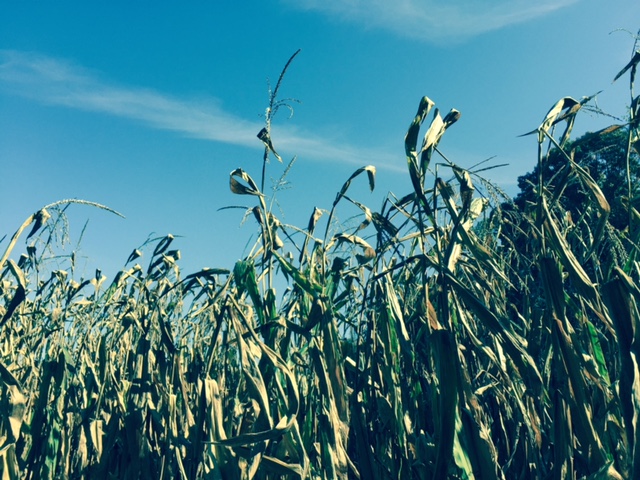
It’s strange, driving down a back road through farm country in October when the corn has been harvested and the trees are changing color. And it’s 85 degrees. My mind and body are connected to this land, and after 39 autumns, most of them spent in this part of the world, I recognize that something is different. Something doesn’t feel right.

The three of us drive along the eastern edge of the valley, our windows wide open. He tells me to turn off of the road. We drive slowly along a tractor lane that separates two fields, the car heaving up and down like a trawling boat.

“Turn here,” he says in a quiet, gravelly voice. Soon we are out in the middle of the field, approaching a quiet grove of trees. We follow the tree line, bend around the back, and he tells me to park where the ground sags like the bottom of a wave, that last glorious moment before the ocean picks you up, lifts you towards the blue.

It is a beautiful day. From here, we walk.

A narrow path splits the trees, then navigates the space between the wood and the 10-foot-high drying corn stalks. They are tan and brittle, and when a breeze blows they rattle like bones.

“The deer must be using this trail this year,” his wife says, and then I notice the corn, some of the cobs gnawed off.

“There it is,” he says, and we stop and the wind is all around us. We stare at a cross pounded deep into the ground just inside the woods. It is a metal sapling, rusting the color of fall. It is a marker that serves as a reminder of forgiveness, a reminder of a past that the current generations have vowed not to repeat.

“There it is,” he says again.

* * * * *

What will we leave behind, when we are gone? I thought of this the other day when I met with someone who told me the story of how her father died when he was only 46 years old. He passed in the middle of the night, cause unknown. I will be 46 in six years. If I would die then, what would I leave behind? What metal crosses have I pounded into this existence? What will the stainless steel letters say about me?

* * * * *

The three of us stand there for a bit, the way you do when you are standing in the presence of something holy. She talks about how well the cross is holding up. He grabs the top of it and, by the firm way it holds to the Earth, I can tell it has been pounded deep. He talks about adding a date to the back, in case anyone stumbles on it in the future.

I wonder about that. I imagine someone crossing through the field, stumbling over the rows, picking their way through the thick undergrowth in that grove of trees, putting their hand up against something that doesn’t move. They take another look. They see a cross with the words “Generations” and “Forgiven.” They see a year.

How are we marking these battles? What will future generations stumble across on their way from here to there?

* * * * *

I do not know who turns away first. I know it is not me. I follow them back to the car and we retrace our bouncing steps, finally back on the smooth road, the sky blue overhead, the warm wind denying fall has ever been here or will ever come back.

A Normal Night Here, a Normal Night There

img_1945
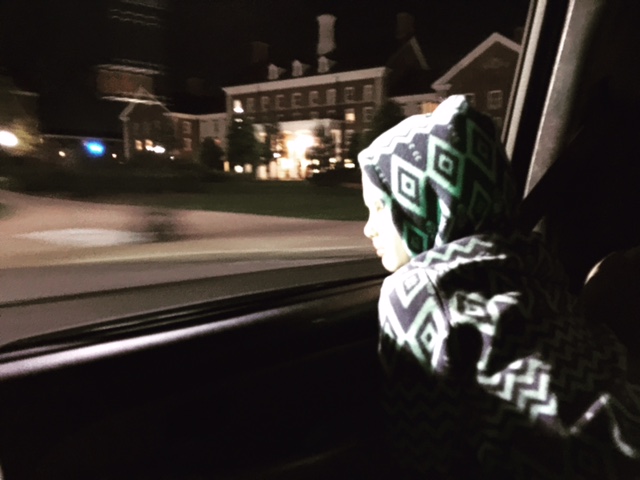
Sometimes you have to roll down your window, pull up your hood, and take in the eye-watering freshness of fall.

It’s been quite some time since I’ve written here. The days are shorter now, and the mornings are cold. There’s a still-new baby in the house, random diapers lying in the hallway, soft cries in the middle of the night. Leaves from the sycamore tree scuttle down the sidewalk, running away from who knows what. The moon, maybe, or tomorrow.

The world is at its uproarious best, and Lord knows there’s plenty to be uproaring about, but sometimes I wonder if we’re creating so much noise that we can’t really hear any of the soft cries for help anymore. Every time Donald Trump breathes there are headlines; meanwhile, Aleppo burns, Haiti drowns, and the same homeless guy wanders up and down Queen Street, cheeks rusted an alcohol red, eyes lost.

But what will we do? What can we do? To be honest, our family is up to our ears in activities and school and always something next on the schedule. We’re under-rested and over-indulged. Every minute of every day is already scheduled so thank you very much but you’ll have to knock on someone else’s door.

Really?

What will it take to break us from this rut we’re in?

* * * * *

My wonderful editor at Revell starting working with me through the edits of The Day the Angels Fell, and it’s a beautiful thing, to spend so much time making something into what it really is. I worked on it for the better part of a week, revisited Deen. I was there, I tell you! On the farm again, wandering the dark passageways at the fair.

I wonder if that’s part of the problem, if we’re all moving so fast we never get to revise our lives. I wonder if we ever took the time to pull back and wait, would we actually see what’s steaming at us from around the bend?

* * * * *

It’s okay, though. You’re okay. You’re doing okay, I promise, the best you can do. I know I am.

Tonight, I’ll administer the sacrament of the bedtime snack, and the spiritual discipline of the brushing of the teeth, and the ministry of herding six children off to bed. Tonight, I’ll read to Leo, the same old lineup of “Let’s Go!” and “The Runaway Bunny” and “How Much Do I Love You?” I’ll go up and sing to Sam and Abra, and Lucy will kiss me on my rough, getting-older, bearded cheek, and I’ll think to myself she’d better not be kissing anyone else like that unless they’re prepared to love her at least a tenth of what I do.

I’ll stop by Cade’s bedroom and say goodnight, and I’ll leave him there, reading in the halo of lamplight, and I’ll sigh the sigh of years that move far too fast. If I’m lucky, Poppy will fall asleep on my chest.

I turn 40 this year. Maybe that’s what this is all about.

Maile and I will collapse into bed and chat about the kids, who is doing what the next day, who is on our minds the most, who needs some direction. We’ll turn out the light and talk some more and one of us might even fall asleep while the other is still pontificating – that’s how these days go, and you can’t take offense because you’re stretched thin, too, and sleep is the only pause.

These are those days, the ones that tumble over and over on each other, like the numbered balls in the lottery drawing.

* * * * *

Outside the house, the politicians will rage, the homeless will pull a piece of cardboard or a coat or an old blanket closer around them, and a cat will pause on the roof, staring wide-eyed at the moon. The lights will be on at Saint James, and a police car will pause for a moment outside the barber shop.

Leo calls out in the middle of the night and immediately falls back to sleep. Poppy cries and dreams whatever it is that babies dream about. I wake the next morning. Make some coffee. Watch the lines in between the blinds start to glow as the sun drifts up over James Street.

* * * * *

I watched this video today. These are my children, bleeding quietly. This is my doctor, going from patient to patient. This is my wife, under the body bag. These are our people.

When will we see it? When will we recognize that this is us?

When I Slept Under the Bed (Or, The Importance of “Hiddenness”)

Photo by Kate Williams via Unsplash

From the time I was six years old until I was around ten, my family lived in a great, sprawling farmhouse with a covered front porch and two huge oak trees in the front yard. There was a garden and barns made for exploring. If you read The Day the Angels Fell, it’s basically the setting for that novel. Every autumn, my father raked all the beautiful, brittle leaves into piles and we ran the path his rake made and we laughed and threw colors around. As the sun set in similar fashion somewhere over the hill, he lit the piles on fire, and the flames danced like savages.

In many ways, I was hidden from the world in those years, living so removed from other people. I went to a tiny school that had tiny problems. My closest friends were, for the most part, my cousins, or the three boys I met in first grade. Whenever I could sneak away from the house, I’d be down at the creek or riding my bike on back-country roads, not a soul in sight.

It was about that time in my life when I took to sleeping under the bed. I’m sure this gives you some kind of psychological magnifying glass with which to view my life. There were three doors in my room: one went into my parents’ room; one opened into a huge closet that didn’t seem to have a back; the third led into the neighboring house (the farmhouse we lived in was split into two separate dwellings). Maybe it was the confluence of all these doors, or the wide windows that opened up onto the porch roof, or the deep-red carpet, but something caused me to crave security, and I found it in the tight space beneath my bed.

I hid away down there, blocking myself in with boxes and pillows and an old blanket I had since my birth. I slept well in that sealed off darkness. I breathed easier.

* * * * *

One of the reasons that hiddenness is such an important aspect of the spiritual life is that it keeps us focused on God. In hiddenness we do not receive human acclamation, admiration, support, or encouragement. In hiddenness we have to go to God with our sorrows and joys and trust that God will give us what we most need.

In our society we are inclined to avoid hiddenness. We want to be seen and acknowledged. We want to be useful to others and influence the course of events. But as we become visible and popular, we quickly grow dependent on people and their responses and easily lose touch with God, the true source of our being. Hiddenness is the place of purification. In hiddenness we find our true selves.

Henri Nouwen

This piece by Henri Nouwen has upended me, as good writing often does. I think about how much of my writing life is spent seeking acclamation, admiration, support, or encouragement. And while I do not believe those things are negative in and of themselves, I do believe that there is also something blessed to receive when we live in the lack of them, when we are forced to find our approval and identity somewhere deeper.

Do I ever leave room for hiddenness? Or must all of my joys and heartaches immediately be shared with the world?

Nouwen talks about the dependency these things create within us. What at first feels like encouragement or support can all too quickly turn into that which my creativity depends on. What does it look like when a writer begins trying to please everyone in an attempt to relive, over and over again, those moments of acclamation? How can one possibly navigate the minefield that is the approval or disapproval of hundreds or thousands of people?

And what, then, will we do with a rush that craves more and more, is never satisfied? How far will we go in our pursuit of the like and the share?

Hiddenness, it seems, in some form, is the answer. But I’m left with more questions than answers.

What does it mean for me, a writer in this particular age, to seek out hiddenness? My word processor underlines “hiddenness” in a scribbly red, as if to negate it, as if encouraging me to delete it from my vocabulary.

“This is not a word,” It says. “Hiddenness is not a thing. Where you do find it, delete it. Replace it with something else. Something in our culture’s vocabulary.”

But hiddenness is a thing, no matter what spell check says. I experienced it sleeping under the bed when I was a child, and it was glorious, that sense of security, of safety. That sense that no one else in the entire world knew where I was or what I was about. Hiddenness is a safe space. It is a place full of truth, a place where God dwells, waiting to commune with us. And while it may be empty of certain, valuable things, I’m quite sure it is full of many others.

Maybe that’s what I’m looking for: a new set of values.

Can we find the courage to hide in a world that only values that which has been found?

A Rather (Extra)Ordinary 17th Anniversary

IMG_1780

You spent a sliver of our 17th wedding
anniversary piecing together grilled cheese
sandwiches and tomato soup for lunch while I
changed diapers. The butter sizzled on the griddle.
Dinner! I shout, and then came the
stampede, the sound of bare feet on wood
floors, not unlike the sound of new rain
on windows. There is a quiet joy in watching
your children eat when they are hungry, even
when the soup
drips onto the floor.

Earlier in the day your mother took
the oldest five to see a movie while you and I
sat in the living room reading books, each our
own, and watching Poppy smile in her dreamy
sleep. I stole glances at you
and remembered, for a moment,
the people we had been 17 years before.

They are strange to me, and very young. I may
have seen them in the city
just the other day. The girl is
quiet and nervous, like a small bird
trying not to stir
in the undergrowth. The boy is confident and
somewhat careless, crashing through
the brush with no concern
for what might be there: a once-every-17-year
flower, or
even
a small bird.

But, there we were, our current selves,
reading, while our sixth
baby slept, and the traffic went by on James Street,
and the heat gathered in clouds on the
window panes. I dozed off. When I woke again
you were sleeping, Poppy resting
on your chest, her breathing mingled
with yours, her rise and fall on top of your
rise and fall, Sunday moving
through all of us like the first breath.

Later, the children running
charging shouting their way from here
to
there, and
Billy Joel came on, the kitchen oddly
perfectly
vacant
except for me
and you

She’s got a smile that heals me
I don’t know why it is
But I have to laugh when she reveals me

And we slow-danced on the cool kitchen tile,
a thunderstorm darkening the alley outside,
the sound of new rain pinging
on the windows. You seemed very happy
there in that small circle, that small revolution,
as if we had found something forgotten
or maybe only
misplaced.