“I Gain Nothing”

When I arrived as a freshman at Messiah College and endured my first preseason for the soccer team, I couldn’t help but notice this guy Peter Greer.  First of all, he was one of the nicest people I had ever met, even to me, an underclassman. Second of all, and I know this goes against what I just said, I wanted to punch him in the face – no matter how many hills or sprints or conditioning drills our coach threw at us, Peter was one of those in the background yelling, “C’mon coach!  Is this all you’ve got for us?  You can do better than this!  We can run all day!”

While I haven’t seen Peter for many years, I just finished reading his book “The Poor Will Be Glad” , and I can tell that little has changed.  Peter is still one of the kindest people on the planet, and he is still working hard to motivate those around him to get better, stronger and more effective.  I think I must have matured at least a little since then, though, because I don’t want to hit him anymore.

The following is a guest post, written by my friend Peter Greer:

In 2002, my wife and I were sent to help Congolese refugees displaced by the eruption of Mt. Nyiragongo. There I witnessed catastrophic devastation: over 400,000 people were fleeing from homes that had collapsed.   Amid the destruction, I thought I would find camaraderie and a spirit of service among the many NGOs that had come to serve in the Democratic Republic of Congo.  Surprisingly, I was wrong.

In the refugee camp, it had been rumored that a camera crew was going to highlight a story of generosity: individuals in the U.S. had donated blankets to the refugees, and the network would feature the NGOs distributing them.  Everyone wanted the news to feature them, handing out blankets.

My wife and I had blankets to give but were not allowed to give them out.  Larger NGOs wouldn’t allow our smaller operation to hand out blankets if their shipments had not yet arrived.  There I was, among the very people and organizations supposed to help those in need, and they were more concerned about showcasing their organizations than helping the poor.  The camera crew never came, and I will never forget how disgusted I felt by the hypocrisy of the ordeal – I also will never forget how I eventually recognized the same hypocrisy in my own heart.

When we were finally allowed to hand out our blankets, a photographer did arrive. Up on a platform, I bestowed my blankets as people walked orderly through a line. The orchestration was almost perfect – we had roped off lines like at an amusement park – and I was the main attraction. We had lists of the families and a system to ensure that each family received their allotted amount. I was on the front lines of personally handing out blankets and helping families that had lost almost everything. Noble cause. Noble mission. Noble actions of a 25-year-old relief worker. A friend was snapping pictures, and I smiled wide for the camera as I did God’s work.

A few weeks later I saw the pictures.  I trashed them.  I wanted to vomit.  It was apparent from that smile that I cared more about my smile for the camera—than serving the poor.   I was no better than the NGOs I despised.

All my life I had thought I had been on the “right road”; I had maintained a clean record, a sparkling image – but it wasn’t enough.  Even if I was a relief worker in Africa, it meant nothing.  If my willingness to serve did not come from the love of God, than it really was empty:

“If I give all I possess to the poor and surrender my body to the flames, but have not love, I gain nothing” (1 Corinthians 13:3)

As I saw those pictures, I began to grasp the truth of the scripture, without the love of God motivating me, my work was in vain, and it became another means to glorify myself.

I have recently been encouraged by the evangelical Christian community’s new focus on justice, poverty alleviation and the growing awareness of the needs around the world, but I do worry that if we make our primary focus service instead of Christ, we will find our service is empty.  I know I found it true in my own life.  It is only out of a deep-rooted understanding of our Father’s love, realizing that “we love because he first loved us,” that we can truly roll up our sleeves and serve (1 John 4:19).

Have a look at Peter’s book, “The Poor Will Be Glad,” HERE and check out his organization, Hope International.

The Poor Will Be Glad – A Book Review

If you have any interest whatsoever in serving the poor of the world, you need to read The Poor Will Be Glad: Joining the Revolution to Lift the World Out of Poverty, by Peter Greer and Phil Smith.

If you are like me, you’ve often thought that if we could just pool enough resources, enough cash, enough food, and ship it to developing nations, the problem of poverty would be solved (actually, when I write that it sounds pretty naive so maybe you’ve never thought that).  Peter Greer addresses this mindset with a story about a Rwandan named Jean.

Jean seized  an opportunity to begin a small poultry business to provide his neighborhood with eggs.  He managed to scrape together funds to purchase several fowl, and his business grew.  Later, a church in America “adopted” the village where Jean lived and worked.  The church decided to donate clothes and supplies.  They also imported eggs from a neighboring community and gave them away.  Suddenly, this one village was flooded with surplus eggs.  It is not difficult to imagine what happened to Jean’s business: people went first to collect the free eggs and bought Jean’s eggs only when the supply of free eggs was depleted.  The market price for eggs plummeted in Jean’s village and, as a result, Jean was forced to sell his productive assets, his chickens.

The next year, after Jean had left the poultry business, the church that had supplied the free eggs turned its attention to another disaster in another part of the world.  Jean’s community had no capacity to produce eggs locally and was forced to import eggs from a  neighboring town.  The cost of these eggs was higher than the eggs Jean had sold, so both Jean and his village were hurt economically by the good intentions of one American church.

You know those container loads of t-shirts that we give to thrift stores, the ones that eventually get shipped to Africa? These “gifts” almost single-handedly decimated the textile trades in some African nations.  We as the church MUST remember that there are larger implications to our giving than we may understand at first glance.  While natural disasters and other crisis may require emergency aid and huge amounts of charitable giving, these strategies are not adequate long-term solutions for helping the poor.

Microfinance, Peter and Phil insist, is the answer to lifting the world out of poverty.

They’ve created a beautiful book, both in content and in appearance. The book is full of stories about how microfinance is changing the landscape of developing nations, and the photographs of these entrepreneurs whose lives have been changed by $40 micro-loans are stunning.

Skeptical?  So was Rob Bell, but he addresses his own skepticism in the foreward of this book:

Because if it is true and legit and if microfinance really does have that kind of effect on the lives of those in poverty, well, that would change everything.

Which is what it’s doing.  It’s changing things on a massive scale.  And every one of us can be a part of it.  For a small amount of money, entire families can be empowered to create entirely new tomorrows.

I hope this raises all sorts of questions for you, beginning with: How?

And to answer that question, you’ll have to turn the page and start reading this inspiring, informative, moving, world changing, extraordinary book.

So once again I say: if you have any interest in serving the poor in this world, you must read this book.  You can take a look at the book HERE

Peter Greer holds a Master of Public Policy from Harvard’s Kennedy School and a BS from Messiah College.  He is the president of Hope International, a global faith-based microfinance organization serving hundreds of thousands of entrepreneurs in 14 countries.  You can follow Peter on Twitter: @peterkgreer , and you can follow Hope International on Twitter: @HOPEtweets

Phil Smith is a philanthropist and private investor who sits on the boards of several companies.  He is the coauthor of A Billion Bootstraps and holds an MBA from the University of Tulsa and a BS in mechanical engineering from Oklahoma State University.

Who’s Driving Your Mower?

Who is driving your mower?

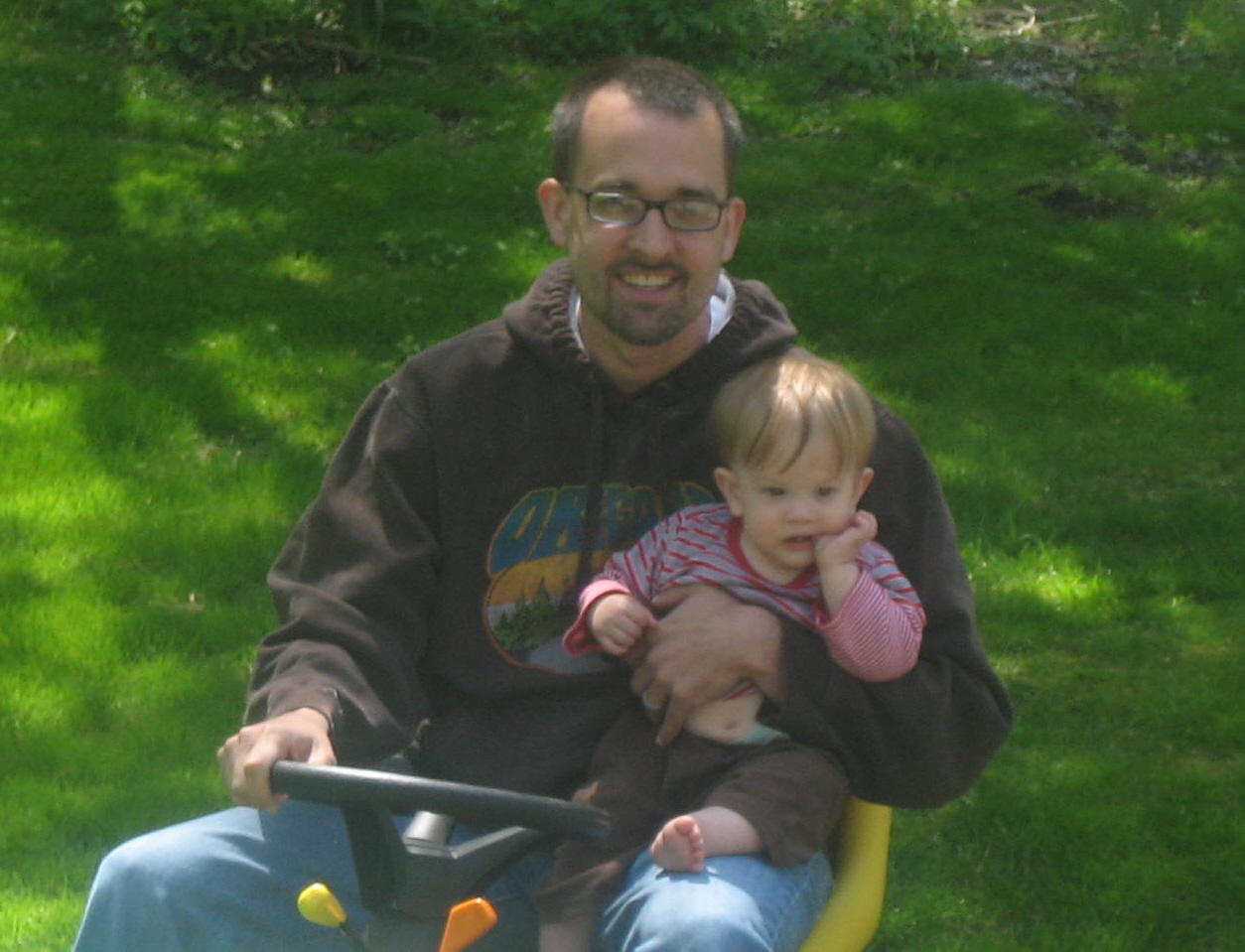
Come by our house on a sunny day and there’s a good chance you’ll see me mowing the yard.  Something I used to despise has become one of my favorite past times…there are few things I enjoy more right now than hopping on my dad’s riding lawn mower (that he loans to me for this purpose) and cruising around our relatively secluded property, the sun shining on my face.

But by far my favorite part of this new mowing experience is that my almost-1-year-old son Sam loves to join me. Maile says that if he’s inside the house  when I start the mower, he sits up and waves his arms in the air, excited at what’s to come.

He sits on my leg as I buzz around the yard, and I have to really hold on to him.  Even though I can’t hear him, I can feel him humming to himself, just jabbering away in his little baby language.

Sometimes he kind of gets in the way when he grabs at the steering wheel, but I gently pry away his hands.

Sometimes, when we’re cutting close to the boundaries, the branches reach out and scratch him.  He doesn’t like this, and I always move him over to my other knee if I see that it’s going to get too painful for him.

He also usually chews on his hands and gets slobber all over my jeans, but I love that he enjoys doing the work with me, even if he’s not really doing anything.

I wonder if this is sometimes how God feels.

I wonder if he just wants me to be excited about spending time with him.

I wonder if he wants me to know that he’s got a firm grip on me.

I wonder if he wants me to get my little fingers off the steering wheel and let him drive.

I wonder if he is trying to show me that even if the branches occasionally scratch my face, it only happens after he has reached out with his own bare hands and, gripping the thorns until his hands bled, kept the worst of it away from me.

Tuesday’s Top Ten Games from My Childhood

When I first thought of the idea of Top Ten Tuesdays, it was with this ideal in mind that we could come together as an international community and agree on something (it is at this point that I have to give a shout out to my loyal British following, my 17 visits from Tanzania, as well as my solitary followers in Hong Kong, Bangladesh and New Zealand).  Don’t we have enough to fight about:  Red v. Blue, North v. South, East v. West, Men v. Women, Chelsea Football Club vs everyone else?

I had no clue that the opinionated, individualistic nature of our humanity went as deep as favorite types of candy,or snack food, or even ice cream for goodness sake.  And I certainly had no idea that certain people, who will remain unnamed, would counter my offer of international commonality with divisive little lists of their own, and then post them in the comments section of my blog.

But this is exactly what has happened.

So today I give you the top ten games from our (notice the OUR) childhood. Tear it up if you want.  Rip it to shreds if you must.  But before you do, just remember – this may be the last fragment of shared humanity left on this spec of dust we call a planet.  Blow it to smithereens at the risk of your own existence.

(This week they are listed in no particular order, in an attempt to find some kind of common ground)

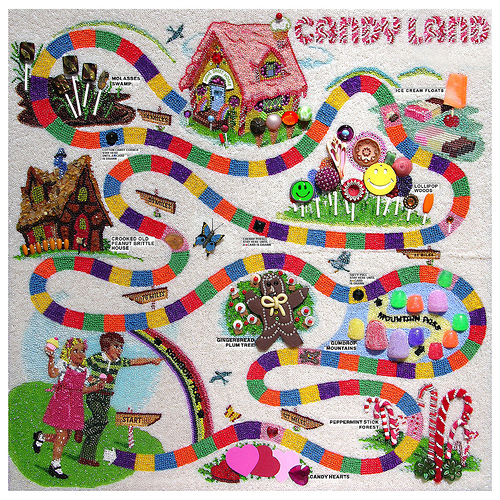
Candy Land – when my children were old enough to play this, and we opened it for the first time with them, I saw the rainbow road and that three-colored ice cream bar, and suddenly I was 6 years old again.  Then I got stuck in that blue, syruppy quagmire while my son cruised to victory (he did a victory dance around the living room), and I wished I was 6 again, so that I could stick my tongue out at him and call him “poopy-face”

Trouble – the spring-loaded, bubble-encased dice did cause a potential problem for this game.  But it was very portable, which made it a traveling favorite.

Chutes and Ladders – or, as you Brits refer to it, Snakes and Ladders (and, actually, Milton Bradley sold it over there first, so TECHNICALLY I should have listed it as the latter).  Who didn’t love seeing their opponent nail that last chute (or snake) and come tumbling back to the bottom of the grid?

Monopoly – we didn’t really know how to play this when I was 6, but the pieces were cool, and the money worked really well for some of the other pretend games we made up.

Sorry – another classic we recently introduced our kids to.  Another game at which I cannot win, no matter how many rules I make up.

Uno – how many people knew that you could take a foreign word, stick it on a pack of numbered, multi-colored cards, and make millions?  I guess just Uno.

War – why was this one of my favorite games as a kid?  You know, the one where you take a deck of cards, split it in half, then flip cards and whoever’s card is highest gets both.  And then the real moment of international intrigue – two cards of the same value are flipped, and war breaks out.  This was probably a favorite of the confrontational ones among us, who will still remain nameless.

Yahtzee – did you ever play this game by yourself when you were a kid, sometimes giving yourself four or five throws per turn (instead of the allotted three), which of course gave you incredibly inflated scores you would then show to your mother and brag about?  Yeah, me neither.

Scrabble – did you ever play this game by yourself when you were a kid?  Okay, I did that.  I was a nerd.  This is why I knew at a young age that the highest scoring word you can use is quartzy (according to some schools of Scrabble), and the longest legal word in North American play is ETHYLENEDIAMINETETRAACETA TES (which is dumb since the board is only 15 spaces across).

Chinese Checkers – what is Chinese about this game?  For that matter, what is checkers about this game (besides the whole jumping over thing)?

So what are the favorite games from your childhood?

7.3 Reasons My Weekend With The Kids Felt Like Survivor

I know we’ve turned our television off for a year, and written break up letters to it (on my old blog) and, more recently, emailed it  a stop-hanging-out-with-my-parents letter.

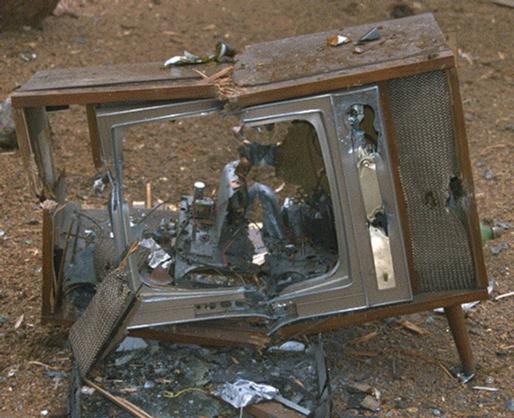
But this past weekend I felt like I was ON television. Watching the kids (ages 6,5,2,1)  for 65 hours without my wife felt like an episode of Survivor.  That’s right, 65 hours.  That’s like 3900 minutes.  That’s like…a lot of seconds.  And even more dirty diapers.  And meals.  And stuff she does every day without ever complaining that it makes her feel like she’s on a miserable reality show.

Anywho…

Here’s 7.3 reasons my own personal house felt like a foreign environment (don’t ask me about 7.3, I don’t know why that number precisely, but it did seem to work on Friday):

1) I didn’t sleep well – for some reason when mom isn’t home, everyone thinks it’s time to start waking in the middle of the night again.  I went from my bed to the couch, from my couch to the floor, and from the floor to a straw mat on bare dirt wondering if someone was going to eat all the food while I was sleeping.

2) I didn’t eat all that well – fortunately Maile made lasagna and soup and chile and put it in the freezer.  Unfortunately, unfreezing things sounds almost as difficult to me as actually making them from scratch, so we still relied heavily on cereal, eggs and cereal.  Did I mention cereal?

3) Alliances were constantly changing – in the span of ten minutes it went from me/cade vs lucy/abra/sam to . . .  me/abra vs cade/lucy (sam was asleep) to . . .  me/lucy/abra/sam vs. cade to . . . me vs everyone else.  And that was the only alliance that seemed to stick.

4) Immunity challenges involved making food while holding Sam, loading the dishwasher before Sam climbed in, trying to feed Sam a bottle of breast milk when all he wanted was milk straight from the tap, and changing Sam’s poopy diaper with Cade and Lucy both crawling on my back.

5) Negotiations never ceased – “Abra, stop screaming or you’re in your bed for a nap!”; “Lucy, if you want to watch the movie tonight you’d better put your sister down!”; “Somebody please entertain Samuel for FIVE MINUTES or I’m putting out your tiki torch!”

6) Seeing my mom pull up to the house reminded me of the family visits on Survivor – lots of tears, hugs and desperate pleas to take me away, responded to with knowing looks, words of encouragement and the delivery of treats.

7) In the middle of the night I combed the house, desperate to find the immunity idol.  I searched: 7.1) in Cade’s box of lincoln logs 7.2) under Sam’s bed and 7.3) in the battery compartment of Abra’s Laughing Elmo

No luck.  When Maile returned on Sunday afternoon, it was too late.  I had just been voted off the island.

7.3 Questions with Jason Boyett (author of O me of little faith)

After reading through my blog yesterday I realized that I didn’t say very much about Jason Boyett’s “O me of little faith”. Which is strange because it was supposed to be a review of his book…but it turned into an exploration of the mental process his book put me on.  Anyway, apologies Jason, for not spending as much time on reviewing your book as I did on reviewing the thoughts that came up while I was reading your book.

Fortunately for all of you, Jason was also kind enough to answer some questions that I had – hopefully these will help tell you a little bit more about his fascinating foray into the subject of doubt.  So, without any further delay, please welcome Jason Boyett! (That’s this chap ——->

*****

1)     I would imagine that many of those who read today’s post might not have heard of you before (except maybe those who read this blog yesterday).  So if you could start off by helping us get to know you better – what is your favorite ice cream flavor, favorite type of candy, and favorite snack food?  (To be honest, I’m not as interested in getting to know you as I am hopeful that you will agree with my own previous choices – you’ve kind of stepped into the middle of an opinion war here on my blog, and I’m looking for allies – if you could answer Turkey Hill Vanilla, Now N Laters, and chocolate covered pretzels, I would owe you BIG TIME).

My favorite ice cream flavor is one from a local place and it’s called Candy Factory Explosion. Vanilla with smashed-up Butterfinger, Reese’s Peanut Butter Cups, M&Ms, chocolate chips, and all sorts of other goodness.

My favorite candy is dark chocolate M&Ms.

My favorite snack food is Bite-Sized Tostitoes chips with fresh salsa.

So, in summary, you owe me nothing at this point.

2)     So anyway . . . on to more relevant questions.  This book is so different from your others – were there any particular circumstances that led to its inception?

Occasionally I fill in for our pastor in my church’s Saturday-night worship service, and one week in 2008 he asked me to speak. It was one of those times when I had no idea what I wanted to talk about. The standard thing to ask yourself in these situations is “What is God teaching me right now?” But I didn’t have an answer, because I was at a point where God seemed absent from my life. Privately, I was going through a pretty intense period of doubt. So in a burst of brilliance or self-absorption or something, I decided to use that sermon to come out of the closet as a doubter, and talk about the relationship between faith and doubt. It was so well-received — it turns out there are LOTS of churchgoers with the same types of questions, though we never talk about it — that I began thinking it would make a good subject for a book. I didn’t have the answers, like 5 Steps to Get Rid of Your Doubt, but I did have my own personal story. My thinking was that, by telling my story, I could offer some hope and encouragement to readers going through the same stuff.

3)     Whenever an author writes about a difficult topic, I think it can be a real struggle to shut out those voices in your head saying things like: “You shouldn’t be writing this book!” or “How can you talk about this topic?” or “It’s going to be an embarrassment for your family!”  Did you have to deal with any voices like this while you wrote “O me of little faith”?  If so, what voices were the loudest?  What were they saying?  (we’ll call this question #3 even though, technically, it’s questions #3, #4, and #5)

Yes, there were definitely those voices. A few of the things I write about in the book made me feel pretty vulnerable — after all, the first two sentences of the book reveal that I’m not always sure that God exists — so it was a challenge at first to ignore the voices of self-preservation and ego. But the point of the book was to be honest and confess this stuff, so a book in which I self-censored some of my failures and doubts would have ended up being useless. Once I came to this realization, it wasn’t too difficult to be real. You can’t subtitle a book “True Confessions of a Spiritual Weakling” and then spend it acting like you’ve got all the answers. In my opinion, any book that focuses too hard asking “What will people think?” instead of asking “What is the truth?” will not be a very good book.

In the end, the loudest voices weren’t the personal ones but the ones urging me to be careful in how I described my upbringing and my childhood church. I was hesitant to harsh on that church environment, because it helped make me who I am. I loved my pastor, my Sunday School teachers, and the whole thing. I still do. But looking back, certain elements of that subculture impacted my faith in ways that weren’t entirely positive, and whitewashing those elements would have weakened the book.

4) Did you find your own personal doubts escalating or receding during the project?

My doubts receded during the project, because as I set out to encourage others, I ended up encouraging myself. Once the project ended, though, and I was able to get back to my reading and study, the doubts escalated. It seems that the more I learn — about faith, theology, history, science, the Bible — the more I doubt. I’m not sure what the answer is for this problem. To stop learning because it leads to too many questions seems like a head-in-the-sand reaction, and that’s too intellectually dishonest for my tastes. I’m a big believer that Truth ought to be able to stand up to honest questioning.

5)     In Chapter One, as well as on your blog, you are very up front about how you tend to trivialize mainstream Christianity’s spiritualization of chance, but in the last chapter you say that “one of the doubter’s most important disciplines…is the lifelong search for God…I keep my eyes open,” and later “we’ll start to see Jesus everywhere, thanks to something called the ‘incarnation’”.  Can you help me better understand this tension?

A better question: Can you help ME understand this tension? As you mention, I’m hesitant to attribute everything that happens in my life to God, as if he’s up there pulling strings and pushing levers and engineering every aspect of my day to fit into some master plan. I used to know a girl who regularly got lost while driving to certain locations, and on the times she never DID find her destination, she always ended up saying, “Well, I guess God just didn’t want me to go there.” I always wanted to say, “OR, you’re just bad at directions and you’re blaming it on God.” That kind of thing drives me crazy.

But you’re right. In the last chapter I talk about the importance of keeping your eyes open to God’s work in the world. And I’ll admit that, occasionally, that “work” might look like something I just described above. He seems to have done those kinds of things in the Old Testament stories. Was the ram in the thicket just a chance occurrence that ended up sparing Isaac’s life? Or did God get involve and provide?

I am the kind of person who doesn’t see God in every nook and cranny of my life…but I sort of want to be that person. While I suspect God intervenes less than we give him credit for, my hope is that he DOES show up every now and then — only in smaller, manageable doses. Like Moses being hidden in the rock and only seeing God’s backside glory, we may briefly get a glimpse of where he’s just been. Not the big picture. Just a sliver of Jesus every now and then in the people and world around us. The tension: I think it’s good to look for those slivers. But I think we need to be humble in our quickness to identify them with certainty.

6)     One of my favorite quotes by Anne Lamott, even prior to reading your book, is that “doubt is not the opposite of faith – certainty is.” I think what she’s saying is that doubt doesn’t eliminate the need for faith, but certainty would.  How does this idea line up with your thoughts on spiritual uncertainty?

I love that quote. We often tend to think of faith and doubt as polar opposites — you either have one or the other. But as Lamott says, we’re wrong. The author of Hebrews says that faith is “being sure of what we hope for” (11:1), and “hope” is a word you use only when the outcome isn’t certain. I wouldn’t say “I hope I’m married to my wife,” because I know that for sure. I have rational certainty that I’m married, and a marriage license to prove it. You only need faith when that absolute certainty isn’t available. Which means faith and doubt aren’t opposites, but companions. Without that element of doubt, you don’t have faith. Instead, you have knowledge. And there’s a big difference.

The point is that it is perfectly understandable for people of faith to struggle with spiritual uncertainty. We are finite creatures trying to wrap our minds around an infinite Creator, so of course we’re going to bump into some roadblocks from time to time. That’s when we doubt. And it’s OK. We don’t have to freak out about it or worry that our faith is crumbling due to the presence of these questions, because doubt is essential to faith.

7)     I found myself arguing with you a lot while reading the first three chapters, something which at first really annoyed me (perhaps due to my non-confrontational nature, or my Anabaptist heritage), but as I continued reading I realized the cause of my angst was two-fold: first of all, I wasn’t comfortable staring directly at the things that caused me the most doubt; secondly, I needed to have a lot more grace for the expression of doubt within our Christian community.  Do you run into a lot of un-graceful attitudes toward “O me of little faith,” (ie jerks like me) or are the majority of responses filled with things like thankfulness and relief that someone is addressing doubt out in the open?

I haven’t run into many jerks so far. Maybe a few who are uncomfortable with the questions I’m asking, but I totally understand that because not everyone gets wrapped up in the questions like I do. I get that not everyone can relate. Spiritual doubt is probably more widespread than we think, but it’s not universal. (And if every annoyed “jerk” handled it as gracefully and politely as you, Shawn, then I’d be really happy. You’re the best jerk ever!)

Mostly, though, the responses have been grateful, because it gives people the freedom not only to doubt without fear, but to be open about it. Our tendency in a performance-focused religious culture is to bury our doubts deep inside so we can keep up the charade of appearing to have it all together. And that sort of fakery leads to a lot of isolation and loneliness. It’s hard to connect with people from behind a mask. And that’s really what I wanted to do with the book — offer some hope and a safe place to discuss these questions. I know the loneliness that comes from doubt, and the freedom that comes from being able to own up to it and find a way to move forward.

Jude 22 says “Be merciful to those who doubt.” The last thing doubters need is judgment, arguments, and a suggested reading list. What we need is grace and mercy.

Jason Boyett is a writer, speaker, and the author of several books, including O Me of Little Faith and the Pocket Guide series of books. I blog about faith, doubt, and culture at www.jasonboyett.com, and I tweet a few times a day at twitter.com/jasonboyett.